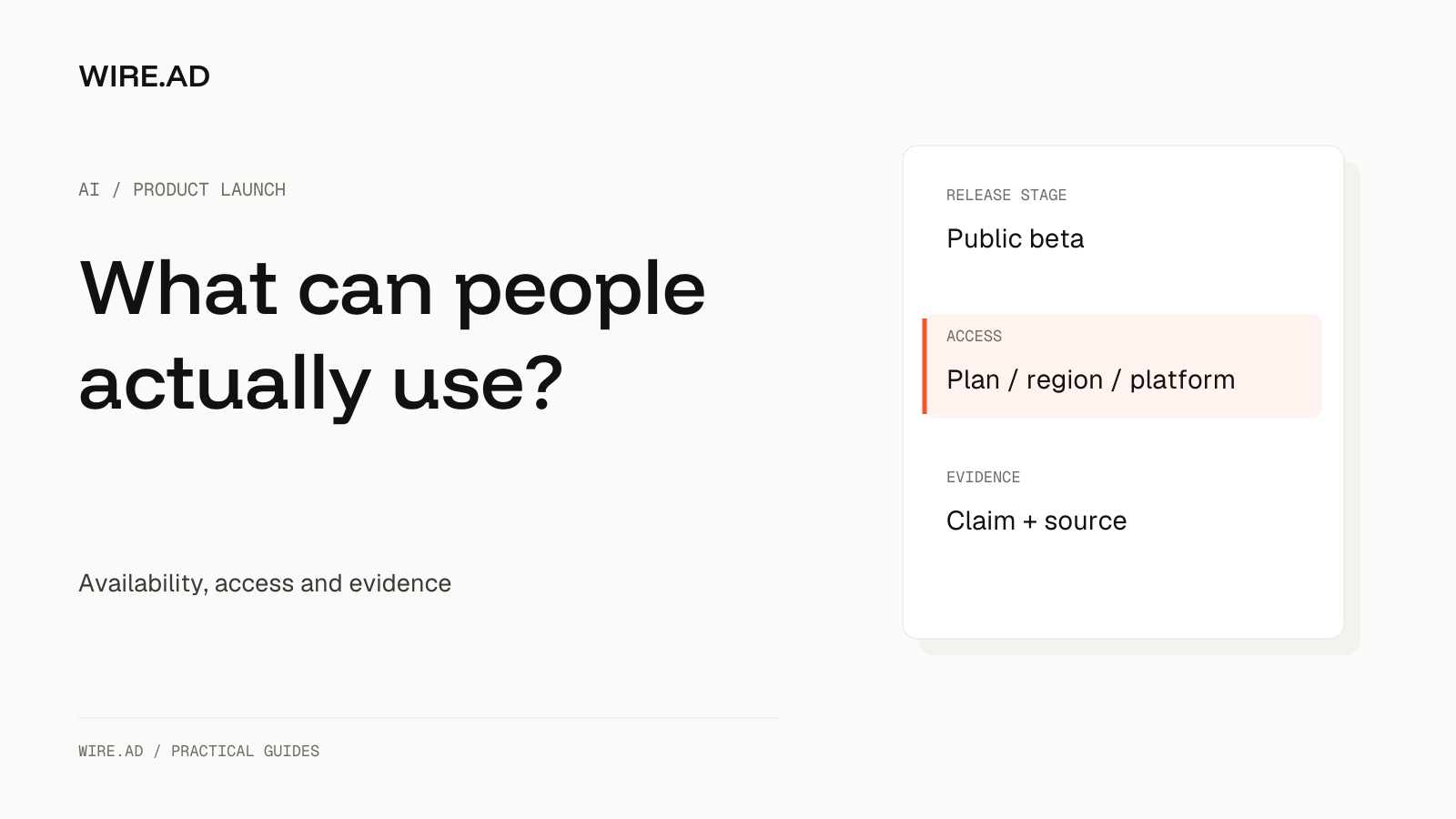
An AI product announcement should tell readers what they can use, who can access it and which claims have evidence. Before writing an AI product announcement, separate the available product from the roadmap. A model score, a product demo and a customer workflow answer different questions. Put the release stage, access conditions and evidence next to the claim they qualify, so a reader can tell what the announcement actually offers.
Describe one usable workflow
Start with the person using the product and the task they can complete. Name the input, the action and the output. Then explain where the work still needs review. “Drafts support replies from an approved knowledge base” is easier to evaluate than “transforms customer experience.”
Use a release-stage field in the approved brief: private preview, public beta or general availability. Add the relevant market, supported platform, plan and access route. Those labels are a practical editorial checklist, not an industry certification. A waiting list is an access route to a future release; it does not establish present availability.
Keep the announcement date and product-availability date separate. A feature described in a presentation can remain planned even after the announcement is public. Link the documentation or product page that supports the exact stage.
Give performance claims a reproducible boundary
For a speed or quality comparison, retain the test conditions alongside the result: task, version, comparison baseline and how the measurement was made. A benchmark result about a model does not by itself establish how an application will perform in a customer’s workflow.
The FTC’s advertising guidance says advertisers need supporting evidence before an advertisement runs. That includes implied claims. A qualification buried elsewhere may leave the headline conveying more than the evidence supports. This is a US advertising baseline, not a complete legal assessment for every AI product or market.
A useful review table asks:
| Claim in the draft | Evidence to attach | Detail to retain in the copy |
|---|---|---|
| A workflow is available | Current access instructions | Plan, region and release stage |
| A task is faster | Documented comparison | Task, baseline and conditions |
| A system supports a language | Product documentation and relevant evaluation | Feature and version |
| A product integrates with a service | Current integration instructions | Supported direction and setup |
| A capability is planned | Approved roadmap statement | Future-tense wording |
These are production checks. They do not imply that a particular vendor has passed them.
Review the first-use path
Follow the same link a reader will receive. Check whether it opens documentation, a purchase flow, a waiting list or a working feature. Ensure the announcement describes that destination accurately.
Build one approved fact sheet for the release, then adapt the emphasis for each audience. A developer needs integration requirements; a buyer may need supported workflows and access conditions. The underlying facts should remain consistent. The press release source pack explains how to organize that evidence before versions are produced.
Keep discovery separate from delivery
Publication, search visibility and AI citations are different results. Google says its AI search features use the same foundational SEO practices and do not require a separate special optimization. Meeting those practices does not guarantee inclusion. Read Google’s guidance before treating a distribution placement as a promised AI-search outcome.