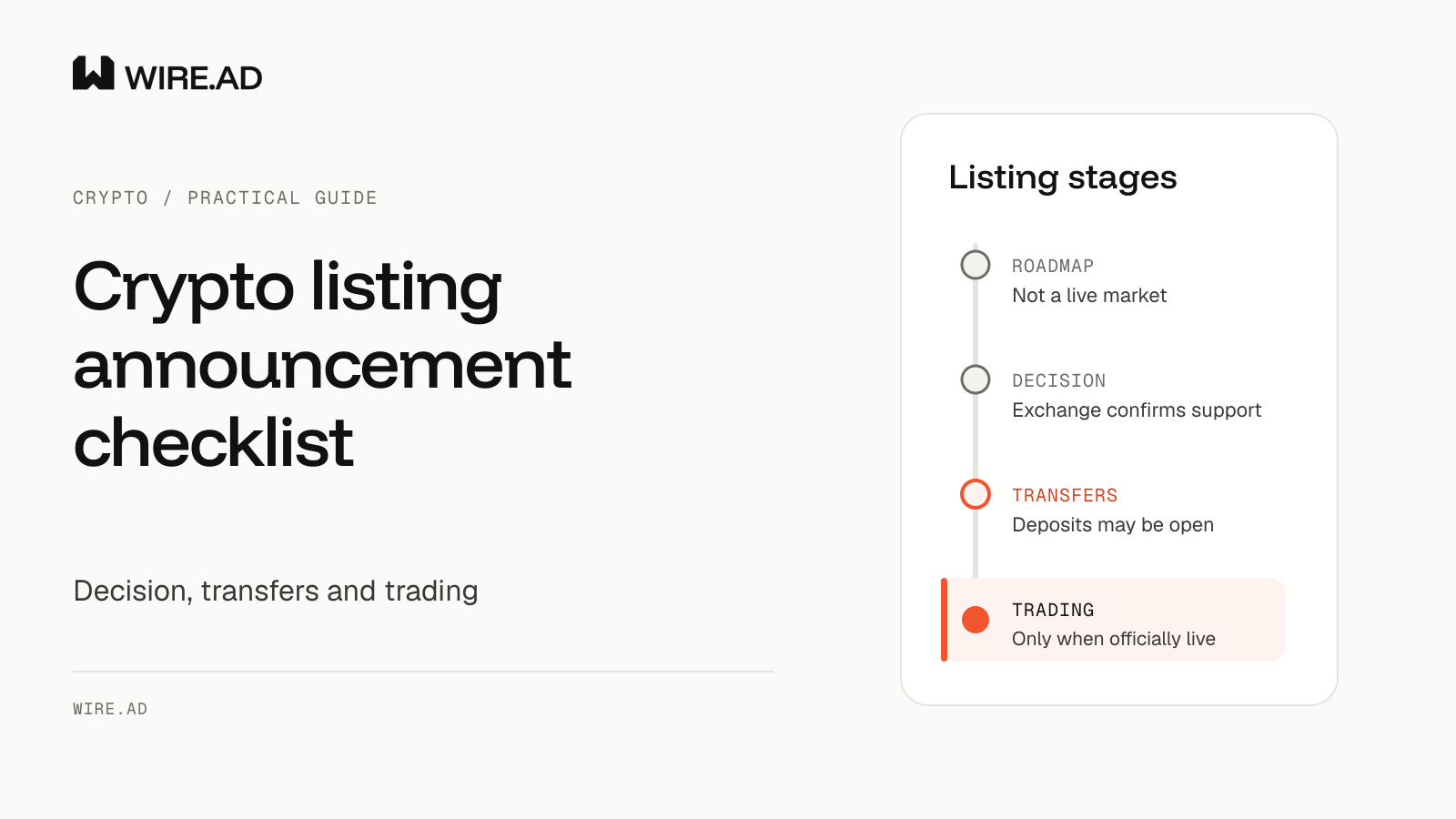
A crypto listing announcement checklist has to separate events that are often compressed into one word: consideration, a decision to list, deposits or transfers opening, order books entering a limited mode, and trading becoming available.
If those stages are mixed together, a release can tell readers an asset is “live” when the exchange has only added it to a roadmap or enabled inbound transfers. The fix is a stage-by-stage source check.
Sources reviewed 12 October 2026: Coinbase’s public listing-process and asset-listing pages, plus current FCA guidance for cryptoasset financial promotions. Exchange processes differ; verify the named exchange’s own notice.
Name the exact asset, network and exchange product
Start with the identifiers a reader needs: asset name and ticker; supported blockchain; contract address when the exchange publishes one; named exchange product; supported jurisdictions; confirmed trading pairs; and an exchange-controlled source URL.
A ticker alone is not enough. Different tokens can share similar symbols, and the same asset can exist on multiple networks. Do not infer a supported network from a project website, wallet interface or earlier announcement.
“Listed on Coinbase” can mean different products or regions. The copy should say which platform and audience the official notice covers.
Distinguish a roadmap from a listing decision
Coinbase’s transparency notice warns that transfers and trading are not supported until an official listing announcement. That is a useful editorial boundary even when another exchange uses different terms.
A roadmap entry may show consideration or planned integration. It does not prove final approval, a launch date, supported pairs, deposit availability, order-book liquidity or access in every market.
If the only primary source is a roadmap, write “added to the roadmap” and stop there. Do not upgrade it to “will list,” “is listed” or “trading now.”
Track operational stages separately
The Coinbase listing-process page describes due diligence, notification, technical integration, then enabling transfers and moving into trading mode when liquidity conditions are met.
| Stage | What it supports | What it does not support |
|---|---|---|
| Official decision | exchange has decided to list | trading is open |
| Transfers enabled | customers may send the supported asset | orders can execute |
| Order book opens | orders may be posted in the stated mode | full trading for all users |
| Trading begins | the named pair is active under stated conditions | global availability |
| Regional rollout | access for the named market | access elsewhere |
Use the exchange’s own words. Preserve “phased launch,” “auction mode,” “post-only,” “limit-only” or “subject to liquidity” when it appears.
Keep timestamps and time zones intact
A listing release may carry four times: the project’s announcement, the exchange notice, transfer availability and trading start. Record each with the stated time zone.
Do not turn “on or after 9:00 PT” into “at 9:00 PT.” If you convert a time, keep the original beside it and check daylight-saving rules for that date. When the exchange says trading will be announced later once conditions are met, the project should not publish a firm trading time.
Verify pairs, liquidity and availability
Copy the exact pair from the exchange notice. The existence of an asset page does not prove every fiat or stablecoin pair is active.
Treat liquidity language carefully. A condition tied to sufficient supply does not support “deep liquidity,” “institutional liquidity” or any price-performance claim.
Availability needs scope: countries, retail or institutional product, spot or derivatives, custody, interface and any customers excluded by local rules. “Available globally” is rarely safe without an exchange-controlled list that says so.
Separate project claims from exchange facts
A project can explain the asset’s purpose, supply or governance. The exchange controls the listing stage, supported network, markets, pairs and start time. Keep those fact owners separate in the claim register.
A project quote cannot prove an exchange action. A repost cannot replace the canonical exchange notice. Screenshots are fragile because pages and account names can be imitated; retain the live URL and time checked.
If the announcement also includes a commercial relationship, verify it independently with the partnership checklist.
Check whether the copy is a financial promotion
Distribution channels do not remove regulatory obligations. The FCA says its cryptoasset financial-promotion rules cover a broad range of communications, including social media, websites, apps and other content directed at UK consumers. It says promotions should be fair, clear and not misleading.
Determine whether the communication is a promotion, which audience it reaches, who communicates or approves it, and which warnings or presentation rules apply. Keep the operational fact separate from inducement language about price, returns, urgency or scarcity. Do not imply regulatory approval from an exchange listing.
Final pre-distribution check
Confirm the exchange-controlled notice; asset, ticker, network and contract; decision versus roadmap; transfer, order and trading stages; pairs, regions and product access; time conditions; promotion review; and logo permissions.
If trading has not started, plan a later update only when the exchange publishes the next stage. Do not silently edit the original release into a new event.
Questions to ask before publication
Is a listing roadmap the same as a listing announcement?
No. Use the exchange’s official notice for a decision, and later sources for transfers and trading.
Can a project announce trading before the exchange does?
Not safely when the exchange makes trading conditional on technical or liquidity checks. State the current confirmed stage.
Does an exchange listing mean regulatory approval?
No. A listing is an exchange action. Registration, authorisation and promotion rules are separate claims requiring their own primary sources.