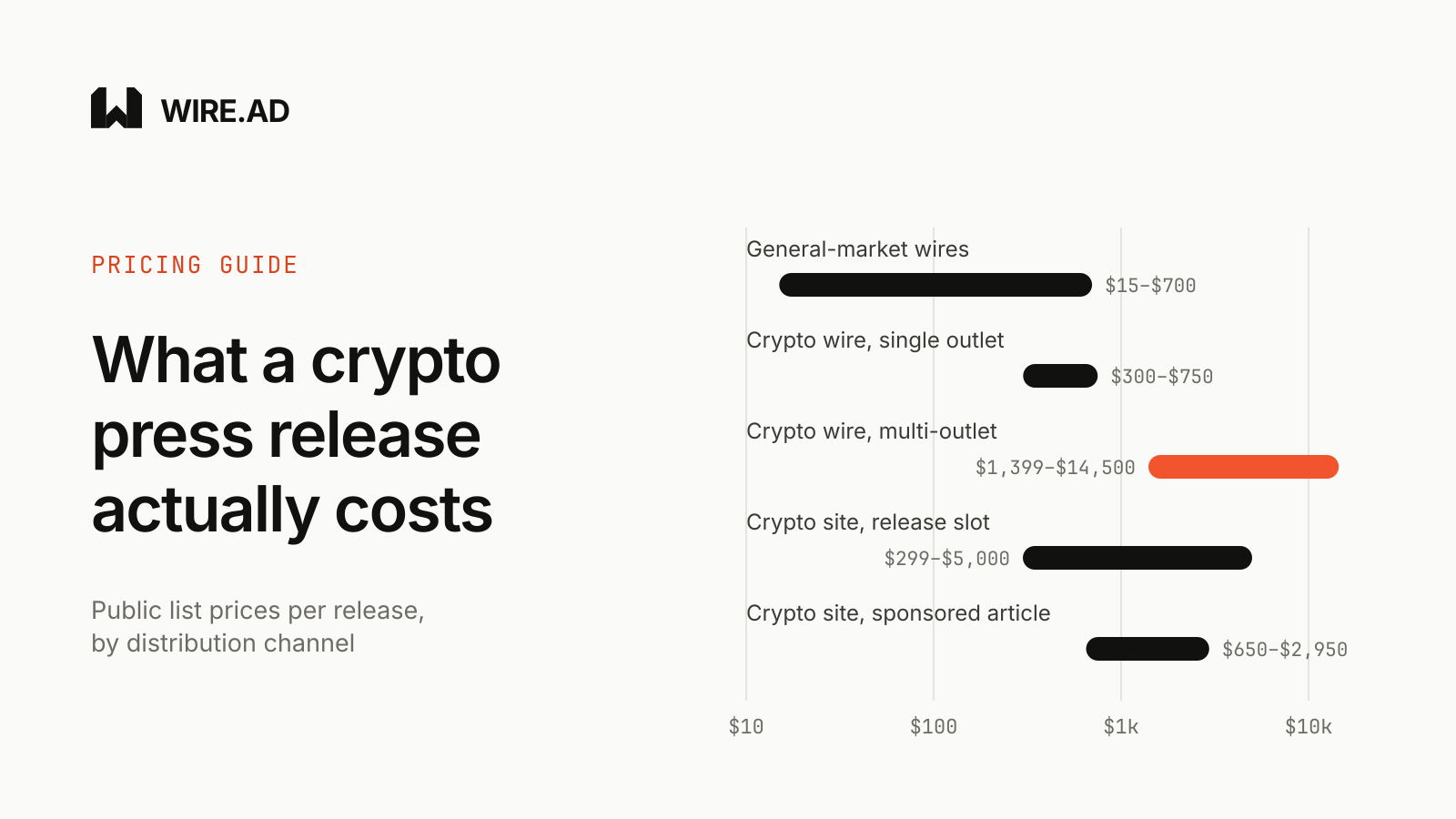
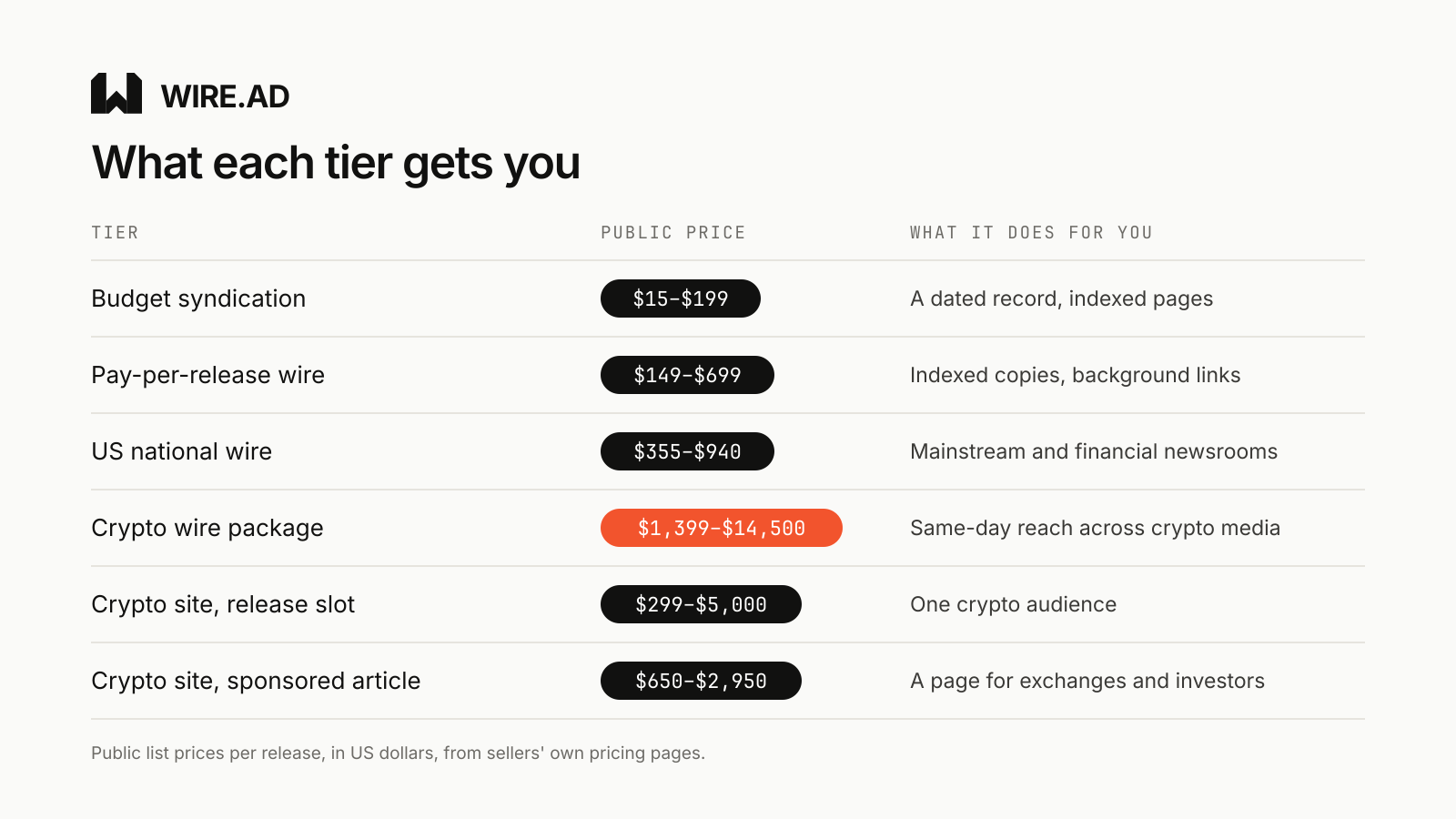
A press release costs $15 to $14,500, and the tier decides what the money buys. Budget syndication runs $15 to $199, pay-per-release wires $149 to $699, and US national wires $355 to $940 for 400 words. Crypto wires charge $1,399 to $14,500 for a package or from $300 for one outlet, and a slot bought from a crypto news site costs $299 to $5,000. The price follows two things: how many named outlets are guaranteed, and how much of the count is automatic reposting.
Press release pricing by tier
| Tier | Typical public price | What you get | What it does for you |
|---|---|---|---|
| Budget syndication | $15 to $199 | A post on the seller’s own site and copies on aggregator sites; crypto-branded services start around $99 | A dated public record and indexed pages. Few readers |
| Pay-per-release wire | $149 to $699 | Regional and digital networks, industry targeting, a word limit; EIN Presswire lists $149 for one release | Indexed copies and background links. Reach depends on the targeting |
| US national wire | $355 to $940 for 400 words | Newsroom feeds and financial portals; PR Newswire and Business Wire | Credibility with mainstream and financial newsrooms. Crypto releases can face extra review |
| Crypto wire, single outlet | $300 to $750 | One or two named crypto outlets | Reach into one crypto audience |
| Crypto wire, package | $1,399 to $14,500 | 8 to 100 or more crypto outlets, plus hundreds of mainstream reposts at the top | Same-day reach across crypto media. The reposts add indexing, not readers |
| Crypto news site, press release slot | $299 to $5,000 | One post, homepage rotation for a set window, 500 to 750 words | Reach into that site’s readers, under a press release label. Indexing is not always included |
| Crypto news site, sponsored article | $650 to $2,950 | A longer piece with more links, sometimes written by the outlet; branded features run $3,999 to $7,499 | Credibility: one page you can send exchanges and investors to, labeled sponsored |
| Top outlet sold as a wire add-on | $1,500 to $7,500 | One placement on one big-name outlet | A name for the report. Check how long it stays up: one $7,500 entry lasts 24 hours |
List prices from sellers’ own public pricing pages, in US dollars per release.
How much should a press release cost?
It depends on who has to read the news. An exchange listing aimed at traders needs crypto media and costs $1,399 to $2,500 through a crypto wire, or from $299 per direct slot on a crypto news site. A funding round that investors and business press should see usually pairs a crypto wire mid package with a national release, about $3,350 at list prices. A product update or partnership mostly interests existing users, and $150 to $750 for one outlet or a pay-per-release wire covers it.
Exchange listing. The date is fixed and the readers are traders who already follow crypto sites. A crypto wire entry package, or one or two direct slots on sites those traders read, does the job. A general wire adds little.
Funding round. Investors, partners and journalists read business news as well as crypto media. A crypto wire mid package from $2,499 plus a national release from $850 puts the round in both places on the same day.
Product update or partnership. Spend the least here and keep the budget for the next big announcement. One crypto outlet or a pay-per-release wire is enough to put the news on record.
Comparing quotes for a launch? Send one brief and get a fixed-price proposal with the package, the channels and the price within one business day.
What is the cheapest press release service?
The cheapest paid tiers start at $15 to $29 and buy a post on the seller’s own site plus copies elsewhere. Crypto-branded budget services list from about $99 to $199. At that price you get indexing and a background link, not readers.
The sellers say so themselves. One long-running general wire sells a $29 tier that adds your news to its own website and goes no further; its $49 to $199 tiers add regional and digital networks. A budget white-label wire starts at $15 and claims 500 or more outlets. A mid-market wire puts it bluntly on its own pricing page: below $100, no journalist sees your release.
Reposting runs all the way up the price list. A smaller crypto wire bundles syndication to hundreds of sites into every package, its $1,500 starter included, and a leading crypto wire adds hundreds of mainstream reposts to its two top packages. A tech publishing platform tells buyers to expect about 100 more sites per release. All of those are copies of one text, so a report that counts them looks far bigger than the coverage behind it. A WIRE.AD report lists each placement with its label and its role in the package, and keeps copies separate (how it works).
General wires also make crypto releases harder to get through. One sends staking, yield and trading-bot releases to a compliance review that can ask for ID, incorporation documents and a WHOIS match. It turns down releases that recommend or speculate on a coin, and keeps the fee when it rejects one. Another asks crypto and NFT issuers for verifiable contacts and a postal address, and takes no cloud-mining releases at all. The cheapest crypto release is often the one that gets accepted the first time.
Can I submit a press release for free?
Yes, with limits. Some press release sites publish for free on their own pages, and exchanges and price aggregators let projects post updates to their community feeds at no cost. Both are self-published: readers see the project as the author, nothing is guaranteed to rank or be indexed, and no editor or crypto news site is involved.
Free posting is a good habit for every announcement, because it leaves a dated public record you can link to. It does not put the news in front of traders, investors or journalists who don’t already follow you.
How much does PR Newswire cost, and is it worth it for crypto?
PR Newswire publishes US starting prices of $355 for a 400-word state release, $650 for top markets and $850 for national distribution, with four-release bundles from $2,395 (Prezly, September 2026). Business Wire starts at $475 local, $510 regional and $940 national for 400 words and says it charges no membership fee (Prezly). EIN Presswire lists $149 for one release, $499 for five plus one, and $999 for fifteen (EIN Presswire).
Those are starting prices. Extra words, images, video, targeting and translation are quoted on top, and older rate cards that still circulate show different overage and membership figures. Industry guides put PR Newswire’s overage at $195 to $325 per extra 100 words and $325 to $490 per image. One reseller quotes $715 to $865 for a city or state send and more than $1,500 nationally, plus a $305 setup fee.
For a crypto company, a national wire is worth it when the news has to reach mainstream financial newsrooms: a round with known investors, a regulatory license, a partnership with a listed company. It is the wrong buy for a token listing. Crypto releases go through extra review there, the readers you need are on crypto sites, and the fee stays with the wire if the release is rejected.
Hidden costs and add-ons
Package prices assume a short release with few assets. One US wire that resells a major national network charges $399, $499 and $699 for 400, 500 and 600 words. Everything else is extra: $150 per 100 words over the limit, $150 for an industry target list, $150 to embed an image, $150 for local saturation, $200 for a YouTube video, $150 per additional country or $1,000 for global reach, and $300 if they write the release for you.
Here is how that adds up on one order. A 600-word release is already the $699 tier, not the $399 one. Embed one image and one video and the total is $1,049. Have the wire write it and you pay $1,349, more than three times the price on the first line of the rate card.
| Line | Price |
|---|---|
| Release, 600 words | $699 |
| One embedded image | $150 |
| One video | $200 |
| Writing by the wire | $300 |
| Total | $1,349 |
EIN Presswire caps length instead, at 700, 1,000 or 2,500 words with one, three or five images and three keyword links, and its fifteen-release pack brings a $149 release down to about $67.
Crypto wires make their money on single outlets and amplification. One sells a top crypto outlet as a $1,500 add-on, another charges $7,500 for theirs. A small crypto site wants $100 to feature a $299 release. One of the oldest crypto brands takes a $5,000 release to $15,000 once social pushes are added. A mid-size crypto site prices a sponsored tweet at $500, a video tweet at $1,500 and a newsletter slot at $2,500. Translation and global distribution at a leading crypto wire come without a published price, so expect a custom quote.
Cost per guaranteed crypto outlet
Divide a crypto wire’s package price by the crypto outlets it guarantees and the tiers get closer. An entry package works out at about $175 per outlet, a mid package at about $125, and a top package at about $87 to $108 before its mainstream reposts. The bigger package is cheaper per outlet only if you need that many crypto sites, so check the extra outlets in a top package one by one before you count the saving.
| Package | Starting price | Guaranteed crypto outlets | Price per outlet |
|---|---|---|---|
| Entry | $1,399 | About 8 | About $175 |
| Mid | $2,499 | About 20 | About $125 |
| Top | $6,499 to $10,799 | 75 to 100 or more | About $87 to $108 |
Starting price of each package divided by the crypto outlets it guarantees. Mainstream reposts are left out of the count.
Same placement, different price
The widest gap sits inside a single outlet. A large crypto news brand charges $5,000 for a press release on its own submission page, $15,000 with social amplification. One reseller lists a release on that outlet at $1,500 to $2,500. Another lists it at $750 on sale, $1,300 regular. A mid-size crypto site charges $450 for a release and $750 for a sponsored post when you buy direct, while a reseller offers the same site for $300 to $750.
When a reseller undercuts the outlet’s own rate card by 50 to 70 percent, you are usually buying a different product, and the listings don’t say what it is. None of them names the section, the label readers see, whether the page gets indexed or how long it stays up. Ask for that in writing, in the outlet’s own terms. If the answers match what the outlet sells directly, the cheaper quote is a real saving. If the seller can’t answer, you know why it’s cheaper.
Dofollow promises and the links that run
Some rate cards and reseller listings still promise dofollow links. We looked at one wire-distributed release as it ran on four crypto sites. Each one labeled it: a “Sponsored” category with a disclaimer above the text on one, a press release section on two, a “PRESS RELEASE” tag on the fourth. Every link to the company carried nofollow, and two sites added sponsored as well. We haven’t bought the dofollow products themselves.
Google’s rules explain the pattern. Its spam policies count “Exchanging money for links, or posts that contain links” as link spam, advertorials and distributed press releases included, and allow them once the links carry rel="nofollow" or rel="sponsored" (Google Search Central, spam policies). The outbound-link guide says it in one line: “Mark links that are advertisements or paid placements” with sponsored (Google Search Central). The same spam page lists wire services and press release sites among the cases it does not treat as site reputation abuse. Distribution is fine; paying for ranking credit through it is what Google penalizes. WIRE.AD labels every paid placement and marks its links rel="sponsored", as set out in our sponsored content policy.
Check indexing as carefully as links. One crypto wire’s own publisher table marks several big-name placements as not indexed, and lists one premium outlet at 24 hours and another at 30 days while the rest stay up indefinitely; the $7,500 add-on is one of the 24-hour entries. A major crypto brand’s advertiser FAQ warns that its press releases may not be indexed by search engines. A placement is worth what its readers see and how the page is labeled.
Are press releases worth it?
They are worth it when you know what each placement is for. A release bought for reach that lands on syndication sites nobody reads does look useless, and that is the experience behind most “press releases are a waste of money” threads. The same release bought for a clear job does that job: a dated record for due diligence, an indexed page that answers searches for your brand, a labeled placement on a site your buyers read, or a page an exchange or investor can check.
Before you buy, write down the job for each line of the quote. If a line has no job, cut it.
What is the most reputable crypto news source?
For buying a placement, reputation is something you can check rather than a name to trust. Look for an outlet with its own editorial staff and a corrections policy, a clear label on paid content, pages that appear in Google News and in search for the outlet’s own headlines, and organic traffic from the country you sell in. An outlet that hides its sponsored label or sells dofollow links fails the check however large its name.
Best practice before you buy: a checklist
Before you pay for crypto press distribution, get four things in writing: the named outlets that are guaranteed, the label readers will see, rel="sponsored" or nofollow on every link to you, and how long each page stays live and indexed. Then ask for a report that marks every URL as a placement or an automatic copy. A seller who can answer all of this before payment is selling you coverage; one who can’t is selling you a count.
| Ask the seller | A good answer |
|---|---|
| Which placements are guaranteed, and which are syndication or reposts? | A list of named outlets guaranteed in writing, with reposts listed separately and kept out of the coverage count |
| What label will readers see on the page? | The outlet’s own label for paid content, such as “Sponsored” or “Press release”, named before you pay |
What rel attribute will the links to your site carry? | rel="sponsored" or nofollow. A paid placement sold with dofollow links goes against Google’s rules |
| Will the page be indexed? | Yes for each named outlet, confirmed in writing, with any outlet that blocks indexing flagged up front |
| How long does the placement stay live? | Permanently, or for a stated period written into the order |
| Does the report separate placements from automatic copies? | Yes: every URL is marked as a placement or a copy and shows the label it ran under |
| What happens if an outlet rejects the release? | A rewrite or a replacement outlet of the same tier, agreed before payment |
| Which extras are in the quoted price? | Word count, images, video, countries and writing are all listed in the quote, with the price of anything extra |
What WIRE.AD doesn’t guarantee
No honest seller can promise search rankings, indexing of every page, a mention in Google’s AI Overviews or in ChatGPT answers, or a set amount of traffic. Those depend on search engines, AI models and readers, not on the person who placed the release. What WIRE.AD commits to is what can be checked: a fixed price agreed before the work starts, every paid placement labeled sponsored, and a report that shows each URL with its label and its role in the package.
Already paid for a launch? Run a free AI Shortlist Check and add your last PR report: we check whether AI names you when buyers ask and review each placement, whether it is live, labeled, indexed and how it links to you.
Market price history
We review the public list prices in this guide every quarter and log what moved here. These are other sellers’ published prices in US dollars, per release and one-time unless noted.
| Edition | What changed |
|---|---|
| October 2026 | First edition. Crypto wire packages list at $1,399 to $14,500, with a median of $2,500 across 19 packages. US national wires start at $850 (PR Newswire) and $940 (Business Wire) for 400 words. |