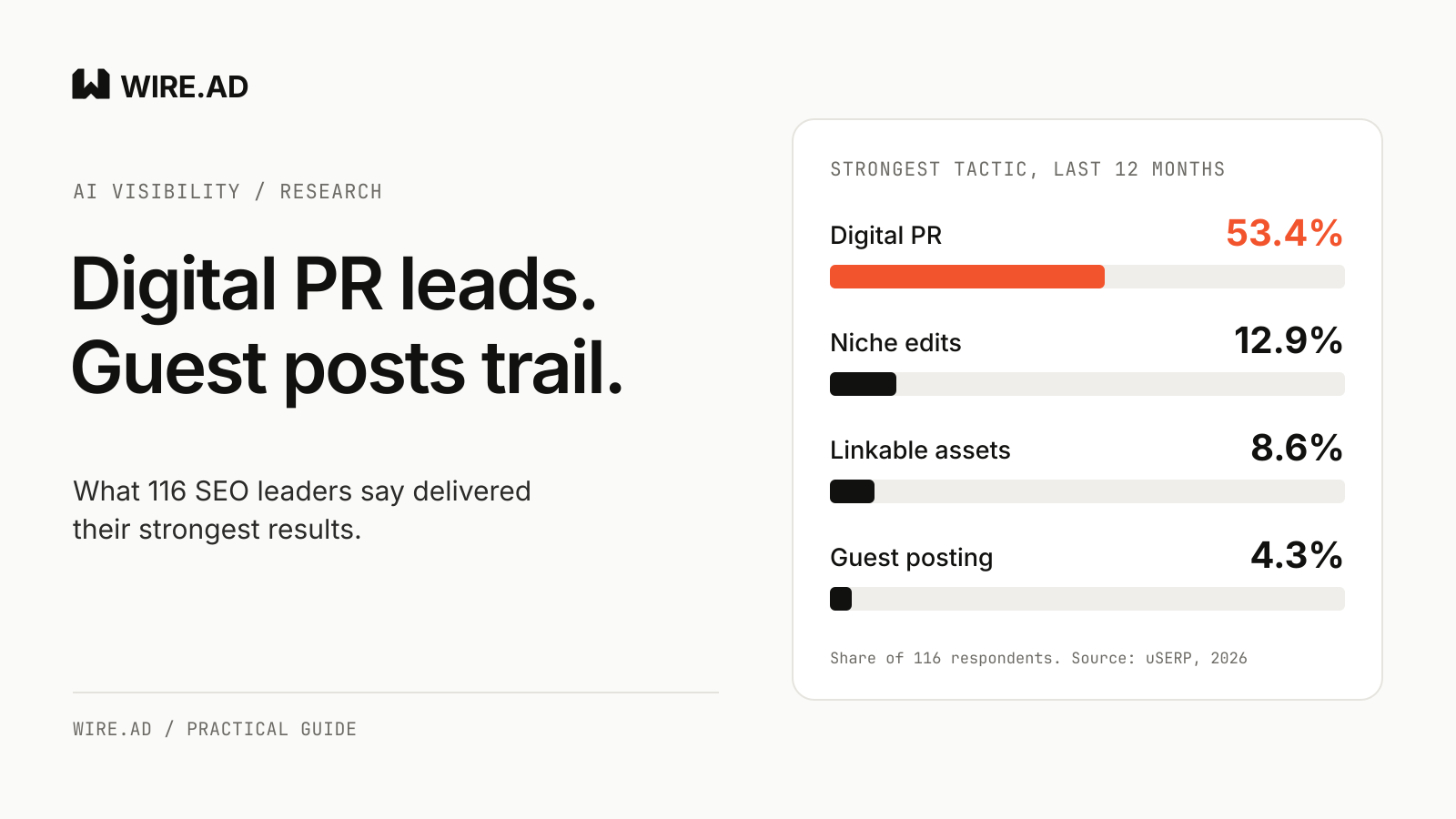
Digital PR vs guest posting is a lopsided contest in uSERP’s State of Backlinks report, a survey of 116 SEO professionals published in September 2026. Asked which tactic delivered their strongest results in the past 12 months, 53.4% named digital PR. Guest posting got 4.3%. For a crypto, fintech or AI company planning a launch, the gap says where a coverage budget should go first: to stories editors choose to run, on sites your buyers and AI assistants already read.
Who answered the survey
The panel is senior. 56.9% of respondents have worked in SEO for more than 10 years, and 47.4% are a director or head of SEO. 44% run SEO in-house for a brand; the rest work at agencies, as consultants or on their own projects.
Two limits are worth keeping in mind. The answers are self-reported opinions and observations, so they describe what experienced practitioners believe and see, which is different from a controlled test. And uSERP sells link building, so it has a commercial view on the topic. The numbers below are still useful because the questions are specific and the report publishes the full answer distribution for each one.
Digital PR leads, guest posting trails
Here is how the panel answered the question about their strongest tactic in the last 12 months:
| Tactic | Share naming it strongest |
|---|---|
| Digital PR | 53.4% |
| Niche edits or link insertions | 12.9% |
| Linkable assets | 8.6% |
| Expert commentary via source platforms | 6% |
| Guest posting | 4.3% |
| Buying placements | 4.3% |
The same report asked which tactic has the largest gap between how widely it is used and how well it works. Guest posting took 40.5% of the answers, more than three times the next option. In an open question about tactics that worked two years ago and are now fading, guest posting (19.4%), paid links (17.9%) and private blog networks (16.4%) made up more than half of the 67 answers.
The respondents describe one failure pattern again and again: a generic article on a blog outside the topic, chosen for its Domain Rating, that nobody reads. Guest posting itself can still work. The bulk version, bought by the dozen to move a metric, is what the panel has stopped trusting.
How WIRE.AD does it. Every package starts from the news itself: a launch, a listing, a funding round, a product release. WIRE.AD writes a version of the release for each outlet in the package, so each placement reads as a story for that outlet’s readers.
Topical relevance decides whether a link is worth having
When respondents chose the single factor that decides whether a backlink is worth acquiring, 58.6% picked the topical relevance of the linking page. The page’s real organic traffic came second at 13.8%, and whether AI engines often cite the domain came third at 12.1%. Domain Rating or Domain Authority was the deciding factor for 11.2%.
For a crypto exchange or a payments startup, relevance has a concrete meaning. A story on a crypto news site, a fintech trade publication or a wire that feeds those sites sits next to coverage your buyers already follow. A post on a general lifestyle blog with a high authority score does neither job.
How WIRE.AD does it. Each proposal names the outlets in the package, grouped by the audience they serve. Crypto, fintech and AI clients get outlets from their own vertical, and the report lists each placement with its date and URL.
Coverage now feeds AI answers
The survey’s newest questions are about AI search. 81.9% of respondents believe backlinks influence whether ChatGPT, Perplexity or Google’s AI Overviews cite a brand. 46.6% say they have watched a specific backlink lead to an AI citation and have before and after evidence. Another 25% believe it has happened for them but cannot prove it.
Several respondents add a qualification: for AI answers, the mention matters more than the link. One described getting a client into a “best tools” listicle that Google’s AI Overview was already pulling from, so a single placement brought both referral traffic and an AI citation. Another said a press release syndicated to more than 700 news outlets was being cited by AI engines in answers about its category within two hours, and still was months later.
Demand for proof is rising faster than measurement. 79.3% of respondents have been asked by a client or senior leader to make AI citations a KPI, while 21.6% track them as a core metric today. Two thirds (67.2%) say zero-click search has shifted their link building toward brand and AI citation.
How WIRE.AD does it. An AI visibility reading is available before and after a campaign. WIRE.AD asks AI assistants the questions your buyers ask, records whether your company appears, and compares the two readings. The AI visibility page explains the method, and the ChatGPT measurement guide shows how to run a basic version yourself.
Sponsored coverage works when it is labeled and relevant
35.3% of respondents paid for, or approved payment for, a sponsored backlink in the past year. The report draws a line between two groups. People who were satisfied described sponsored coverage on sites that already rank and get cited, tagged as sponsored. People who regretted it described generic multi-topic blogs picked for their Domain Rating.
That distinction matters for regulated sectors. A fintech or crypto company is better off with a sponsored article that says it is sponsored, on an outlet its buyers recognize, than with an unlabeled guest post on a site nobody in its market reads. The disclosure protects the outlet, the reader and the company.
How WIRE.AD does it. Every placement in the report carries its label: editorial, sponsored or press release. Sponsored links follow the outlet’s rules, and the sponsored content policy sets out how WIRE.AD handles disclosure.
What this means for a launch budget
The report closes on one pattern in the “smartest link of the year” answers: something worth citing, put in front of the right person at the right moment. Original data, a product worth writing about and a well-timed announcement appear far more often than link requests.
For a launch, that translates into a short checklist:
- Lead with news an editor would run without payment, then add sponsored placements where they reach the right readers.
- Choose outlets by audience and topic first. Use authority scores as a floor, never as the reason to buy.
- Ask for a report that shows each placement’s label, date and URL.
- Measure AI answers before and after, so the effect on citations is visible.
If you want to see where your company stands in AI answers today, the free AI Shortlist Check runs the buyer questions for your category and sends the result by email. To plan the coverage itself, send a brief and WIRE.AD replies with a fixed-price package.