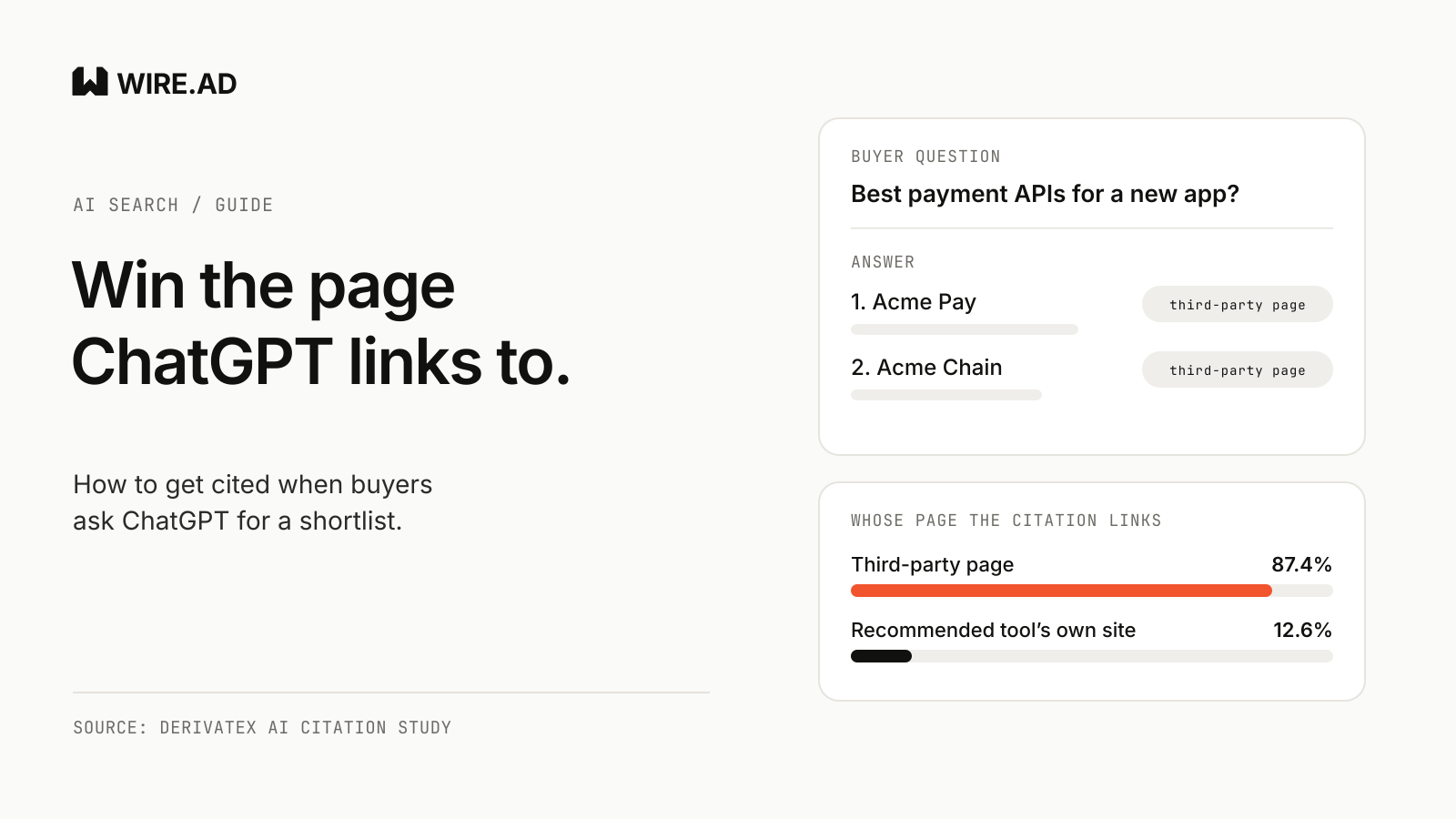
To get cited by ChatGPT, get your company onto the pages ChatGPT already links when it answers a buyer’s question, and make sure its search crawler can read your own pages. A study by DerivateX found that ChatGPT cited the recommended tool’s own website for 11.6% of its software recommendations.
Of the recommendations that carried a citation, 87.4% linked a third party instead: a niche blog, a competitor’s comparison post, a media article or a Reddit thread. For a crypto, fintech or AI company, how to get cited by ChatGPT is mostly a question of which outside pages carry your name, and how well they carry it.
What the study measured
DerivateX ran 40 buyer questions, one for each of 40 B2B software categories, through ChatGPT with web search on. Each question went into a fresh temporary chat ten times. The team logged every tool ChatGPT named, whether the tool got a clickable citation, and which domain that citation pointed to. The dataset holds 233 recommendations of 219 distinct tools. The report was published on May 31, 2026.
Keep three limits in view. The study covers one assistant and one type of question: vendor discovery, the “what are the best tools for X” moment. The categories are B2B software such as CRM, analytics, developer tools and security, so crypto and fintech are adjacent rather than tested. And DerivateX sells AI search services, so it has a commercial view on the result. The numbers are still useful because the method is published and the question type is the one that matters most to a buyer.
The citation usually goes to someone else’s page
ChatGPT attached a citation to 92.3% of the tools it named. So being named with a link is close to automatic once ChatGPT decides to recommend you. The open question is whose page sits behind the link, and in 87.4% of cited recommendations it belonged to someone other than the vendor.
Picture the buyer’s side. They read that your product is a strong choice, click the source, and land on a list someone else wrote. That list decides how your product is described, which competitors stand next to it and whether the reader clicks through to you. In 25 of the 40 categories, no recommended vendor was cited through its own website at all.
This is why a launch plan that stops at “get mentioned” leaves the most valuable part to chance. The cited page is the part a buyer actually opens.
How WIRE.AD does it. Each placement in the campaign report is listed with its URL, label and date. That gives you the exact pages to look for when you later check which sources ChatGPT links in answers about your category.
Where the cited pages come from
The study grouped every citation by source type:
| Source type | Share of citations |
|---|---|
| Independent and niche blogs, plus vendor-owned content | 81.9% |
| Major media and press | 8.8% |
| Community and social, mostly Reddit | 8.4% |
| Review aggregators | 0.9% |
Review platforms barely register. The large group is specialist content: blogs that cover one category closely, and vendors that publish an honest comparison of their own market. The study names Procurify, a procurement software company whose “best procurement software” article was the cited source for five different brand recommendations inside one answer.
For crypto, fintech and AI launches, the specialist layer has a clear equivalent. It is the crypto news site that writes category roundups, the fintech trade publication that covers payments infrastructure, and the AI newsletter that compares developer tools. A story on those outlets sits on pages ChatGPT can retrieve for your category’s questions. A placement on a general site with a high authority score may sit nowhere near them.
How WIRE.AD does it. Outlets in a package are chosen by vertical and audience first. A crypto exchange gets crypto outlets, a payments company gets fintech outlets, and every placement carries its editorial, sponsored or press release label.
Let OAI-SearchBot read your pages
OpenAI’s crawler documentation is direct on this point. OAI-SearchBot is the agent that surfaces websites in ChatGPT’s search features, and sites that opt out of OAI-SearchBot “will not be shown in ChatGPT search answers”, apart from navigational links. GPTBot is a separate agent for model training, so you can allow OAI-SearchBot and still disallow GPTBot. OpenAI says a robots.txt change takes about 24 hours to reach its search systems.
Check your own robots.txt, your newsroom and any press page you host. The AI crawler controls guide walks through each agent and what each setting does.
Build the page ChatGPT can quote
The study retrieved the pages ChatGPT cited and found a consistent shape. Every cited page used a numbered or bulleted list. Most carried the current year in the title, and many included a comparison table and an FAQ. Small sites focused on one category dominated the cited set, and domain authority did not predict which pages were cited.
Your own site can compete for the citation when it publishes the page buyers would want: a current comparison of your category that names competitors fairly and dates every fact it uses. Product pages rarely win this. For a crypto or fintech company, that comparison also has to carry the same risk and licensing wording your legal team requires on any public claim.
The category matters too. Own-site citations clustered in technical and developer-facing categories, where vendors publish deep documentation and technical comparisons. The study reported a 50% own-site citation share in single sign-on and identity. If you sell an API, an SDK or infrastructure, your documentation is a citation asset in its own right.
Named from memory or cited from search
The tools ChatGPT named without any link were mostly long-established category leaders, the names a model can list from its training data. Newer tools in the same answers were the ones pulled from fresh lists and linked. The study describes these as two separate routes into an answer.
A challenger brand cannot speed up the first route. It can work on the second one now, by appearing in the current pages ChatGPT retrieves and by publishing one of those pages itself. That is also the route a launch can move, because a launch creates news that specialist outlets want to cover.
How WIRE.AD does it. An AI visibility reading is taken before the campaign and again after it. WIRE.AD asks the buyer questions for your category in a fresh chat with web search on, records whether your company is named and which page is cited, and compares the two readings. The report names the assistant that gave each answer. The ChatGPT measurement guide shows how to run a simple version of the same check yourself.
A launch checklist
- Write down the five to ten questions a buyer in your category asks ChatGPT, and save today’s answers with the linked pages.
- Allow OAI-SearchBot in robots.txt on your site, newsroom and documentation.
- Publish one honest category comparison on your own domain, with a table, an FAQ and dated facts.
- Place your launch news on the specialist outlets your category’s answers already link to, labeled Sponsored or Press release where it is paid.
- Ask the same questions four to eight weeks later and compare which pages ChatGPT cites.
The free AI Shortlist Check researches five buyer questions in your category with an AI agent and emails the answers with their sources and the method used. To place your launch on outlets chosen for your segment and markets, send a brief and get a fixed-price package with every placement labeled.