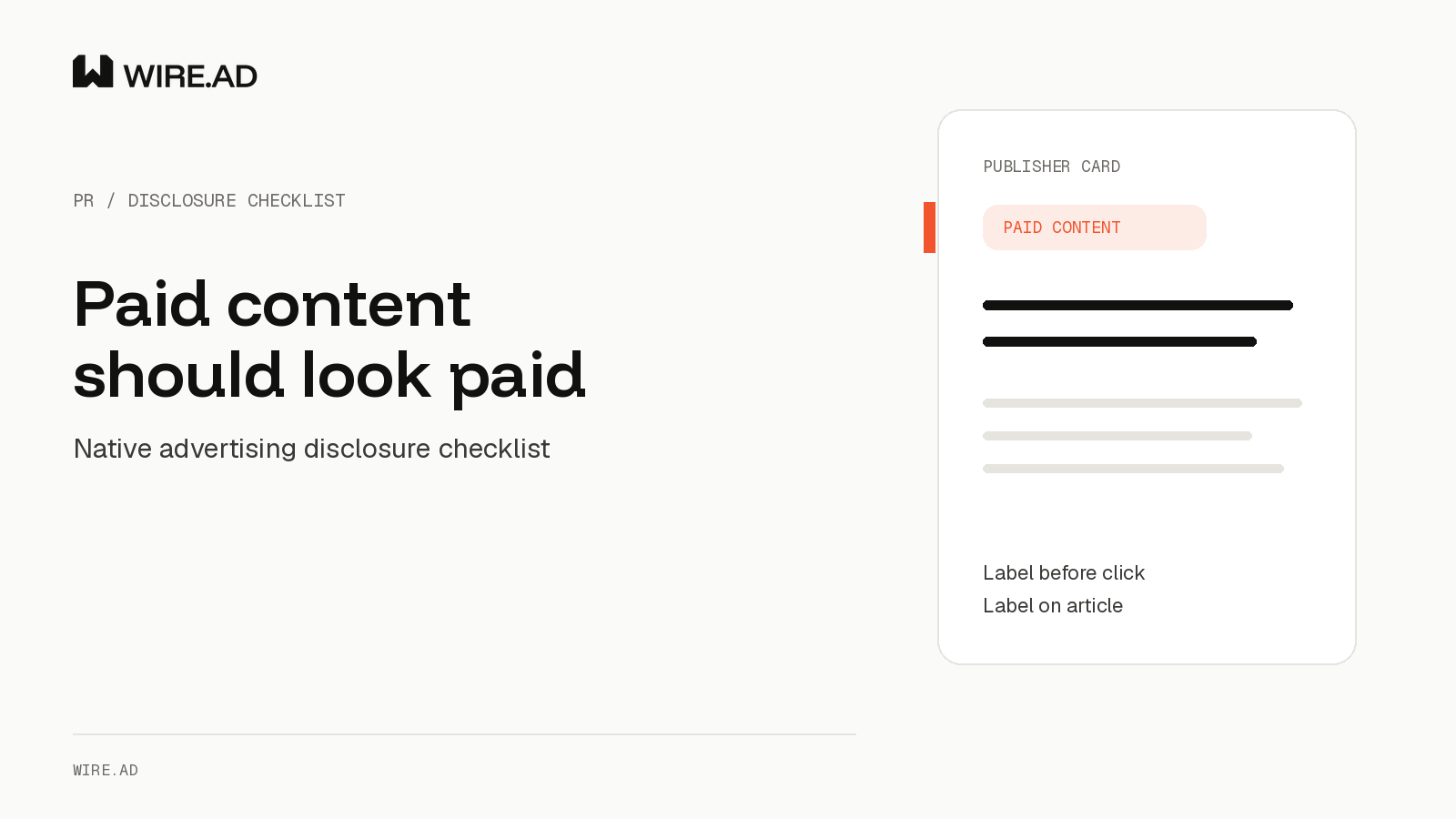
A native advertising disclosure checklist helps a communications team make paid articles recognizable before a reader clicks, while they read, and when the piece is shared. The practical test is the page’s overall impression. If its format could lead a reasonable reader to mistake advertising for independent editorial coverage, a small note buried at the bottom will not fix the problem.
This guide applies the US Federal Trade Commission’s published guidance to a typical sponsored article workflow. The FTC says the right disclosure depends on context, and its guides do not create a safe harbor. Legal and compliance teams should adapt the process to the campaign, audience and markets involved.
1. Decide whether the placement is advertising
Start with the commercial arrangement, not the template name. Record who paid, what the publisher agreed to distribute, who controls the copy, and whether the placement promotes the sponsor’s product or reputation.
A paid article can borrow the look and feel of the host publication. That similarity is exactly why the disclosure has to do useful work. Ask what a reader would infer from the headline, image, byline, page furniture and surrounding recommendations without relying on a subtle label.
Paid amplification can also change the analysis. The FTC notes that when a marketer promotes independent editorial content about its product, the paid dissemination is advertising even if the underlying article was produced independently.
2. Put the disclosure before the click
A reader should not have to open an article to discover that it is an ad. Add a clear label to every card, headline module, recommendation widget, search result and email teaser that presents the paid story.
The FTC cautions that terms such as “Promoted” or “Promoted Stories” may be ambiguous. Plain labels such as “Ad,” “Advertisement,” “Paid Advertisement,” or “Sponsored Advertising Content” are more likely to explain the relationship. Choose the shortest wording that remains unmistakable in the surrounding design.
Check the mobile card as carefully as the desktop version. A label that disappears after a responsive crop, sits below the headline, or uses low-contrast type cannot inform the click.
3. Repeat the disclosure inside the article
Readers may arrive through a direct link, search engine or social post and never see the listing card. Repeat the disclosure near the article title, before the first claim or call to action.
Placement and presentation matter together. Keep the label close to the paid content, large enough to read, and distinct from navigation or background design. Do not make readers expand a panel, hover an icon or scroll to the footer to understand the relationship.
If the article includes an author or publisher byline, do not let that element contradict the paid label. State the sponsor or commercial relationship in plain language when that information affects how readers assess the piece.
4. Carry the disclosure into every reuse
A paid article rarely stays on one page. List every planned derivative before launch: LinkedIn posts, X posts, Telegram messages, email subject lines, video captions, quote cards and partner reposts.
The FTC advises advertisers to make sure disclosures accompany native ads that are shared. Build the required label into the source copy and creative rather than expecting each channel owner to remember it later. A social preview should disclose the commercial nature before a user follows the link.
If a third party changes the headline or image, review the new version. A disclosure that worked beside one creative may become unclear after repackaging.
5. Check the claims as advertising claims
A disclosure tells readers that content is paid. It does not cure an unsupported claim. Verify product, performance, customer and comparison statements against the source pack, and retain evidence for the final version.
Separate verifiable facts from forecasts and opinions. Attribute company claims to the company. If an endorsement appears in the article, apply the FTC’s endorsement guidance as well as the native advertising review.
Do not use the label to imply that a regulator approved the campaign. The FTC assesses the net impression and the particular facts.
6. Assign approval responsibility
The sponsor, agency and publisher may all affect the final presentation. Name one owner for each stage:
| Stage | Owner | Evidence to retain |
|---|---|---|
| Commercial brief | Sponsor or agency | Scope, payment and distribution terms |
| Claim review | Sponsor and counsel | Approved facts and supporting documents |
| Disclosure wording | Compliance and publisher | Approved label and placement |
| Page QA | Publisher | Desktop and mobile screenshots |
| Social reuse | Channel owner | Final copy, creative and link |
| Post-launch check | Campaign owner | Live URLs and corrected variants |
The FTC says advertisers cannot assume an affiliate or publishing partner will make the necessary disclosures. Agencies should not proceed with a native ad they know is deceptive, and parties may share responsibility depending on their role.
Preflight check
Before release, confirm that:
- the paid relationship is recorded;
- the disclosure appears on every pre-click placement;
- the article repeats it near the title;
- wording is understandable to the intended audience;
- type, contrast and position work on mobile;
- social and email variants carry the disclosure;
- claims are supported and attributed;
- the sponsor, agency and publisher have approved their parts;
- screenshots and final URLs are saved.