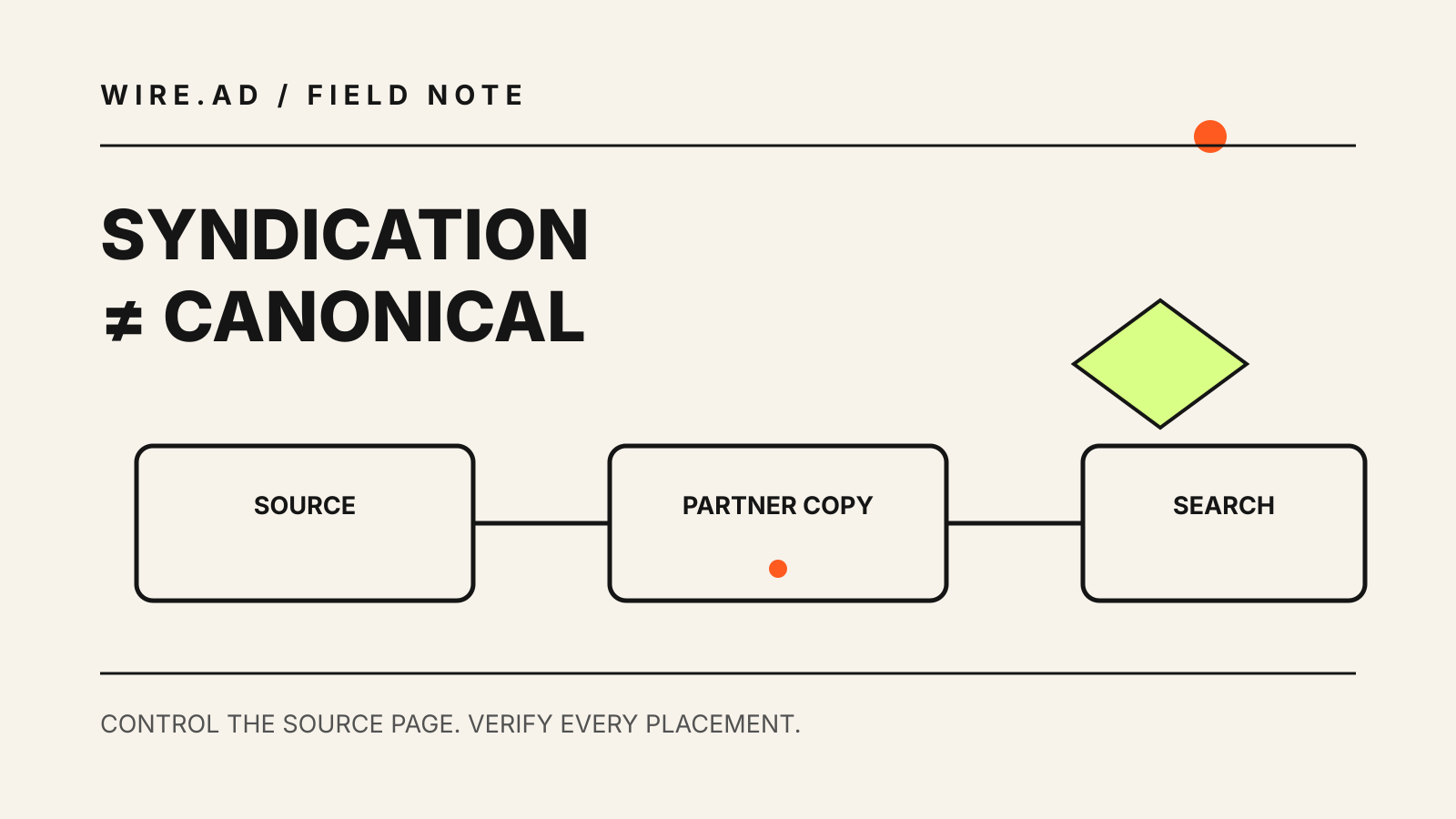
Press release syndication creates several public copies of the same announcement. A canonical URL can help search systems understand which page you prefer, but it does not give the source publisher complete control over a partner’s indexation.
That distinction should shape the distribution brief. Treat the source page, partner copies and search visibility as separate deliverables.
Start with one source page
Publish the definitive version on a stable URL you control. The page should carry the approved facts, named contacts, supporting links and any corrections that appear later.
Use an absolute, self-referencing canonical on that source page. Keep internal links consistent: if the canonical is the HTTPS URL without tracking parameters, link to that version from the newsroom, sitemap and related articles.
Google’s canonical URL documentation describes canonicalization as a signal, not a guarantee. Redirects and rel="canonical" are strong signals, while sitemap inclusion is weaker. Conflicting signals make the preferred version harder to determine.
A partner’s canonical is the partner’s decision
A syndicated outlet may publish your copy under its own template, URL and editorial policy. Some partners point their canonical tag to the source. Others use a self-referencing canonical. Some do not accept canonical requirements at all.
Record that behavior before buying a placement. A useful inventory field is simple: source canonical, self-canonical, no canonical commitment, or indexing blocked.
Do not describe source-pointing canonicals as guaranteed consolidation. Search engines may choose a different canonical after evaluating the pages and their links.
Google gives special guidance for syndicated copies
Google’s canonical troubleshooting guide says a canonical tag is not the recommended way to keep syndicated material out of search results. If a publisher does not want a syndicated copy indexed, the more effective option is for the syndicating partner to block indexing of that copy.
That is a commercial and editorial choice. A partner may sell an indexed public article, so a noindex requirement can change the product being purchased. Put the requirement in writing before the order, not after publication.
Decide what outcome the campaign needs
There are at least three legitimate patterns.
1. Source-led announcement
The company newsroom is the definitive reference. Partner copies provide reach and discovery, while the source page carries the full asset set and correction history.
Ask whether partners can point canonical tags to the source, but report what each page actually does. Do not promise that search systems will consolidate every signal.
2. Outlet-led article
An outlet produces or materially edits its own article. That page should normally stand on its own. Forcing the article to canonicalize elsewhere could undercut the outlet’s editorial value and make the placement less useful.
Label paid material correctly and keep the factual source links visible. The placement should be evaluated as its own page.
3. Wire-style replication
Many pages carry substantially the same release. Here, indexation and canonical policies vary most. The campaign report should separate confirmed publication from search indexation and from canonical behavior.
A live URL proves publication. It does not prove that the page is indexed, ranked, selected as canonical or likely to remain visible forever.
Put canonical checks in the order workflow
Before placement:
- Confirm the definitive source URL.
- Remove temporary preview and campaign parameters from the preferred URL.
- Ask the outlet about canonical and indexing policy.
- Record whether the requested policy is contractual or only preferred.
- Make sure the content is suitable for the outlet’s audience and disclosure rules.
After placement:
- Open the public page and confirm status 200.
- Inspect the rendered canonical tag.
- Check that the canonical URL resolves and is not blocked.
- Verify the paid-content label and sponsored link attributes where required.
- Save the check time because templates can change.
- Recheck every corrected or replaced page.
Report what you can verify
A distribution report should name the public URL, publication time, label, canonical value at the time checked and any indexing restriction visible in the page markup.
Avoid turning those observations into search promises. Canonical selection is made by the search engine. Indexation can change. Ranking is a separate outcome.
The practical rule is straightforward: control the source page, agree partner behavior in advance and verify the page that actually went live. Canonicals belong in the evidence column, not in the guarantee column.
Sources reviewed: Google Search Central, canonical URL documentation and canonicalization troubleshooting guidance, accessed October 19, 2026.