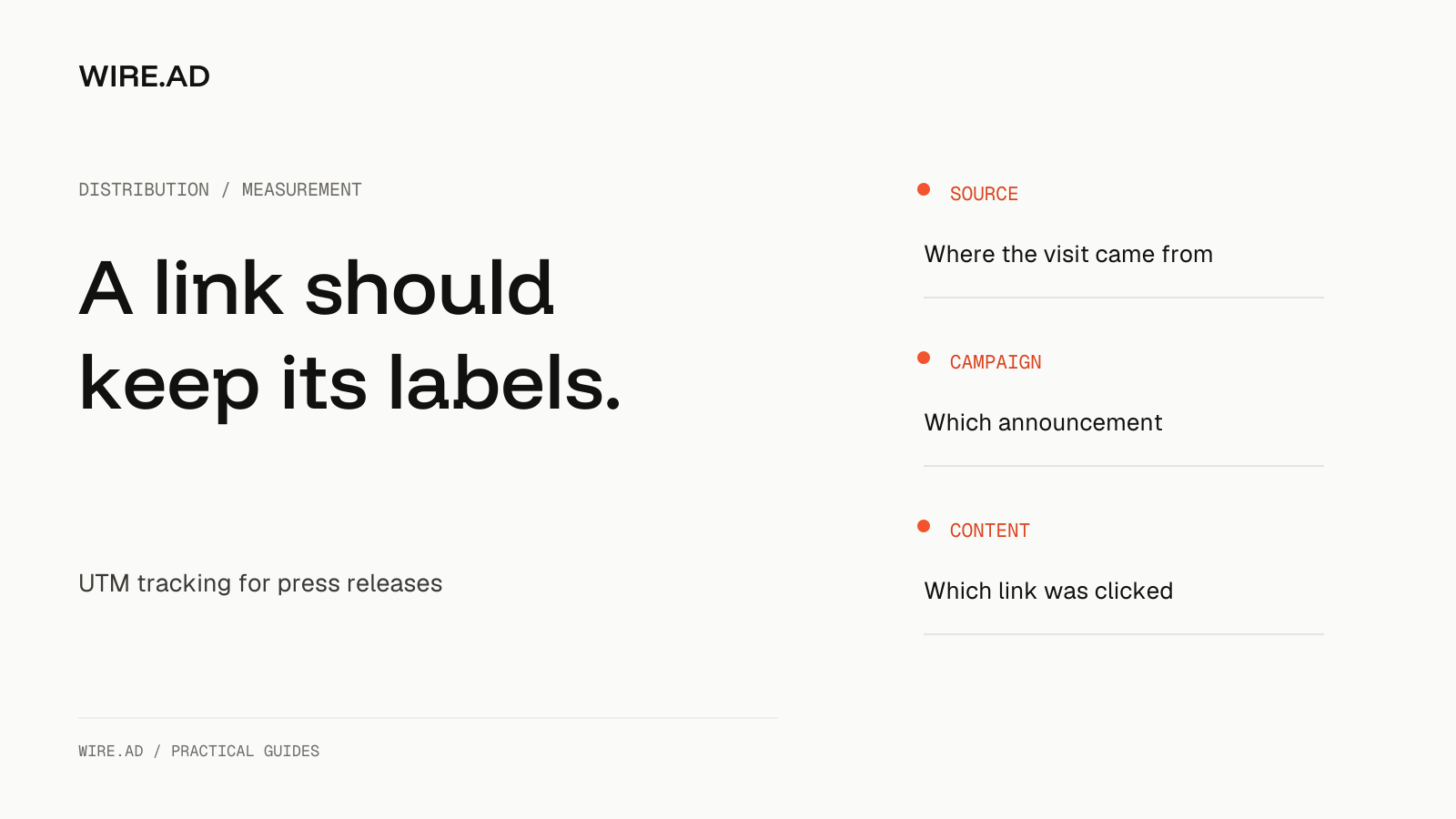
Press release UTM tracking identifies visits from campaign links; it does not measure every reader of a placement. For press release UTM tracking, agree the naming scheme before a campaign goes live. Give each distribution source a stable value and use the same campaign identifier throughout. Then test the final links, retain them in the placement ledger and compare referred visits with the actions visitors actually complete.
Assign a clear job to each field
Google Analytics documents campaign parameters for identifying referral traffic. Its URL-builder guidance recommends including source, medium and campaign together, and explains that values are case-sensitive.
A practical naming scheme for a release can use:
| Field | Job | Hypothetical example |
|---|---|---|
utm_source | Identify the referring outlet or channel | example-outlet |
utm_medium | Group the placement type | referral |
utm_campaign | Identify the overall announcement | product-launch |
utm_content | Distinguish links or creative variants | body-link |
The examples are a proposed convention, not a mandatory Google taxonomy. Choose values that fit the organization’s reporting setup and use them consistently. A change in capitalization or spelling can split reporting values.
Agree the tagged URL before submission
Keep the clean destination and approved tagged URL in the campaign brief. Ask whether the outlet accepts the query parameters and preserves them through its own redirects. A published page can contain the right company name while sending its link to an unexpected destination.
For a hypothetical release, a tagged link might be:
https://www.example.com/product?utm_source=example-outlet&utm_medium=referral&utm_campaign=product-launch&utm_content=body-link
Use a real destination on the customer’s domain in the actual campaign. Never place an email address, access token or other sensitive value in a campaign parameter. The parameter values are visible in the URL and should be treated as public labels.
The tracking convention must also survive localization. Different language versions can share the same campaign label while retaining distinct source and content values. That makes it possible to inspect each placement without fragmenting the overall launch.
Test the final reader journey
Open the published placement, follow the link and check the landing page. Record the actual destination after redirects, whether the parameters survive and whether the page offers the intended action.
Test the customer’s measurement setup separately. A correct URL cannot repair a missing analytics tag, a broken conversion event or a consent configuration that has not been implemented as intended. Keep the technical observation precise: a link opens, an event fires in the test, or a conversion appears in the relevant report. None of those observations establishes a result for all visitors.
Report what the tracking can show
Google’s guidance places campaign source, medium and campaign information in the Traffic acquisition report. Use the relevant acquisition fields rather than expecting every page-path dimension to contain UTM values.
A campaign report should separate placement delivery from referred traffic and completed actions. A placement can be live with few measurable visits. Someone can read it without clicking. Another person can discover the company later through a different route. UTM data supports analysis of tagged-link traffic; it does not establish the total influence of an announcement.
Retain the final URL and verification date beside each placement. The distribution-report checklist explains the other delivery evidence to keep.