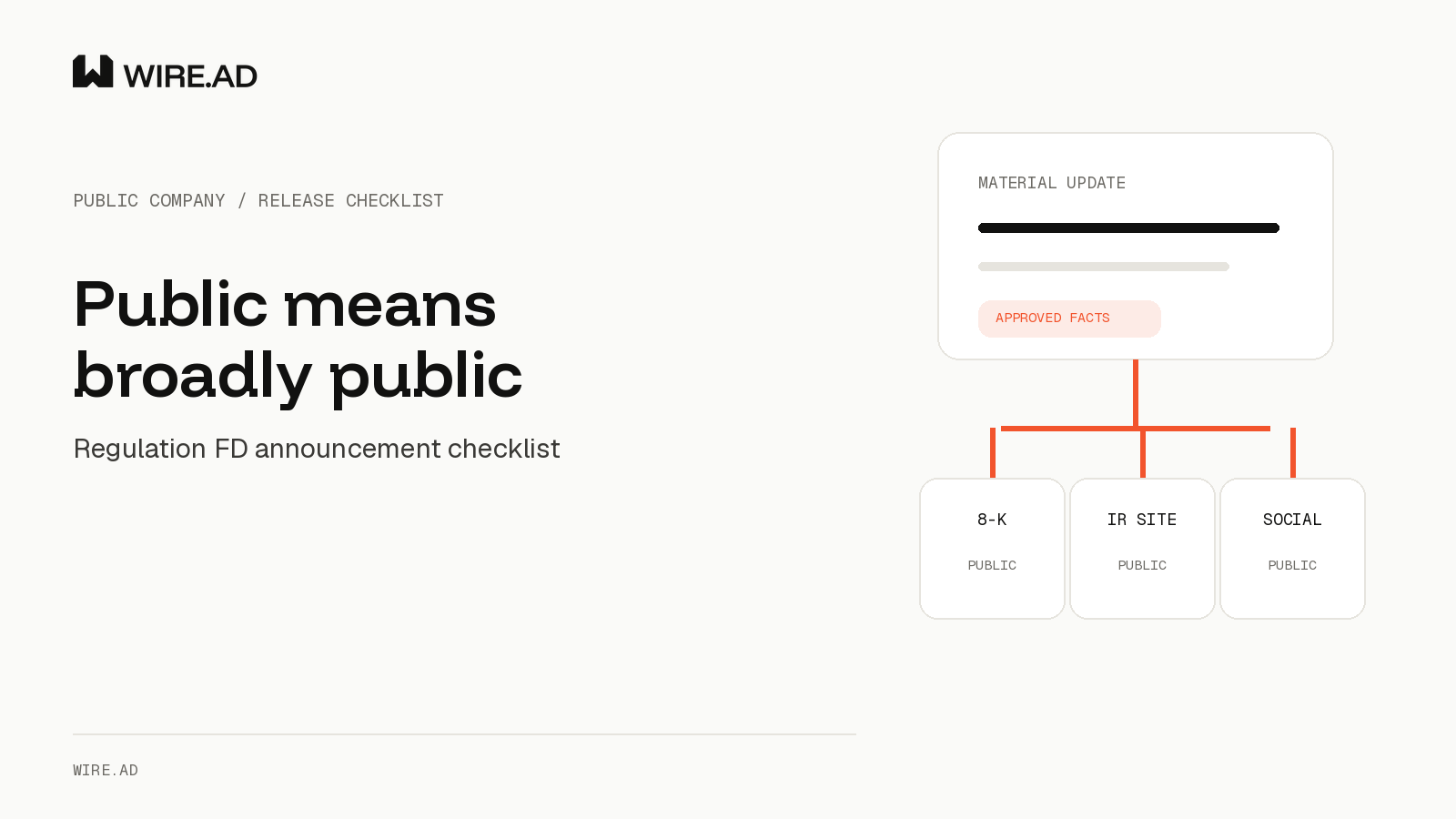
A Regulation FD announcement checklist helps a public company coordinate legal review, filing, investor communications and distribution before material information reaches a limited audience. The central question belongs to issuer counsel: does Regulation FD apply, and is the information material and nonpublic? A communications team should never make that legal conclusion from a press release template.
The US Securities and Exchange Commission permits several methods of broad, non-exclusionary disclosure. A Form 8-K is one route. A company may also use another method, or a combination of methods, that is reasonably designed to distribute the information broadly to the public. A press release is a distribution component, not an automatic guarantee of compliance.
1. Identify the decision owner
Name issuer counsel or another qualified legal owner before anyone drafts channel copy. Give that owner the facts, intended recipients, proposed timing and every planned distribution method.
The review should answer:
- whether the issuer and communication are within Regulation FD;
- whether the information is material and nonpublic;
- whether any permitted exclusion applies;
- which disclosure method and timing are appropriate;
- what to do if a selective disclosure may already have occurred.
Keep the legal decision separate from editorial approval. Communications can improve clarity and reach, but counsel owns the compliance conclusion.
2. Build one approved fact set
Create a source pack containing the board- or management-approved facts, financial figures, filing references, named spokespeople, quotations and contact details. Mark every number with its source and effective date.
Use that pack for the Form 8-K, investor relations page, press release, social copy and executive talking points. This reduces the chance that a social post introduces a detail missing from the filing or release.
Write uncertainty plainly. Separate completed events from agreements, targets, forecasts and statements about future availability. Include required cautionary language where counsel directs it.
3. Choose the public disclosure route
Document the method before scheduling distribution. The SEC’s Regulation FD adopting release describes Form 8-K and other methods reasonably designed to provide broad, non-exclusionary public distribution.
The SEC staff has also said that an open meeting alone is not adequate when the public is not given access by webcast, broadcast or a similar method. The mere presence of the press does not establish public disclosure.
A practical release plan may combine:
- an SEC filing when required or selected by counsel;
- a public investor relations page;
- a broadly distributed announcement;
- an investor alert;
- approved social posts from channels investors know to monitor;
- an accessible webcast for a related call or presentation.
The appropriate combination depends on the issuer’s established channels and the facts. Do not treat this list as a substitute for legal advice.
4. Treat the investor website as a channel, not a file cabinet
The SEC has explained that website disclosure can help satisfy Regulation FD depending on whether the website is a recognized distribution channel, whether posting makes the information available to the securities marketplace in general, and whether investors have had a reasonable waiting period to react.
Publish to a stable, public URL. Check that the page does not require registration, work only on desktop, or hide the announcement behind a rotating banner. Add the time and date, link any filing, and preserve the version that went live.
Use email alerts or other established methods to direct investors to the page when appropriate. A previously unused page should not suddenly be treated as a recognized disclosure channel without analysis.
5. Use social media only as an established route
In its 2013 report on social media, the SEC said companies can use social channels to announce key information if investors have been alerted which channels will be used. The analysis follows the same principles applied to company websites.
Record the exact company account, who controls it and how investors were told to monitor it. Use the account consistently. A personal executive account, a new handle or a channel never identified to investors creates avoidable uncertainty.
Social copy should link to the full public disclosure and remain faithful to the approved fact set. Do not release an extra metric, qualification or timing detail in the shorter post.
6. Sequence the release
Prepare a minute-by-minute run sheet:
| Time | Action | Owner | Verification |
|---|---|---|---|
| T-30 | Final legal and factual approval | Counsel and finance | Approved source pack |
| T-10 | Load filing, IR page and announcement | Authorized operators | Preview URLs and files |
| T | Execute primary public disclosure | Filing or IR owner | Public timestamp |
| T+1 | Distribute release and alerts | Communications | Delivery records |
| T+3 | Publish approved social posts | Channel owners | Live post URLs |
| T+10 | Check all public routes | Campaign owner | Screenshots and link log |
Do not promise simultaneous timestamps across systems that cannot deliver them. Counsel should approve the sequence and acceptable operational tolerance.
7. Prepare for accidental selective disclosure
Give investor relations, executives and communications staff one escalation route. If someone may have shared material nonpublic information selectively, stop improvising and contact issuer counsel immediately.
Regulation FD has timing requirements for public disclosure after intentional or non-intentional selective disclosure. The legal team should determine whether the rule was triggered and what response is required. The communications team’s job is to keep the approved channels ready and preserve an accurate event log.
Final checks
Before release, confirm that:
- counsel has recorded the applicability and materiality decision;
- all channels use the same approved facts;
- the chosen public disclosure method is documented;
- filing and investor relations links work without credentials;
- any social channel was previously identified to investors;
- executive and spokesperson copy contains no extra facts;
- the release sequence has named owners;
- timestamps, screenshots and final files will be retained;
- an escalation path is active.