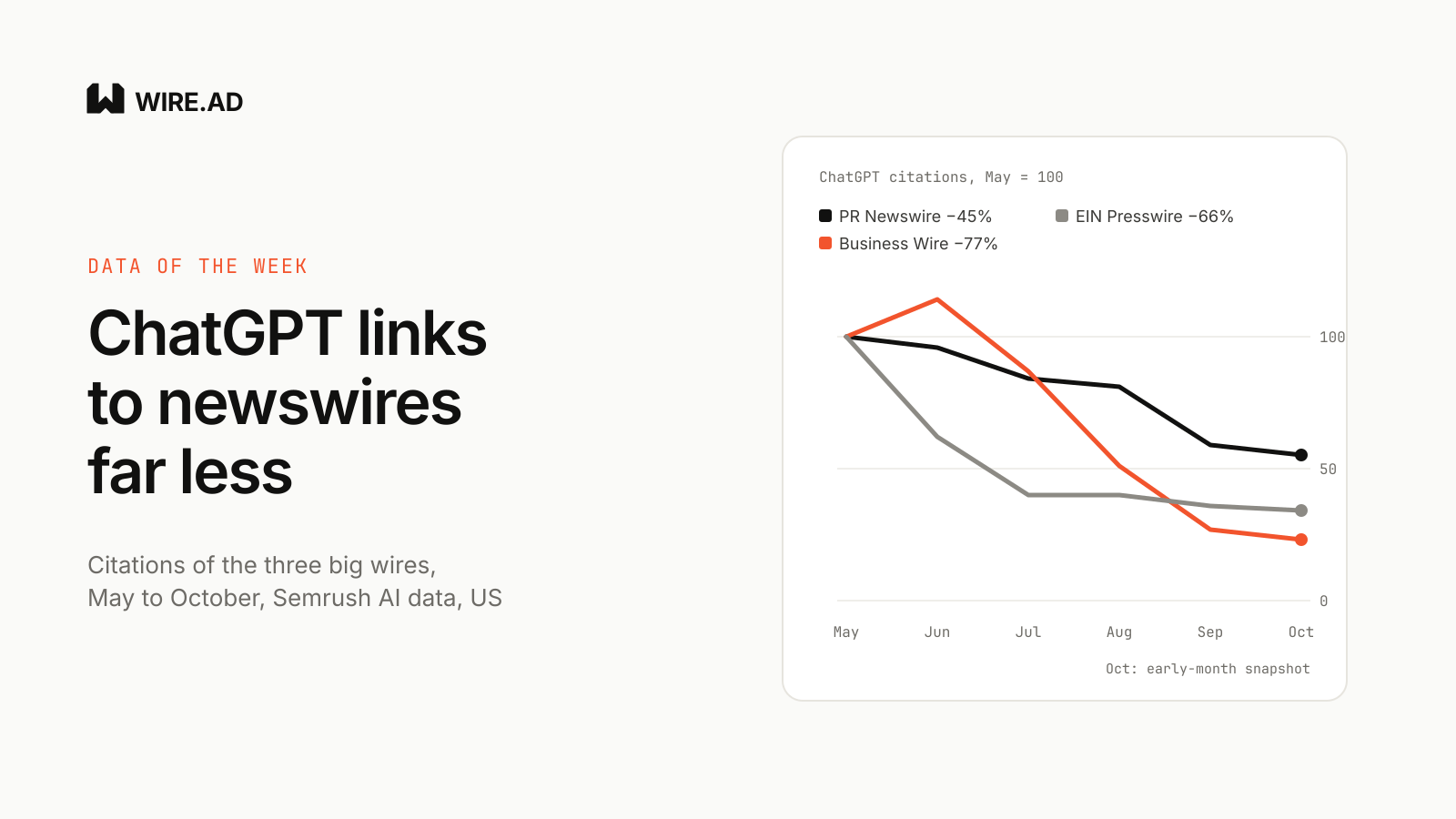
Do press releases show up in ChatGPT? Yes, but far less often than in May. On ChatGPT, citations of PR Newswire fell 45% between May and October 2026, Business Wire 77% and EIN Presswire 66% (Semrush AI data, US market). Cited pages fell by almost the same share. The other domains tracked alongside the wires fell as much or more, so the honest reading is that ChatGPT links out less, not that press releases were singled out.
What changed on ChatGPT, May to October 2026
| Wire | May | Jun | Jul | Aug | Sep | Oct* | May to Oct |
|---|---|---|---|---|---|---|---|
| PR Newswire | 139,222 | 133,911 | 116,341 | 112,778 | 81,634 | 75,952 | -45% |
| Business Wire | 42,159 | 48,240 | 36,819 | 21,459 | 11,229 | 9,633 | -77% |
| EIN Presswire | 5,379 | 3,317 | 2,164 | 2,145 | 1,949 | 1,840 | -66% |
Citations are links to the domain in ChatGPT answers. Semrush AI data, US market. *October is a snapshot taken on October 4, so it covers a partial month. Across full months, May to September, the falls are 41%, 73% and 64%. The story is the same either way.
The decline was gradual rather than one step. PR Newswire slid a few percent a month until a 28% drop from August to September. Business Wire fell for four months running, steepest from July to September. EIN Presswire lost most of its citations between May and July, then levelled off. August to September was the largest step the three had in common.
Distinct cited pages fell with citations: PR Newswire 45%, Business Wire 75% and EIN Presswire 64%. Citations per cited page stayed at roughly one throughout, so ChatGPT is citing fewer release pages, not citing the same pages less often.
The brand names held up better than the links. PR Newswire mentions, meaning answers that name the brand, were down only 6% while its citations halved; citations per mention went from 65 to 38, and Business Wire’s from 54 to 22. ChatGPT still talks about the big wires. It sends far fewer links to their pages.
The other assistants moved too, in different directions. Gemini cut wire citations hardest (PR Newswire 77%, Business Wire 69%, EIN Presswire 63%). Google AI Mode cut them by about a third to a half. Google AI Overview barely moved: Business Wire up 11% and EIN Presswire up 9%, with PR Newswire down 28%. Even on AI Overview, mentions of all three wires fell about 30%.
Is it the wires, or is it ChatGPT
The same monthly tracking covers seven other PR domains, all small specialist sites with between 7 and 223 ChatGPT citations in May. Their median fall was 85%, and pooled they lost 63% of their citations, against 53% pooled for the three general wires. The wires did not fall further than the rest of the sample. They fell roughly in line with it, and less than the small sites. Seven small domains are a weak control rather than a market-wide baseline, so treat this as a direction, not a measurement.
What points the same way is the shape of ChatGPT answers. An independent ChatGPT citation tracker reports that the average answer cited 4.7 to 4.9 sources after the March 2026 model release, down from 6.4, and that on August 8 the share of answers using site-restricted searches jumped from 0.37% to 16.8% (independent ChatGPT citation tracker, updated September 25, 2026). That timing sits next to the August to September step in the wire figures. It is worth pointing out and it does not prove the cause.
OpenAI has announced nothing here. Its help page on ChatGPT search describes how the product searches and cites, with no note about how many sources an answer carries. Everything above is observed from the outside.
How WIRE.AD does it. A wire release is bought for what it reliably delivers: a dated public record, indexed pages and newsroom feeds. The report shows each placement with its label and its role, so the value of the campaign is clear whichever way the assistants move.
What AI answers in crypto PR cite instead
That is the other half of the question. Across 78 AI answers to crypto PR prompts, the 30 most cited domains fill 338 citation slots, and the split looks nothing like a wire report.
| Source type | Share of citation slots |
|---|---|
| Third-party “best agency” ranking pages | 41% |
| Agency websites | 30% |
| LinkedIn, Reddit, Medium and YouTube | 12% |
| Crypto-specialized newswires | 9% |
| A B2B review directory | 5% |
| A finance portal carrying syndicated releases | 2% |
| Exchange-published content | 1% |
| General newswires | 0% |
Crypto PR prompts, 338 citation slots across the 30 most cited domains. Semrush AI data, US market.
The adjacent niches look similar. In fintech PR answers, agency sites took 57% of slots, LinkedIn and YouTube 18% (LinkedIn alone was cited in 40% of answers), news and trade media 7%, and a single general newswire 5%, on AI Overview only. In AI-startup and tech PR answers, agency sites took 80% and social platforms 14%, with newswires at zero.
Google’s surfaces carry most of these answers. AI Overview produced 51 of the 78 crypto answers, with AI Mode and Gemini on 11 each and ChatGPT on 5. By Semrush’s volume estimate for the topic, AI Overview holds 61% and ChatGPT about 24%, so ChatGPT matters for demand even though it gave few of the answers in this sample.
The number of slots you are competing for differs by platform. On crypto PR prompts the average answer cited 15.1 sources on AI Mode, 7.4 on ChatGPT, 7.1 on AI Overview and 3.0 on Gemini.
A media-intelligence study of more than 25 million AI citations found earned media behind 84% of them, journalism 27% and paid content 0.3%, with press releases appearing almost entirely in industry-trend answers (Muck Rack, May 7, 2026). Its follow-up puts press releases at about 1% of industry-trend answers and about 1.1% of all citations, and notes that releases carrying statistics, data and FAQ-style facts get picked up more often (Muck Rack, June 4, 2026).
How WIRE.AD does it. Before a campaign, an AI visibility reading shows which sources the answers in your category already cite, and the channel mix is built around them alongside the wire.
What to do with your next release
Buy a wire release for what it reliably does: a dated public record, indexed pages, newsroom and financial feeds. Nobody can promise you a citation in ChatGPT or an AI Overview, and the last five months show why a plan that depends on one is fragile.
Measure before and after. Run the questions your buyers actually ask in the assistants they use, save the answers and the cited links, then run them again two weeks after the announcement. Distribution is not visibility until you have checked.
Give the release something quotable: a number, a date and a plain claim in the first two sentences, because that is the kind of release AI answers reach for. Then work on the sources those answers already cite, which in this niche means third-party rankings, review directories, threads and other people’s coverage rather than your own announcements. Keep one canonical page on your own site that says what the product does, who funded it and the key figures, and update it after the news cycle ends.
Want to know what the assistants say about you now? WIRE.AD measures what AI answers say about a company before a campaign and again after it.
How we read these numbers
The monthly figures are Semrush AI data for the US market, covering ChatGPT in search mode, Google AI Overview, Google AI Mode and Gemini. Perplexity and Claude are not in this data. Four things are worth knowing before you quote any of it.
The sample moves. Semrush counts answers from its own prompt database, and that database grew from 261 million prompts in May to more than 317 million (Semrush, May 14, 2026, Semrush, July 27, 2026, Semrush knowledge base). A bigger database should raise a domain’s counts rather than cut them, but we cannot see how each month’s prompt set was composed, so part of any move may come from the sample.
Citations are not clicks. Semrush counts answers that link to a domain. It does not report traffic from those answers, and a cited link is not a visit.
October is a partial month, taken on October 4, and a few October cells on Google platforms repeat September exactly. Where a full comparison matters, use May to September.
The baseline is thin: ten PR domains, no news sites or reference sites for comparison, and full answers available for 78 crypto, 25 fintech and 88 AI-startup prompts, of which ChatGPT supplied five or six per niche. Read the niche shares as a shape, not a ranking.