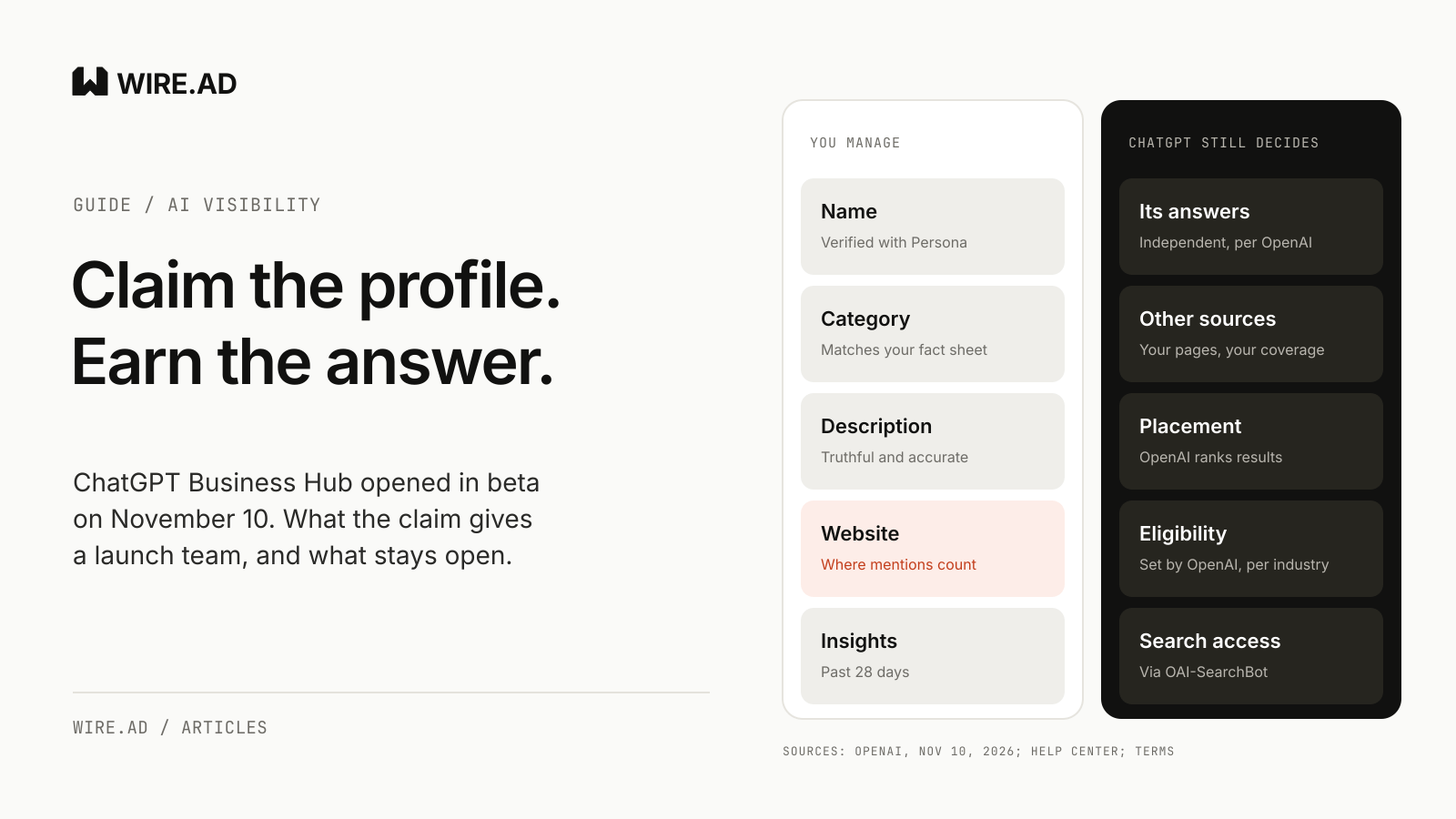
To claim your business in ChatGPT, open Business Hub from the ChatGPT sidebar, find your listing, verify that you own or represent the company, then pass an identity check with Persona. OpenAI opened it in beta on November 10. For a crypto, fintech or AI company, once Persona verification is approved, the claim gives you a profile and, where activity meets OpenAI’s reporting thresholds, a 28-day view of how often ChatGPT references your website. The answers stay with ChatGPT, which OpenAI says may also use other sources.
So a launch plan has two parts: the profile you control, and the pages and coverage the answers draw on.
What OpenAI launched on November 10
OpenAI’s announcement describes three pieces. Business Hub lets a company claim its organization, update key details and, for sellers, add product feeds with pricing and availability. Insights show mentions, website clicks and “discovery topics”, which OpenAI defines as common themes across conversations where the company’s website is cited. Business Agents let eligible companies publish a chat agent that answers questions about their offerings, for now only ecommerce and online service businesses in the US.
The post puts ChatGPT’s audience at 1.2 billion people a week. It also draws a line that matters for anyone tempted to treat the profile as a shortcut: the agent conversation is “distinct from ChatGPT’s independent answers”, and sponsored placements are labeled and kept separate from responses.
How the claim and verification work
The help center guide lists the verification methods it may offer, such as a code to the business phone or email, a TXT record on the website’s domain, or a Shopify login. Which ones you see depends on your business. OpenAI then reviews the claim and emails a decision. A second step follows. You complete identity verification with Persona, which may ask for a government-issued ID, business registration information and proof of authority, before you can publish changes, connect a feed or see insights. The help center says the blue check appears after Persona approval, not on the claim alone.
You don’t need an ads account or an Enterprise agreement to claim. Teams in stealth should note how publishing works.
If no listing exists and you create a new profile through Persona, OpenAI’s approval publishes it automatically, with no separate publishing step. And support cannot delete, unpublish or hide a published profile as part of a setup or ownership request. A company that wants its product name kept quiet until announcement day should time the claim with that in mind.
Your profile sits beside your pages and your coverage
The profile is one input. The Businesses in ChatGPT Terms, updated November 9, say that claiming a listing “does not give you exclusive control over its contents” and that OpenAI “may supplement, edit, or replace information using other sources.” The help center says ChatGPT may also use other sources when it answers questions about a business. OpenAI’s own business page adds that ChatGPT “continues to make independent recommendations and comparisons” and that claiming “does not guarantee higher placement or sales.”
The help center also says claiming a profile “doesn’t change its visibility in ChatGPT,” and that advertising doesn’t influence ChatGPT’s independent answers. Eligibility for search answers still runs through the crawler. OpenAI’s crawler documentation says sites opted out of OAI-SearchBot “will not be shown in ChatGPT search answers, though can still appear as navigational links,” and that robots.txt changes can take about 24 hours to register. Its search help page says results are ranked on “multiple factors intended to help users find relevant, reliable information” and that placement is not guaranteed.
For a launch, that means a dated announcement page on your own domain, open to OAI-SearchBot, plus coverage on outlets your buyers already read. Our guide on how to get cited by ChatGPT covers the page side in detail.
How WIRE.AD does it. With AI visibility added, placements are chosen for the questions buyers ask in the category. Every paid placement is labeled Sponsored or Press release with rel=“sponsored” on its links, and the AI visibility service reads the answers before the campaign and again after it, so the change is measured on the same questions.
Mentions count references to your website
The insights tab gives companies OpenAI’s own numbers on how they appear in ChatGPT, and its definitions are narrow. For an online business, the help center says, “a mention counts when ChatGPT references the business’s website. The brand name alone doesn’t count.”
If ChatGPT names your protocol in an answer without referencing your website, that answer adds nothing to the mentions figure, whatever sources it drew on. So a launch can shape what ChatGPT says long before this tab shows it.
Other limits are spelled out too. Insights cover the past 28 days. Discovery topics “don’t reveal individual prompts or directly measure customer intent.” Counts may be incomplete, and a blank metric can mean the activity sits below a reporting threshold, data is still being collected, or reporting is unavailable, so a blank “doesn’t necessarily mean zero activity.” Read a small number as a floor.
Because the window rolls, take a screenshot before the announcement and again about four weeks after. That gives you two snapshots of the same 28-day measure, which is as close to a before and after as the tab allows.
How WIRE.AD does it. The free AI Shortlist Check asks the questions a buyer would ask and records whether the company is named. With AI visibility added to a campaign, a second reading follows 4 to 8 weeks after the placements run, and the report lists each placement with its label, so the two readings can be read side by side.
Crypto and fintech teams have extra checks
OpenAI doesn’t say whether crypto or financial services companies can claim today. The Businesses in ChatGPT policy says OpenAI may decline a request when a business’s offerings or practices “raise significant safety or integrity concerns,” and may hold off on other categories until it has the safeguards to support them. The business page names industry as one factor. If a claim stalls, the category may be the reason, and the policy says eligibility may change over time.
The content rules read like a compliance brief. Information must truthfully represent the business, with no “false or misleading claims about prices, availability, qualifications, or likely results,” and no “unsupported guarantees, or claims that conceal material terms such as fees or conditions.” For a yield product or a card launch, the profile description deserves the same review as the release.
The Business Agents Policy goes further for any team that becomes eligible later. An agent may explain offerings and give general information, but must not provide “advice that legally requires a professional license,” and it must not ask for unnecessary or high-risk personal information, which the policy says includes financial or authentication credentials.
Two clauses in the Terms are worth a lawyer’s read before you submit. Basic business information submitted for public display, including name, address, category and website, is licensed to OpenAI on a perpetual and irrevocable basis. And a company that provides a product feed agrees that any text and data mining opt-out it reserves “will have no effect” with respect to OpenAI, a point to weigh against any crawler opt-outs your site already uses. With a feed, the Terms also require you to let OpenAI’s crawlers access your sites, and insights data is treated as OpenAI confidential information. This is general information; counsel decides what the terms mean for your company.
How WIRE.AD does it. We confirm the facts of an announcement with the client before anything goes live, and risk wording is set per version where the market requires it. You can reuse that approved fact sheet when you fill in the profile, so the name, category and description match across every version.
Before launch day
- Decide who claims. Claiming is initially open to eligible businesses with a website. The person must own the company or be authorized to represent it, and Persona may ask for ID and registration documents.
- Pick the verification route that fits your setup. The domain TXT record suits teams whose developers control DNS.
- Hold off on creating a new profile until the announcement is public, since approval publishes it.
- Write the profile from the approved fact sheet, with no claims about returns or results.
- Check robots.txt and your CDN rules so OAI-SearchBot can reach the announcement page.
- Record the insights tab, or note that it is blank, before launch.
- Read it again about four weeks later, next to the list of where the announcement ran.
Launching this quarter? Send the announcement and the questions buyers ask in your category. You get a fixed-price proposal: facts confirmed with you, a version per outlet, every placement labeled, and, with AI visibility, AI answers measured before and after.