Crypto marketing regulations by country differ in the detail, but most of them start from the same question: is the announcement aimed at people in that market? If it is, regulators in that market will often apply their rules, wherever the company is incorporated. So before a launch release goes out, list every market it targets, check what each one requires of the issuer, and put that market’s risk wording into the version written for it.
Three enforcement actions from the past two weeks show where that line sits, and why a launch plan starts with the market list, before the outlet list.
How regulators decide a campaign targeted their market
On November 5, Thailand’s Securities and Exchange Commission filed a criminal complaint against BG Limited, the operator of Bitget, alleging that it runs a digital asset exchange without a license. It also asked the digital economy ministry to block the platform from December 5, 2026.
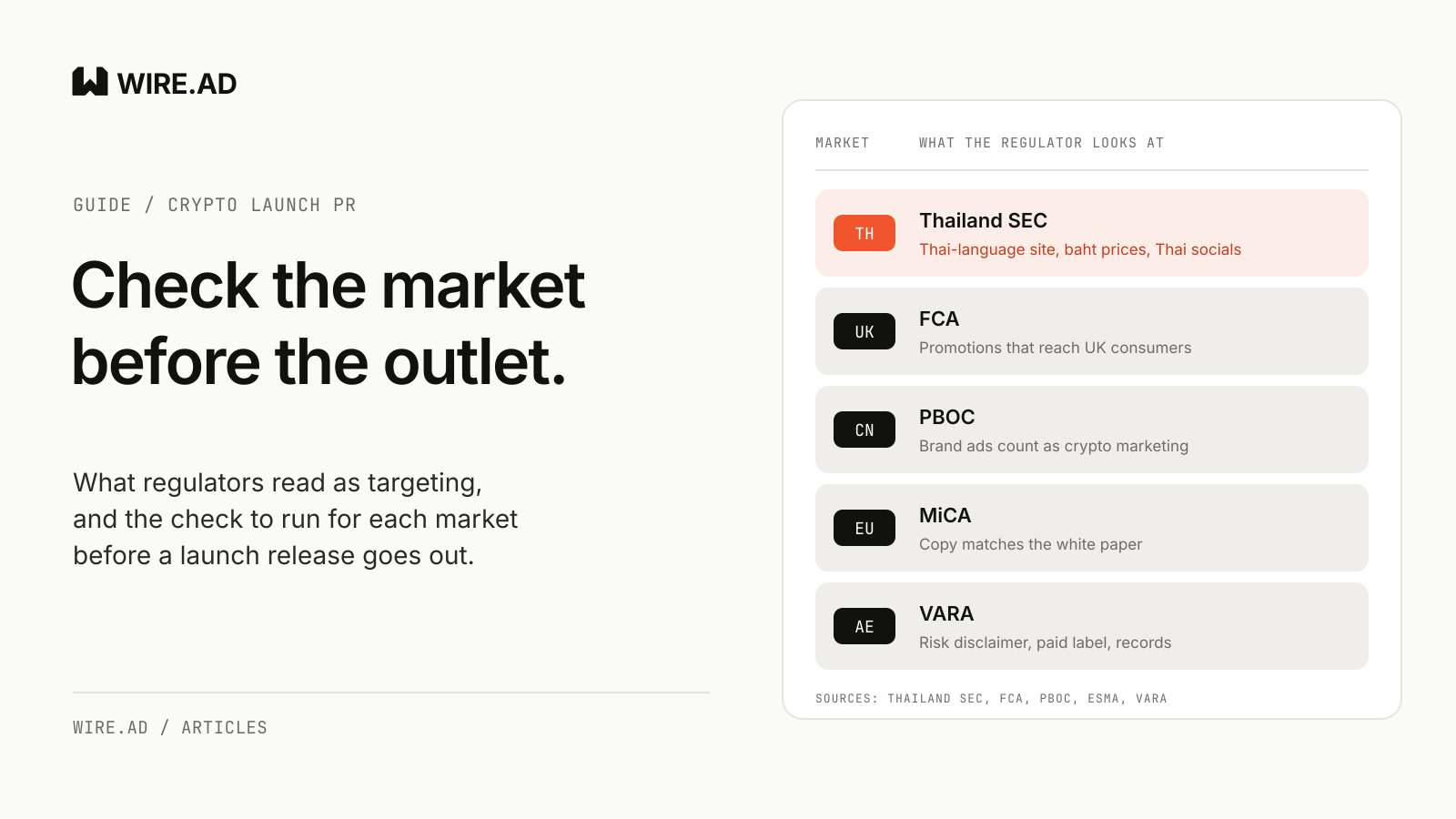
Much of the evidence the SEC lists is marketing. The platform “offered a Thai-language website with the option to display equivalent values in Thai baht.” It “solicited users and promoted its services in Thai” through its website and social accounts, which the release names on X, Telegram and TikTok. The complaint also names an individual who publicized Bitget’s services on a Facebook page and a YouTube channel. The SEC alleges that this amounted to assisting the unlicensed business, an offense under the Emergency Decree on Digital Asset Businesses read with Section 86 of the Criminal Code.
The UK made the same point on October 29, when the FCA announced High Court undertakings from HTX’s operator not to knowingly communicate unlawful financial promotions to UK consumers, covering its website, apps and social media. “Crypto firms should be under no illusion: being based overseas does not put them beyond the reach of UK law,” said Steve Smart, the FCA’s executive director of enforcement and market oversight.
Here is the catch for a launch team. Local language, local currency and local handles are what a good campaign builds on purpose, and they are the same signals a regulator cites as proof of targeting. A release translated for a market, with prices in its currency, will likely be read as aimed at that market.
How WIRE.AD does it. Once a version uses a market’s language or currency, we treat it as aimed at that market. It is edited for the outlet it runs on and carries risk wording where that market requires it.
Brand promotion can count as crypto marketing
In an interview carried by Financial News, a newspaper supervised by the People’s Bank of China, an official who heads a PBOC department said that Solana had placed high-profile ads through domestic entities, on the outer wall of the Citigroup Tower in Shanghai’s Lujiazui district, and that promoting the Solana brand in this way was virtual currency marketing. The PBOC, with local financial regulators, police and market supervisors, halted the planned “Solana Accelerate China 2026” events before they opened and will investigate the entities and individuals involved.
The rule behind it is a notice issued in February 2026 by the PBOC and seven other departments. Domestic entities and individuals who know, or ought to know, that an overseas party is illegally providing virtual currency services into the mainland, and still assist it, face liability under the law. The official said the next focus is domestic dealers and the domestic affiliates of overseas platforms.
So the scope reaches well past the token sale. A brand campaign, an event and a sponsored article can all be read as promotion of the token behind them. And a local partner who books the billboard can face liability of its own.
The EU checks consistency with the white paper
Under MiCA Article 7, marketing for a public offer or admission to trading of a crypto-asset other than an asset-referenced or e-money token must be clearly identifiable as marketing, fair, clear and not misleading, and consistent with the white paper where one is required. It must say that a white paper has been published, give the website, phone number and email of the offeror (or the person seeking admission, or the trading platform operator), and carry a fixed statement that begins: “This crypto-asset marketing communication has not been reviewed or approved by any competent authority in any Member State of the European Union.” Where a white paper is required, nothing goes out before it is published.
One detail makes this a per-country question even inside the EU. Article 7(3) gives the power to assess compliance to “the competent authority of the Member State where the marketing communications are disseminated.” A release disseminated in Germany and France can be assessed by each country’s authority for what ran there. Our Signal Weekly of November 9 covers the Dutch regulator’s reminder on what it expects before a launch.
The UAE sets rules for content, labels and agencies
Dubai’s VARA applies its Marketing Regulations to all marketing of a virtual asset or related activity “in or targeting the UAE”. Marketing of a virtual asset must not include a call to buy or sell it. It must carry a prominent disclaimer that virtual assets may lose their value in full or in part and are subject to extreme volatility, and say clearly that the investor can lose all the money they invest and has no financial protection. Content a third party publishes for payment needs a clear and prominent notice that it is part of a paid arrangement. Records of all marketing and its distribution are kept for at least eight years. Firms licensed in DIFC, ADGM or at federal level answer to those regulators’ rules as well.
Two passages matter to anyone buying placements. The firm that instructs a third party “remains responsible at all times” for the marketing it runs. The third party must check that the firm is permitted to market in or to the UAE, get its approval before publishing, and can be held liable if it skips those steps.
In a VARA case study, a factual “About” page with no invitation to buy and a prominent disclaimer is compliant. A social post announcing an upcoming listing with “Who’s getting ready to trade?” and rocket emojis is not, because the overall message implies urgency and a near-term rise in value. In another example, the line “Not financial advice. DYOR.” is judged insufficient as a disclaimer.
How WIRE.AD does it. Every paid placement is labeled Sponsored or Press release, its outbound links carry rel=“sponsored”, and each version carries risk wording where the market requires it. The client confirms the facts of every version before it goes live, and the report lists each placement with its label and link.
Ad platforms keep their own market list
Paid search adds a second set of rules. Google Ads lets crypto exchanges, software wallets and coin trusts advertise only in approved locations, only if the advertiser is licensed there and certified by Google, and with a separate application for each location or group of locations. Ads for ICO pre-sales, initial DEX offerings or the purchase and sale of crypto are prohibited wherever the advertiser is based.
Google changed the UAE entry on October 21. Exchanges and software wallets targeting the UAE now qualify with a license from the Capital Market Authority, the DFSA, the FSRA or VARA, plus Google certification.
A market check before the release goes out
Run this once per market, before any outlet is booked. This guide is general information, and counsel answers the legal questions; the list makes sure someone asks them.
- Write down the target markets, then add the ones the copy signals through language, currency, local handles and events.
- For each market, state the issuer’s license or registration status in one sentence you can print.
- For EU readers, confirm whether a white paper is required and published, and check every figure in the release against it.
- Put the required risk wording into the version for that market, prominent and complete.
- Remove calls to buy, price predictions and urgency from versions for markets that prohibit them.
- Label every paid placement and keep a dated copy of each version with where it ran.
- Leave out the markets where the issuer is not permitted to market. A release can run in four markets and skip the fifth.
How WIRE.AD does it. One order can cover several markets, with a version written for each and the facts confirmed with the client first. The market list is checked against our content policy before any outlet is booked, and we decline markets where the issuer is not licensed or registered for what it promotes. The crypto press release distribution page shows how a multi-market package comes together.
Planning a launch in several markets? Send the announcement and your target markets. You get a fixed-price proposal with one version per market, each with the risk wording that market requires.