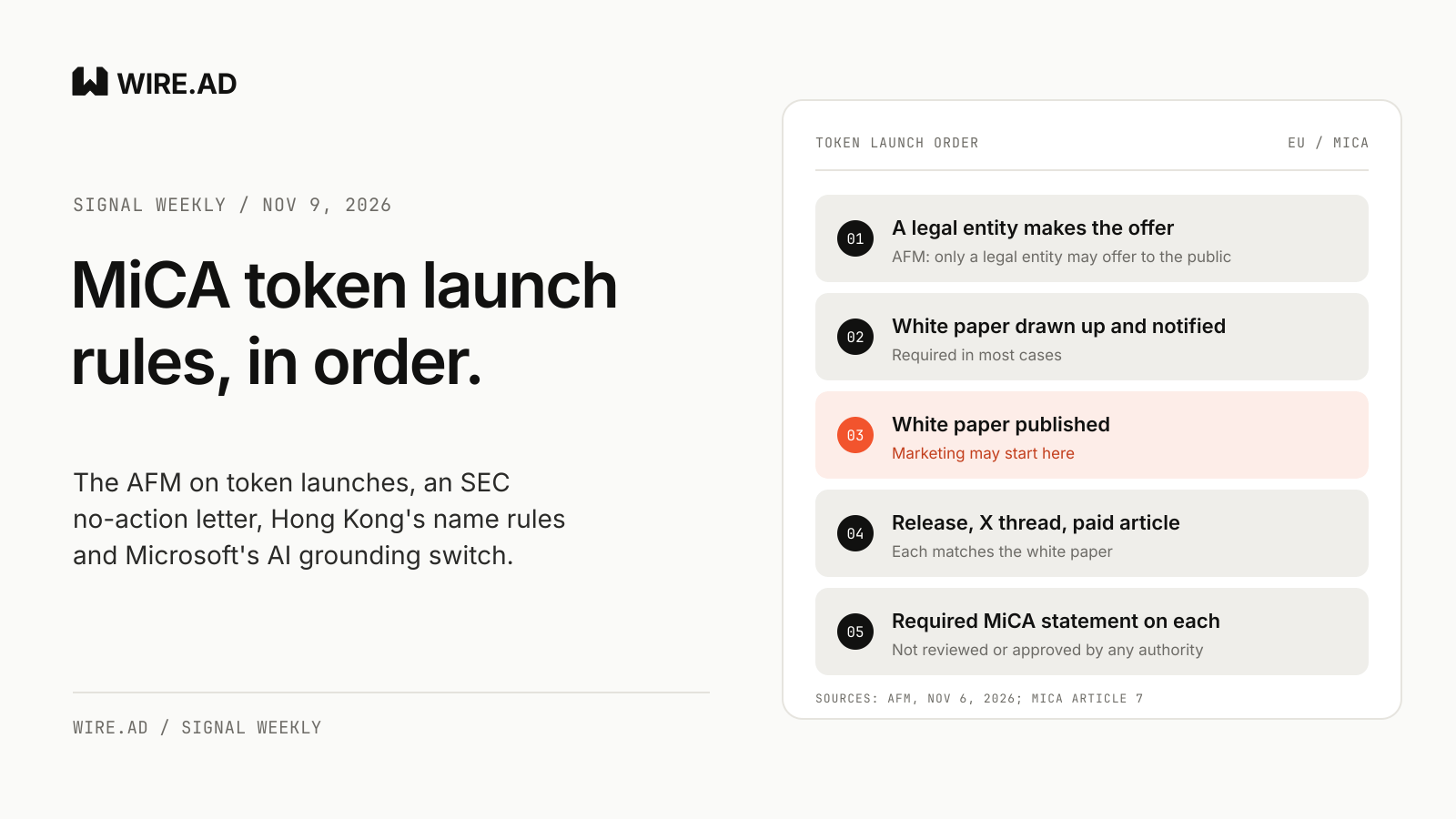
If your token launch thread is drafted before your white paper is published, the Dutch regulator has just explained why that order is a problem. The AFM set out the MiCA token launch rules in plain terms this week and said many tokens, memecoins among them, are offered without meeting them. Also: how to describe an SEC no-action letter in a release, the word pairs Hong Kong plans to reserve for licensed firms, Microsoft’s new switch for AI grounding, and a fintech savings claim the FTC settled.
This week in 30 seconds
- The AFM reminded token creators on November 6 that only a legal entity may offer crypto-assets to the public in the EU, that most offers need a white paper, and that marketing on websites and social media must match it.
- SEC staff issued a no-action letter on Canton Coin on November 3. The letter states the Division’s view and its enforcement position, and says it gives no legal conclusion.
- Hong Kong’s SFC will ask lawmakers to restrict names that pair words like “crypto” or “token” with “exchange” or “trading platform” for unlicensed firms.
- Microsoft is adding a page-level AI Grounding preference, separate from the shared AI training signal, that decides whether a page can inform answers in Copilot and Bing.
- The FTC and Washington State settled with a payment processor over “40% to 60%” savings claims and a “risk-free” cancellation promise.
The AFM sets out what a token launch needs under MiCA
On November 6 the Netherlands Authority for the Financial Markets (AFM) published a press release aimed at people who create and offer crypto-assets, memecoins included. Its message is short. Only a legal entity may offer crypto-assets to the public, and private individuals are prohibited from doing so. In most cases a white paper must be drawn up, notified and published. Marketing communications must be fair, clear and not misleading, consistent with the white paper, and clearly identifiable as marketing, and the AFM says those requirements “also apply to content published on websites and social media platforms.” The accompanying factsheet says the AFM “observes that many crypto-assets, including memecoins, are being offered to the public without meeting MiCAR requirements.” Enforcement can mean warnings, instructions or fines.
“A crypto asset can now be launched within minutes. However, this accessibility should not be mistaken for a lack of responsibility,” said Hanzo van Beusekom, a member of the AFM’s executive board.
The rules come from MiCA itself. What changed is that a national supervisor has told launch teams, by name and in writing, that it is checking.
Our reading: for a project offering a token to the public in the EU, the order of documents matters. MiCA Article 7 says that where a white paper is required, no marketing communication may go out before it is published. The same article requires marketing to state that a white paper has been published, give the offeror’s website, phone number and email, and carry a fixed two-sentence statement, which begins: “This crypto-asset marketing communication has not been reviewed or approved by any competent authority in any Member State of the European Union.” The second sentence says the offeror is solely responsible for the content. So if your offer needs a white paper, the launch announcement, the X thread and the paid article all wait for it, and each one carries that statement. Whether your offer needs one, and which exemptions apply, is a question for your counsel. Read every figure in the release against the white paper: supply, unlock dates, the rights a holder gets. If the release says something the white paper does not, change the release. Our crypto press release guide covers headline limits and risk wording per market.
How to describe an SEC no-action letter
On November 3 the SEC’s Division of Corporation Finance answered a request about Canton Coin dated October 30. In reliance on the representations in that request, the Division “is of the view that Canton Coin is a ‘digital commodity,’” as the term is described in the Commission’s March 2026 interpretation. It also said that, based on the facts presented, it will not recommend enforcement if Canton Coin is minted programmatically by Super Validators, Validators and application providers “in the manner and under the circumstances described” in the request, without registration under Section 5 of the Securities Act or Section 12(g) of the Exchange Act. The last paragraph sets the limits: the positions rest on the facts presented, different facts “might require the Division to reach different conclusions,” and the response “expresses the Division’s position on enforcement action only and does not express any legal conclusion on the issues presented.”
Canton announced the letter on November 4.
The Division also updated its crypto asset FAQ on November 2. That page says the answers are staff views with “no legal force or effect.”
Our reading: a letter like this is worth announcing. Name the source exactly: SEC staff, Division of Corporation Finance, no-action letter, date. Quote the operative sentence instead of paraphrasing it, and keep the condition that it rests on the facts in your request. A journalist or a compliance reviewer will open the letter and compare. The same discipline applies to a Form D or any other filing.
Planning a token launch or a listing? Every WIRE.AD release carries the risk wording of each market it runs in, and the facts are confirmed with you before anything goes live.
Hong Kong moves to reserve “crypto exchange” for licensed firms
The SFC published consultation conclusions on November 6 on restricting names that may falsely suggest a business is regulated. The proposals cover combinations of two lists. The conclusions paper lists, among others, “crypto”, “cryptocurrency”, “digital asset”, “token”, “tokenised assets” and “virtual asset” in the first, and “exchange”, “market”, “trading platform” and “clearing house” in the second. Close variants are caught too, as are names implying a link to a well-known exchange.
The SFC received nine submissions and will work with the government to put a bill to the Legislative Council. The list will move into a schedule so it can be updated by subsidiary legislation. Commencement is deferred until six months after enactment. Unauthorized use of a restricted title is a criminal offense, which is why, the SFC says, the list cannot be updated by circular.
Our reading: check the brand name before the launch, and the product name too. If the law passes as proposed, a name such as “Acme Crypto Exchange” or “Acme Token Market” would need SFC authorization for a business operating or with a physical presence in Hong Kong. Check with Hong Kong counsel before you pick the name. Launch copy aimed at Hong Kong readers should describe the platform by what it does and state its licensing status in one sentence.
Microsoft splits AI training from AI grounding
Last week we said we would track whether other AI providers commit to the shared AI training signal. OpenAI and Anthropic both responded on October 30, the same day as Google. OpenAI said it aims to implement the signal “in the coming months.” Anthropic’s help center says it began recognizing the signal on October 30, and that a robots.txt rule naming ClaudeBot takes priority over the general setting.
The detail that matters for announcements is in Microsoft’s post of October 30. Microsoft adopts the shared AI Training preference and adds its own AI Grounding preference, set page by page, which controls whether content can help inform generated responses in Bing, Copilot and Microsoft 365. There are three values. Allow is the default. Disallow keeps the page out of grounding. DisallowExtended keeps grounding to Microsoft-operated experiences and excludes grounding services Microsoft sells to third parties. Microsoft starts honoring the new preferences on February 1, 2027, and after March 1, 2027 the old NoArchive and NoCache tags stop counting for training or grounding. Its warning is plain: “If you select DisallowExtended or Disallow for grounding, you will see reduced brand visibility in AI experiences.” It adds that allowing training or grounding guarantees nothing either: “Neither choice guarantees inclusion, traffic, or payment.” The preferences leave eligibility for Bing search results unchanged.
Our reading: training and grounding are now two decisions at Microsoft, and grounding decides whether a newsroom page is eligible to inform answers in Copilot and Bing. A company can opt out of training and keep its launch pages eligible for grounding. Check the newsroom’s NoArchive and NoCache tags this month, and set a grounding preference in Bing Webmaster Tools once it opens on December 15, before the old tags stop counting on March 1, 2027.
Our AI visibility service records what AI assistants say about a company before a campaign, asks the same questions afterwards, and reports the difference.
Does AI name you when buyers ask? Run a free AI Shortlist Check: we research five buyer questions and report which answers name you and which pages they cite. Add your last PR report and we review each placement in it too.
A savings claim the FTC settled
On November 2 the FTC and Washington State announced a $600,000 settlement with payment processor Riverside Payments, its leasing affiliate and their operators. The complaint says Riverside at times told small businesses they could save “40% to 60%” by switching, while those who switched typically paid more. It says the quote sheets left out fees, the 26-page contract buried a $695 early termination fee, and businesses were falsely promised they could cancel anytime without penalty under a “no-risk” guarantee. Ads also claimed sales agents could earn $75,000 to $95,000 a year; the complaint says the average was $3,787. The proposed order bans unsubstantiated savings claims and suspends a $32,083,921 judgment once $600,000 is paid.
Our reading: last week’s issue covered an FTC suit over a “$0 per month” claim, and this is a second FTC action on a pricing claim. Before a launch release quotes a savings figure, put the comparison behind it on file: against what, for which customer, over what period, with which fees included.
Number of the week: 200,000+
That is the floor on how many new tokens the AFM says are created every day: “Over 200,000,” according to the factsheet it published with its November 6 reminder. The AFM does not give a source for the figure.
For a legitimate project, that is the noise around a launch. A named legal entity, a published white paper and marketing that matches it are the first things the AFM tells consumers to check.
Dates to put in your calendar
| Date | What happens |
|---|---|
| November 18, 2026 | Comments close on the FCA’s CP26/36 crypto perimeter guidance and GC26/7 DeFi guidance |
| November 30, 2026 | Comments close on the FTC’s call for comment on platforms’ role in impersonation ads |
| December 15, 2026 | Temporary grounding preferences open in Bing Webmaster Tools for sites still using NoArchive or NoCache |
| February 1, 2027 | Microsoft starts honoring the new AI Training and AI Grounding preferences as it crawls |
| February 28, 2027 | The FCA’s application window closes for firms with existing UK cryptoasset business that want to rely on the savings provision |
| March 1, 2027 | NoArchive and NoCache stop counting as training or grounding preferences at Microsoft |
What we’re watching next week
The FTC asked the public on November 2 to comment on impersonation ads, listing advertiser vetting before ads run as one possible platform duty, and we’ll look at who files before November 30. The FCA’s CP26/36 closes on November 18 with no change this week; we’ll cover its PERG 8 changes on financial promotions before then. We’ll also watch for OpenAI’s implementation date for the training signal and for the SFC’s bill.