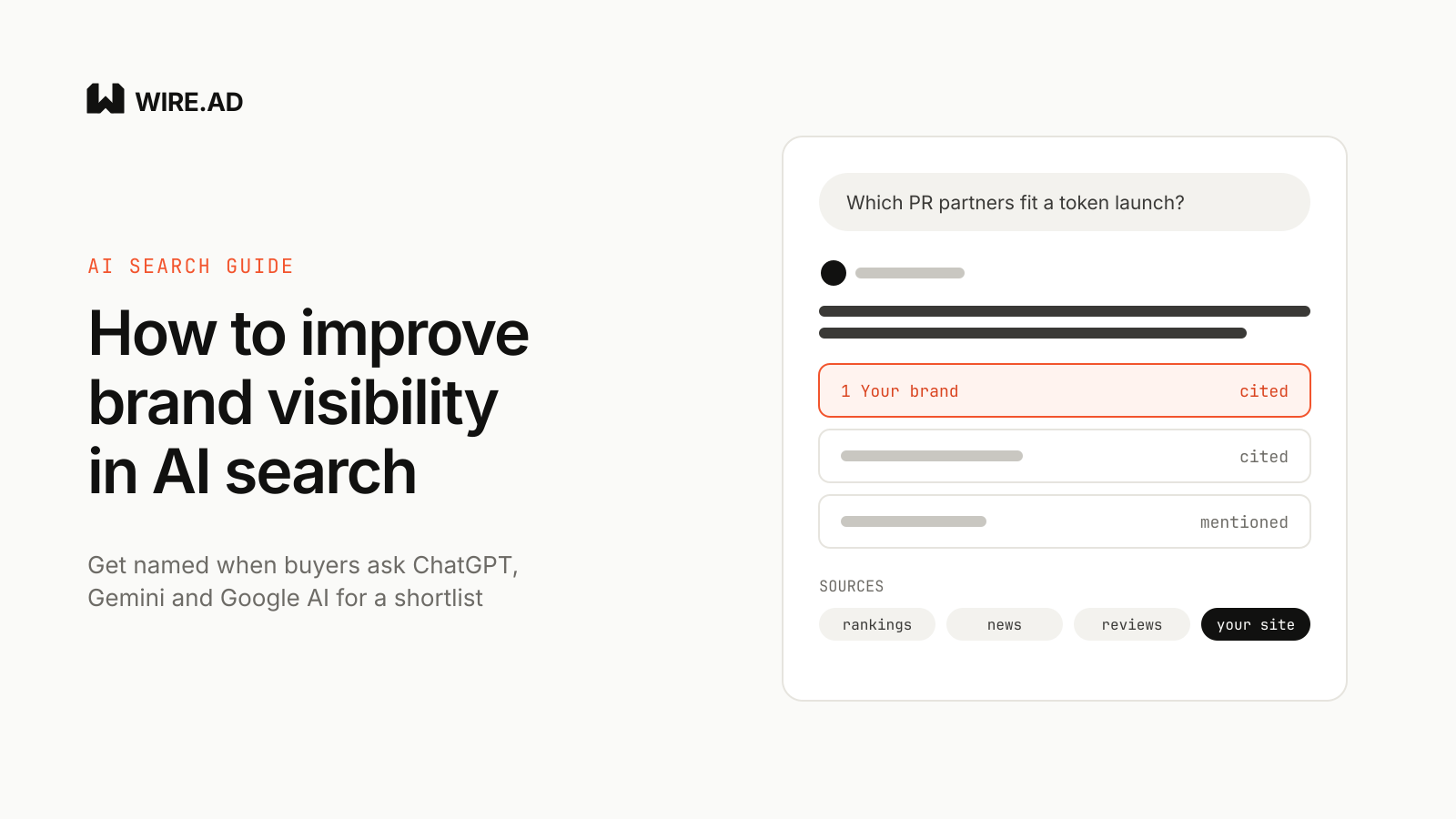
To improve brand visibility in AI search engines, four moves do most of the work. Let the crawlers that feed each assistant’s search in, earn mentions on the third-party sources those assistants already read, publish pages that answer a buyer’s question in the opening line with dated figures and named quotes, then measure the share of answers that name your brand before and after a campaign. Google documents “no additional technical requirements” for its AI answers, and OpenAI says there is “no way to guarantee top placement”.
How each AI assistant finds its sources
Google AI Overviews and AI Mode
Google’s position is that this is still search. A page has to be indexed and eligible to appear in Google Search with a snippet, and beyond that there are “no additional technical requirements” to be a supporting link in AI Overviews or AI Mode (Google Search Central). The optimization guide published in May 2026 says the generative features are “rooted in our core Search ranking and quality systems” and retrieve pages from the Search index (Google Search Central, May 2026).
Two mechanics matter for planning. Answers may use a “query fan-out”, issuing several related searches across subtopics before composing a reply, so the page that gets cited often answers a sub-question you never wrote for. And eligibility runs through Search Console: a site has to be included in Search generative AI features there, and the Generative AI performance report is where the resulting impressions appear. Crawl control is Googlebot’s robots.txt, with nosnippet, data-nosnippet, max-snippet and noindex to limit what is shown.
ChatGPT
ChatGPT search inclusion hangs on one crawler. Sites opted out of OAI-SearchBot “will not be shown in ChatGPT search answers”, though they can still appear as navigational links, and each bot setting is independent of the others, with changes taking about 24 hours to apply (OpenAI, bots documentation). GPTBot is the training crawler and a separate decision; ChatGPT-User fetches at a user’s request and does not decide what appears in search.
Retrieval is less tidy than the usual shorthand suggests. ChatGPT search rewrites the prompt into one or more targeted queries and sometimes partners with other search providers, Bing among them (OpenAI help center), which is not the same as running on Bing’s rankings. Across 15,000 long-tail prompts, 8.0% of the URLs ChatGPT cited in text sat in Google’s top 10 and 8.1% in Bing’s top 10, while about 80% did not rank in Google’s top 100 for the original prompt (Ahrefs, May 2025). Citations drawn from fan-out queries matched Google’s top 10 only 6.82% of the time (Ahrefs, September 2025). Any public website can appear, and referrals arrive with utm_source=chatgpt.com attached, which gives you one measurement signal for free (OpenAI, publishers FAQ).
Perplexity, Copilot and Gemini
Perplexity asks you to allow PerplexityBot and publishes WAF allow-list steps for Cloudflare and AWS, which is where most accidental blocks live; Perplexity-User is user-initiated and generally ignores robots.txt (Perplexity docs). Of the three big assistants it stays closest to classic rankings, with 28.6% of its citations in Google’s top 10 in the Ahrefs sample and 65% for short-tail results.
Bing Webmaster Tools opened an AI Performance report in February 2026 covering Copilot, Bing’s AI summaries and selected partner integrations, with total citations, average cited pages and grounding queries (Bing Webmaster blog, February 2026). Later additions include Citation Share, the percentage of citations your site holds for a given grounding query, and a Compare view built for before-and-after content updates (Bing Webmaster Tools help).
Gemini discovers pages through Google’s index. In Muck Rack’s analysis of more than 25 million cited links, Gemini cited sources in 82% of responses and averaged about eight citations, with Reddit as its largest single domain at roughly 2.4% (Muck Rack, May 2026). How many sources an answer carries differs by surface: AI Mode answers run 15 to 24 sources, AI Overviews 5 to 7 and Gemini 2 to 4 (Semrush AI data for the US market, May to October 2026).
Why mentions matter more than links
The strongest published correlate of being named in an AI answer is not a backlink. Ahrefs compared 75,000 brands against their AI Overview visibility and found branded web mentions at 0.664 on Spearman’s rank correlation, against 0.527 for branded anchors, 0.392 for branded search volume and 0.218 for backlinks (Ahrefs, May 2025). The distribution is lopsided: brands in the top quartile for web mentions averaged 169 AI Overview mentions against 14 in the next quartile, and 26% of brands had none at all. A later cut extended the pattern to ChatGPT and AI Mode, where web mentions correlated at 0.66 to 0.71 and YouTube mentions at about 0.737 (Ahrefs, December 2025).
Read those as direction, not physics. They are correlations, the samples lean toward established brands, and secondary analyses report an earlier cut at 0.65 for AI Overviews but 0.30 for Perplexity and 0.15 for ChatGPT, so the per-platform breakdown is unsettled (secondary analysis, September 2026).
What the mentions are matters too. Muck Rack put earned media at about 84% of AI citations, journalistic sources at about 27% and paid or advertorial content at 0.3% (Muck Rack, May 2026). The mix moves with the question: industry trend queries cited journalism in 46% of responses, more than twice the rate of how-to and comparative queries.
Hold on to one distinction. Being named in the answer is a mention; being the linked page is a citation. Only 6 to 27% of the most-mentioned brands also ranked among the top sources cited, depending on industry and platform (Semrush, September 2025). Mentions follow what other people publish about you. Citations follow what is indexed and retrievable when the question gets asked.
What makes a page citable
In controlled tests, three content changes moved visibility more than anything else. The GEO paper benchmarked rewrites across 10,000 queries and found that adding cited sources, quotations and statistics produced relative gains of 30 to 40% on its position-adjusted word count metric, while keyword stuffing gave “little to no improvement” and an authoritative tone “no significant improvement” (Aggarwal and others, arXiv 2311.09735, November 2023). Fluency and readability work added 15 to 30%, and the gains concentrated where you would want them: for a source ranked fifth in search results, citing sources improved visibility by 115.1% and adding quotations by 99.7%, whereas citing sources cost a rank-one source 30.3%.
Those are test-bench figures from 2023 and 2024, not a rule for the assistants you query today, and Google says you do not need to “write in a specific way just for generative AI search”. The two readings sit together without much friction, because dated facts, specific numbers and attributed quotes are what a journalist wants as well. Bing’s advice runs the same way: clear headings, tables and FAQ sections, claims supported by evidence, content kept fresh.
Freshness is measurable. Across 7,683 dated pages carrying 47,097 citations in ChatGPT, Gemini and Perplexity, 75% of cited pages had been updated within the last year and 88% within two, and it is the update that counts, since a quarter of the “fresh” pages were first published more than two years earlier (Seer Interactive, July 2026). An earlier cut showed different profiles per engine, with about 85% of AI Overview citations from 2023 to 2025 content against 71% for ChatGPT (Seer Interactive, June 2025). The same July 2026 study limits what updating your own pages can do: across four brands, roughly 2% of cited pages belonged to the brand itself, so recency is mostly an earned-media problem. Journalism citations peak in the first month after publication, and 57% of them were published within the previous twelve months (Muck Rack, May 2026).
Entity hygiene is the cheap part. Organization structured data on the home page helps Google disambiguate your company, and sameAs can point to your profiles on social and review sites (Google Search Central). Bing asks publishers to “align text, images, and video so they consistently represent the same entities”. Do not oversell it to yourself, because Google also states “there’s no special schema.org markup you need to add” for generative AI search.
Then keep one canonical page per announcement on your own domain. In an analysis of 4 million citations across ChatGPT, AI Mode, AI Overviews and Gemini, internal press releases and newsroom content made up 18.15% of ChatGPT’s citations against 2.98% overall (BuzzStream, February 2026).
Where crypto, fintech and AI answers draw from
Grouped by source type, the pages that answer your buyers’ questions are rarely your own.
- Third-party rankings and comparison pages. Listicles and best-platform pages are what a recommendation prompt retrieves, and in finance Google AI Mode leaned on comparison sites (Semrush, September 2025).
- Community threads. Reddit appeared in 176.89% of ChatGPT finance prompts, meaning more than once in an average answer (same study). Across 680 million citations gathered between August 2024 and June 2025, Reddit was the top-cited domain for AI Overviews and for Perplexity (an AI search analytics study, updated August 2025).
- LinkedIn. Reddit and LinkedIn both ranked among the five most-cited domains on ChatGPT, AI Mode and Perplexity (Semrush, November 2025). In fintech PR answers, LinkedIn was the top cited domain, appearing in 40% of answers (Semrush AI data for the US market, May to October 2026).
- Review platforms. Review sites were the fourth most-cited source in digital technology, at 20.04% in ChatGPT (Semrush, September 2025).
- Wikipedia. It was ChatGPT’s single largest source at 7.8% of citations in the same 680-million-citation study, and sat in the top three cited domains for 12 of 17 industries on ChatGPT against 3 of 17 on Gemini (Muck Rack, May 2026). Notability there follows independent coverage, so it is a result rather than a tactic.
- Company and agency sites. These win brand-definition prompts, the “what is X” and “is X legit” questions, where your own pages and newsroom are the natural answer (BuzzStream, February 2026).
Two cautions. The assistants do not share a source set: Muck Rack calls them “three effectively separate information environments”, and ChatGPT and Google AI Mode agreed on 67% of mentioned brands but only 30% of sources (Semrush, November 2025). The shares also move fast: ChatGPT cited Reddit in close to 60% of prompt responses in early August before falling to around 10% by mid-September in one 13-week sample (Semrush, November 2025). A review of 30 such studies warns that their headline percentages often measure different denominators (SSRN, September 2026).
For a crypto company the Google surface carries most of the weight, with Google AI Overviews accounting for 51 of 78 analysed crypto PR answers (Semrush AI data for the US market, May to October 2026). For a fintech, the company and founder LinkedIn presence is doing real work.
Where press releases fit
A wire release is a distribution step, not a visibility plan. Press releases accounted for 1.1% of AI citations in Muck Rack’s May 2026 data, down from about 6% in December 2025 and close to July 2025’s 1.2%, mostly because ChatGPT cited them less often. A separate count put newswire citations at 0.21% of its dataset and syndicated release copies at 0.04%, against 14.09% for news publications (BuzzStream, February 2026). In the US market, ChatGPT citations of the three big general wires fell between May and October 2026: PR Newswire from 139,222 to 75,952, Business Wire from 42,159 to 9,633 and EIN Presswire from 5,379 to 1,840 (Semrush AI data for the US market, May to October 2026).
A study run by a major wire operator with an AI-visibility analytics firm reported that 99.3% of more than 8,000 of its releases from one week in May 2026 were cited by ChatGPT or Claude, with an average of eight hours to first citation (wire operator’s own study, July 2026). It is vendor-funded, and it asked the assistants about each release’s own news. Both results hold at once, because one measures everyday buyer prompts and the other measures whether the record is findable when someone asks about that specific announcement.
So buy a release for what it demonstrably does. It puts a dated, crawlable record of the facts where an assistant can find it within hours of the question. It feeds trend-type questions, where about 1% of responses to industry trend queries contained a press release citation, roughly 3.5 times the rate for best-of questions (Muck Rack, May 2026). And it gives journalists and third-party sites something to write from, which is the part that produces the mentions that correlate with being named. Host it on your own newsroom as well as the wire, put the fact and the number in the first line, attribute every quote to a named person, and keep the company name and description identical to your site and profiles.
How WIRE.AD does it. The release is built as a record an assistant can quote: the confirmed fact and its number in the first line, a named person behind every quote, and one canonical page it points to. The report then shows each placement with its label and its role, so you see which part sets the record and which part reaches the people who write about you.
How to measure AI search visibility
Measure the share of answers, never the rank. SparkToro had 600 volunteers run 12 prompts 2,961 times across ChatGPT, Claude and Google’s AI and found under a 1-in-100 chance that two responses to the same prompt return the same brand list, with the same order closer to 1 in 1,000 (SparkToro, January 2026). Coverage of the work summed it up: “Repeat presence means something. Exact rank does not.” (Search Engine Land, January 28, 2026). Across 994 varied prompts in one category, leading brands still appeared in 55 to 77% of answers, which is why presence across many runs is usable when single runs are noise.
A workable routine:
- Write a fixed set of buyer-style questions per market in the wording a buyer uses, such as “What are the best platforms for crypto press release distribution?” and “What should crypto startups consider when hiring a PR firm?”. Add brand-definition prompts such as “What is [brand]?”.
- Run each prompt several times per window on each assistant you care about, keeping the wording and the market constant.
- Record three things: the share of answers naming the brand, the sources cited in those answers, and how the brand is described. Drop rank position.
- Take the baseline before the campaign and re-run the same set after it. Average change in prompt coverage ran at around 120% across the top 100 domains in one period (Semrush, October 2025), so read direction across several windows.
- Add first-party data: the Generative AI performance report in Search Console, AI Performance with Citation Share and Compare in Bing Webmaster Tools, and
utm_source=chatgpt.comreferrals in analytics.
If you want a reading before building any of that, the AI Shortlist Check is the free way to see where your brand stands in AI answers about your category.
Myths to skip
- llms.txt. Google says you do not need new machine-readable files for Google Search, and a file you publish “will neither harm nor help your site’s visibility or rankings in Google Search” (Google Search Central, May 2026). Of 137,000 sites, 28% published one and 97% of those files received zero traffic in May 2026, with no AI bot requests for files that did not exist (Ahrefs, March 2026). In a sample of about 300,000 domains, 10.13% had the file and dropping the variable improved the model’s accuracy (SE Ranking, September 2026). Google’s John Mueller puts the objection structurally: such a system “can’t trust what is here as a way of differentiating between different websites” (Search Engine Journal, June 2026).
- Special schema and chunking. Google: no special markup is needed, and “There’s no requirement to break your content into tiny pieces for AI to better understand it.”
- Keyword stuffing and an authoritative tone. Stuffing performed 10% worse than baseline on Perplexity in the GEO tests, and authoritative style produced no significant improvement.
- Buying mentions. Google says seeking inauthentic “mentions” across the web “isn’t as helpful as it might seem”, with spam systems applying to ranking and generative features alike. Paid and advertorial content was 0.3% of citations (Muck Rack, May 2026).
- A page per fan-out query. Producing content for every fan-out variant “primarily to manipulate rankings or generative AI responses” falls under Google’s scaled content abuse policy.
- “Rank first and ChatGPT will cite you.” Its overlap with Google’s top 10 is about 8% (Ahrefs, May 2025). Even AI Overviews have loosened: 76% of their citations ranked in Google’s top 10 in July 2025 (Ahrefs) against about 38% in a March 2026 update, with roughly a third at positions 11 to 100 and a third outside the top 100 (Ahrefs, March 2026).
- “Blocking GPTBot hides me from ChatGPT.” It does not, because OAI-SearchBot is the search setting. The real risk runs the other way: a blanket AI-bot block, or a CDN or WAF refusing OAI-SearchBot and PerplexityBot, takes you out.
- Google-Extended. As quoted in September 2026 reporting, Google’s crawler documentation says Google-Extended does not affect inclusion in Google Search and is not a ranking signal, since it governs Gemini app and Vertex AI training and grounding (reported September 2026).
- Tool dashboards as ground truth. Google: “No third-party tool has access to our internal ranking or AI systems.”
How WIRE.AD does it. Every paid placement is labeled sponsored and its links carry rel="sponsored", which keeps the campaign inside Google’s rules. Progress is read as the share of answers that name your brand, before the campaign and after it.
A 30-day plan
Days 1 to 7. Access and baselines. Check that robots.txt allows Googlebot, OAI-SearchBot and PerplexityBot, and that the CDN and WAF allow their published ranges, including the Cloudflare and AWS steps in Perplexity’s documentation. Verify the site in Search Console and Bing Webmaster Tools, include it in Search generative AI features, and save the current Generative AI performance and AI Performance reports as your starting point. Crawler setting changes take about 24 hours.
Days 8 to 14. Baseline prompt set. Fifteen to 25 buyer questions per market, each run several times on each assistant, recorded as share of answers naming the brand, sources cited and how the brand is described.
Days 15 to 21. Owned pages. For each question the prompt set exposed, one page that answers it in the opening line, with dated figures, their sources linked and quotes attributed to named people. One canonical newsroom page per announcement. Organization markup with sameAs pointing to the official profiles, and one name, one description and one logo everywhere. Update the pages you already have rather than adding thin new ones, since the update date is what the recency data tracks.
Days 22 to 30. Third-party surfaces. Pitch the data you hold to journalists who cover the beat, because earned coverage is the measured correlate. Get the brand onto the ranking and comparison pages your buyers’ prompts return. Keep company and founder LinkedIn profiles current, and answer questions in the communities where your category is discussed, under your own name. Then re-run the prompt set and compare windows rather than single runs.
Need to know whether a campaign changed anything? WIRE.AD measures the share of AI answers that name your brand before and after, with no citation guarantee.