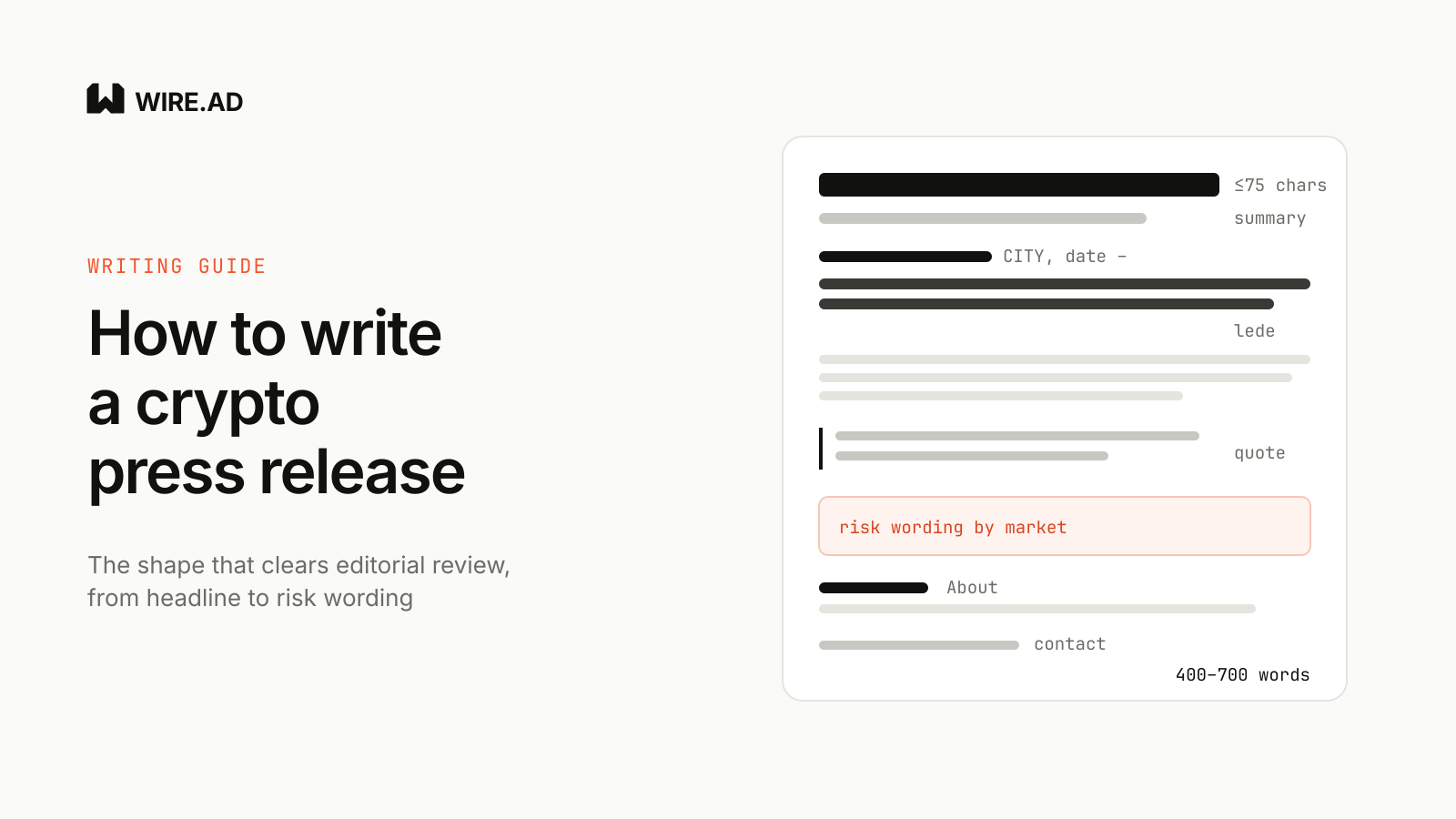
A crypto release that clears editorial review has a fixed shape: a headline naming your company and the news in under about 75 characters, a summary of one or two sentences, a dateline, a lede that carries the whole announcement, facts in two to four sentence paragraphs, one quote attributed by name and title, the risk wording your audience’s regulator requires, an About paragraph and a contact with a name on it. Keep the file between 400 and 700 words.
Press release length limits
Several crypto wires cap a submission at 700 words in total, and the cap counts the title, the opening summary and the About section. One crypto data site’s desk allows under 1,000 words on the same all-inclusive basis. Smaller crypto desks sit between 300 and 800 words, and one refuses anything under 400. General wires such as EIN Presswire ask for 300 to 800 words and warn that releases “overly short or long may have trouble being indexed” (EIN Presswire, editorial guidelines, December 2, 2025).
One window fits all of them: 400 to 700 words including the boilerplate, which in practice is a 450 to 600 word body plus the About paragraph and the contact block. Write to the widest limit you have found and the file comes back for cuts from the desk with the strictest one.
Supplier pages contradict each other, so work from the editorial policy and not the sales FAQ. One crypto wire that caps releases at 700 words on its policy page quotes 400 to 800 words in its FAQ, with 800 to 1,000 allowed on occasion. The policy page is the text the editor applies.
Headline, summary and dateline
The headline carries the company name, the verb of the news and the concrete object. Crypto desks put the ceiling between 60 and 80 characters: one asks for under 10 words or 75 characters, one for under 80, and one prefers 60 or fewer and edits headlines itself. The summary runs one or two sentences and stays under 150 characters at two desks, which also use it as the meta description. No exclamation points, no whole words in capitals, no clickbait, and no attaching your news to an unrelated story.
The source of the news has to be unmistakable. One crypto wire requires the headline to indicate the news and its source, and EIN Presswire “requires a clear news source to be identified in the headline” (EIN Presswire). When an agency distributes for a client, the client is the source.
The dateline follows one pattern: CITY, Region, Country, Month Day, Year, then an en dash and the first sentence. The city goes in capitals and the date is the issue date rather than the event date, a convention set out in a university reporting text (Kent State University, Reporting and Writing with the Audience in Mind).
Crypto press release structure
The order below is the consensus of crypto and general wire rules, and skipping an element is the most common reason a file goes back to the sender.
- Headline: source company plus the news, under about 75 to 80 characters.
- Summary: one or two sentences, under 150 characters at some desks.
- Dateline with the issue date.
- Lede that names the company and the announcement in full.
- Body in two to four sentence paragraphs, with every acronym explained on first use.
- One quote in quotation marks, attributed by full name, job title and company. A spokesperson quote with no name attached is refused.
- Risk and regulatory wording for the markets the release reaches.
- About paragraph.
- Media contact: name, position, email, and a phone number where the wire asks for one.
Formatting is part of acceptance. Desks reject tables, HTML tags, forced line breaks and non-standard characters, take a document file rather than a PDF, and want links as anchor text instead of raw URLs. Allow one link per 100 to 150 words, up to about five in total, with social links grouped at the end. Two desks accept links only to the official website and the official X account. Every link has to resolve at review time, so a site that is not live yet means removing the link or waiting.
Crypto press release template
[Company] [verb of the news] [concrete object]

[One or two sentences, under 150 characters, naming the company and what is new.]

[CITY], [Region], [Country], [Month Day, Year] – [Company], [one clause of plain
description], [announced what, with the date it takes effect].

[Paragraph 2: the facts a reader needs to act on. Numbers with their date and
source. For a launch: what users can do today. For a listing: pairs, deposit and
withdrawal times, trading start with the timezone. For a round: size, type, lead
investor, use of funds.]

[Paragraph 3: scope and mechanics. What is live, what is next and labeled as a
plan, which third parties are involved and have approved being named.]

"[One or two sentences on what the company is doing and why, with no
superlatives]," said [Full Name], [Job Title] at [Company].

[Paragraph 4: supporting detail. Audit report link, documentation link, token
terms with vesting and conditions stated plainly.]

[Risk and regulatory wording required for the markets this release reaches.
Use the exact text your jurisdiction prescribes.]

About [Company]

[Two to four sentences: what the company builds, where it is registered, who
uses it, and the official website.]

Media contact

[Full Name], [Position]
[email address]
[phone number]
[Official website] | [Official X account]
Count the words of the whole block, including the headline, the summary and the About paragraph, before you send it anywhere.
Language crypto desks reject
Two crypto wires share the same policy wording: objective language, free of advertising or hype, no superlatives or subjective adjectives, no exclamation points, no capitalized whole words, and no terms of direct address such as “you” or “we” outside a quotation. One crypto data site repeats it and adds that the body is written in the third person. EIN Presswire calls the same problems “hype flags” and lists “exclamation points; hyperbolic product/service claims” along with upper case characters (EIN Presswire).
Speculation is a separate ban. Desks refuse opinion-based statements, guaranteed profit claims, unrealistic return projections, misleading market statements and anything that reads as pump language. Yield promises and fixed APYs are refused outright at desks that run a legitimacy check on the issuer.
For a UK audience, the FCA’s finalised guidance pushes in the same direction: promotions have to be fair, clear and not misleading, avoid “exaggerated claims”, give a balanced view of risks and rewards, and keep facts and figures “accurate, up-to-date, and substantiated”. Past performance needs a warning that it “is not a reliable indicator of future results”, and features cannot be called guaranteed, protected or secure unless the Handbook conditions are met (FCA, FG23/3, November 2, 2023).
How WIRE.AD does it. Every file is edited to the rules of each desk it goes to: neutral third-person wording, facts in place of adjectives, and each figure confirmed with you before it goes live.
What journalists do with a press release
Cision’s 2026 State of the Media report surveyed 1,899 journalists across 19 markets. Two thirds, 66%, count material from PR teams among their top sources of story ideas, while 72% find a quarter or fewer of the pitches they receive relevant. Pitches get dropped for irrelevance (82%), for being too promotional or sales-focused (53%), for having no clear news angle (34%), for length (16%) and for carrying no contact for follow-up (8%). What they want more of: data or research (47%), embargoed or early access (45%) and access to experts (42%). Engagement comes from relevance to the beat (79%), a timely angle (35%) and credible data (33%). Half name accuracy and combating misinformation as their biggest challenge, and one respondent asked for “confirmed specs, real context (what’s actually new), clear embargoes” (Cision, 2026 State of the Media).
Muck Rack’s State of Journalism 2026, covering nearly 900 journalists, found 86% saying at least some of their stories start from a PR pitch and 88% immediately disregarding a pitch that misses their beat (Muck Rack, March 19, 2026).
The practical read: the release is the record, and the confirmed numbers, the date and a named contact belong in the first paragraph where a journalist on a deadline will find them.
Risk wording by market
Most crypto outlets attach their own line to a paid release, saying the content came from the client, that the outlet does not endorse it and that readers should do their own research. Mining and staking releases attract a longer standard disclaimer at some desks. None of that carries your own regulatory obligation, and the wording below is prescribed text that has to appear as written.
United Kingdom. The FCA’s cryptoasset financial promotions regime took effect on 8 October 2023 and applies to any firm marketing cryptoassets to UK consumers, including firms based overseas and regardless of the technology used. Websites, apps, social posts and online ads all count as promotions. There are four lawful routes: communication by an FCA-authorised person, approval by an authorised person, communication by an MLR-registered cryptoasset business, or an exemption under the Financial Promotion Order. Outside them, the promotion breaches section 21 of FSMA, “punishable by up to 2 years imprisonment, an unlimited fine, or both” (FCA, marketing cryptoassets to UK consumers). The prescribed warning under COBS 4.12A.11R(1)(d) reads: “Don’t invest unless you’re prepared to lose all the money you invest. This is a high-risk investment and you should not expect to be protected if something goes wrong.” In digital media it is followed by the linked text “Take 2 mins to learn more” (FCA, Cryptoasset Financial Promotions Instrument 2023; FCA press release). Older summaries still circulate the earlier high-risk-investment line “you are unlikely to be protected”; for cryptoassets the final wording is “you should not expect to be protected” (FCA, PS23/6). A shorter warning is permitted only where a third-party platform’s character limit is exceeded. The same regime bans incentives to invest, including refer-a-friend bonuses, imposes a 24-hour cooling-off period on first-time investors and requires an appropriateness assessment. Adding the warning to an otherwise unlawful promotion does not make it lawful.
European Union. Under MiCA Article 7(1), a marketing communication for a public offer or an admission to trading must be clearly identifiable as marketing, fair, clear and not misleading, consistent with the crypto-asset white paper, and must state that a white paper has been published along with the offeror’s website address, telephone number and email address. It also has to carry this statement: “This crypto-asset marketing communication has not been reviewed or approved by any competent authority in any Member State of the European Union. The offeror of the crypto-asset is solely responsible for the content of this crypto-asset marketing communication.” Where the person seeking admission to trading or the platform operator prepared it, that party replaces the offeror in the statement. Article 7(2) prohibits disseminating any marketing communication before the white paper is published, market soundings aside (ESMA, MiCA Article 7). The CASP regime applies from 30 December 2024, with a transitional period for existing providers running until 1 July 2026 at the latest and shorter in some member states; the rules for asset-referenced and e-money tokens applied from 30 June 2024 (ESMA, MiCA Article 143). In practice the release has to match the white paper on supply, dates and rights.
United Arab Emirates. VARA’s marketing rules cover all marketing in or targeting the UAE. It must be fair, clear and not misleading, clearly identifiable as promotional, and must not state or imply that investments are safe or low risk or that returns are guaranteed, imply that investment decisions are trivial, imply that past performance guarantees future results, or create urgency or a fear of missing out. Paid third-party content needs a clear and prominent notification of the arrangement. Marketing of a virtual asset must not include a call to buy, must carry a prominent disclaimer that virtual assets may lose their value in full or in part and are subject to extreme volatility, and must state that the owner or investor can lose all the money they invest and does not benefit from any form of financial protection (VARA Rulebook, marketing requirements). VARA’s own examples make the point that “Not financial advice. DYOR.” is not sufficient, and give a compliant version: “Not financial advice. Crypto is highly volatile and may drop in value significantly. You may lose the amounts you invest and your investments do not benefit from any form of financial protection.” The same guidance flags “don’t miss out on its bull run” as prohibited FOMO language (VARA, examples of marketing content in breach). Agencies marketing on a client’s behalf share liability, need the client’s approval before publishing, and marketing and its distribution details are kept for at least eight years.
United States. The SEC’s interpretation of 17 March 2026, joined by the CFTC, set out a taxonomy of digital commodities, collectibles, tools, stablecoins and digital securities, with Chairman Atkins stating that “most crypto assets are not themselves securities” (SEC, March 17, 2026). Marketing still decides a lot: “How an issuer markets and promotes a contract, transaction, or scheme is relevant” to whether an investment contract is being offered, and a non-security asset falls into that analysis when it is sold with representations or promises of essential managerial efforts from which buyers would expect profit (Federal Register, March 23, 2026). Corporation Finance staff guidance says promoting a system’s current utility and capabilities likely does not create such promises on its own, while a buyback announced for a system that is not yet functional can, where it is presented as creating yield or return for token holders (SEC, crypto asset FAQs, updated September 28, 2026). Section 17(b) of the Securities Act makes it unlawful to publicize a security for the issuer’s consideration “without fully disclosing the receipt… of such consideration and the amount thereof”. One SEC order describes an issuer that “announced, via a press release, that Seagal would endorse its ICO” and quoted him, where “Seagal’s quote in the press release did not disclose that he was being paid” (SEC, 2020); other touting settlements reached $250,000 (SEC, 2022) and $1.409 million (SEC, 2023). Separately, the FTC Endorsement Guides require material connections such as payment, free product or a business relationship to be disclosed “clearly and conspicuously” in a way that is “difficult to miss”, and reach advertisers and intermediaries including PR firms (16 CFR Part 255).
A disclaimer alone does not fix a promotional problem. IOSCO’s work on finfluencers records regulators finding promoters who “overly relied on disclosures and disclaimers”, including “a disclaimer falsely stating that they do not provide financial advice” while giving it (IOSCO). These regimes change, the obligation follows the audience a release actually reaches rather than where the company sits, and this guide is not legal advice: have counsel review the file before it goes to a regulated market.
How WIRE.AD does it. Each version carries the prescribed wording for the market where it runs, placed beside the outlet’s own disclaimer, and every paid placement is labeled sponsored. Your counsel signs off on the final file.
What each announcement has to contain
Token launch or TGE
Token name, ticker, chains, contract address, total supply and launch-day circulating supply, plus distribution and vesting stated factually with conditions and limitations spelled out, which one general wire requires explicitly. Say what the token does in the product today and leave future value out of it. For an EU offer, publish the white paper first, link it, give the offeror’s website, phone and email, and carry the Article 7(1)(e) statement. For a UK audience, you need a lawful route and the prescribed warning, with no incentives to buy. For the UAE, the VARA disclaimer and no call to buy. Out: price targets, return figures, guaranteed listings, false urgency, misleading fundraising figures, and audit claims where no public report exists. Name the auditor only when you can link the report. Presales are refused outright at several crypto desks, and one asks for a legal opinion and token disclosure before it will look at one.
Exchange listing
The exchange announces first. One large exchange’s listing terms treat any announcement by the client before its own official release as a breach, and reserve the right to change the listing time unilaterally. Take the values from the exchange’s own notice and keep them identical: deposit and withdrawal start, available trading pairs, trading commencement date and time with the timezone, and fees. Naming the exchange needs its written permission, as does naming any third party at the desks that check. One crypto data site accepts a release only when the token it names is already listed there, and some general wires require a tracked listing on a major aggregator.
Funding round
Round size and currency, round type, lead investor and participants, valuation only where it has been disclosed, use of funds and the close date. Every named investor confirms in writing, and one general wire requires authorization for fundraising and investment news to come directly from the third party rather than as a forwarded screenshot. If tokens formed part of the round, keep language away from anything implying holder returns. One large self-serve wire does not accept funding announcements at all and refers them to full-service membership.
Product or mainnet launch
Date live, network, what users can do today, verifiable metrics with their date and source, the audit link and the documentation link. Avoid fastest, first or only without a benchmark you can cite. Separate shipped features from the roadmap and label plans as plans, which is what desks mean when they ask for confirmed facts to be kept apart from future ones.
Partnership or integration
The partner approves the text in writing, and logo or ticker use needs written authorization at one general wire. State the scope: what is integrated, when it goes live and who uses it. Give the partner quote a name, a title and a company. Do not reference or imply an endorsement by any government, regulator or financial authority.
Why crypto press releases get rejected
- No news in it. One general wire denies a document whose primary purpose is to sell with no other newsworthy element, and journalists reject the same thing as too promotional or lacking a news angle.
- The release promotes a token as an investment. Two crypto wires refuse content promoting any token or crypto asset, or giving advice or recommendations on an investment product.
- Price predictions, return figures, yield promises or guaranteed listings.
- Hype language: superlatives, exclamation points, capitalized words, “you” and “we” outside quotes.
- Over the word or character limit, or the wrong image. Desks ask for one image per release at 1200x720, 1280x720, 1200x600 or 1280x675 depending on the desk, usually 16:9, with margins so nothing crops and no charts illustrating income or profit.
- Too many links, broken links, raw URLs, or links to anything other than official properties. An abnormally high number of inbound links can get a release pulled after publication.
- A third party named without written permission, which covers partnerships, deals, acquisitions and fundraising.
- Missing or unverifiable contact details, or an anonymous team. Crypto and NFT issuers are asked for verifiable contacts and a postal address at one general wire.
- Unverifiable claims about audits, metrics or partners.
- Duplicated, templated or previously distributed text, and content that appears to be produced entirely by automated systems.
- Excluded categories: cloud mining, mixers, gambling, scam recovery, forex bots and content about unresolved legal disputes.
- Formatting the desk cannot use: tables, HTML, forced line breaks, PDFs.
Frequency matters too. One desk takes one release per entity or event per week, another one per partner per month, and a release may be distributed only once at a general wire.
How WIRE.AD does it. Each draft is checked against these points and against every desk’s own limits before it is sent, so the file that reaches the editor is one they can publish as it stands.
Questions to ask before you pay for distribution
- Which placements are guaranteed by name, and which part of the count is automatic reposting?
- What label will readers see on the page, and what
relattribute will the links to your site carry? - What are the exact limits: word count, headline and summary characters, image size and ratio, number of links?
- Does an editor review before publication, is one revision round included, and what happens to the fee if the release is rejected?
- Which disclaimer does the desk attach, and does it sit alongside the wording your own jurisdiction prescribes rather than replacing it?
- Who has to approve each third-party name in the text, and by when?
Draft ready and no plan for where it goes? Send the file and the markets it has to reach, and WIRE.AD comes back with a fixed-price package, the channels and the label on each placement.