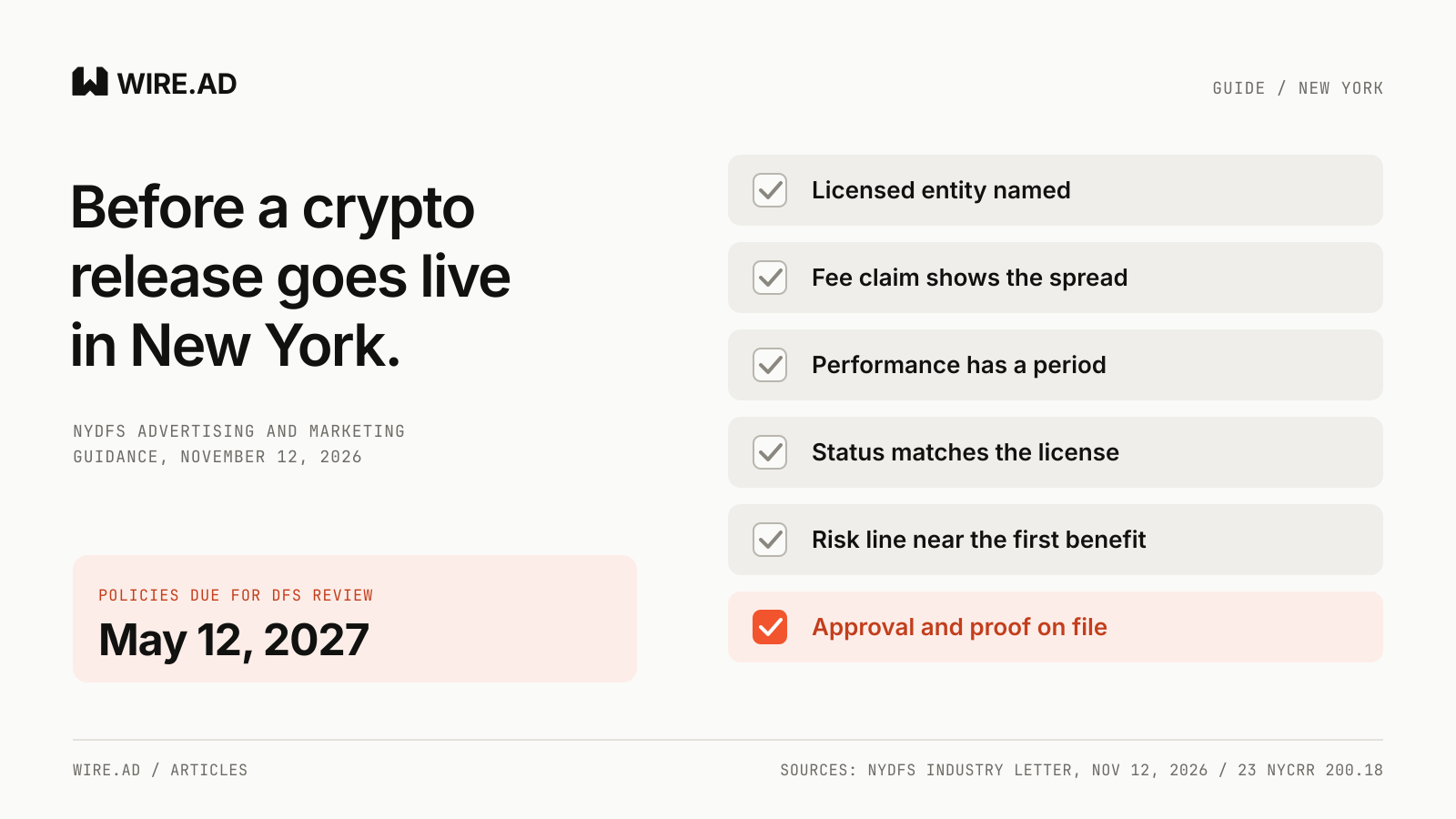
The NYDFS crypto advertising guidance, issued on November 12, 2026, tells every BitLicensee and New York limited purpose trust company in virtual currency to put board-approved policies behind its marketing, with evidence kept for each claim and secondary review of each piece. Its definition of marketing material is wide enough to take in a launch release that promotes a product, so it is safest to give the release the same review as an ad.
What the NYDFS guidance covers and when it applies
The guidance came as an industry letter from Acting Superintendent Kaitlin Asrow, addressed to virtual currency entities licensed under 23 NYCRR Part 200 or chartered as limited purpose trust companies. The Department calls them VCEs. A company that holds neither is outside its direct scope, though the letter still shows how New York reads a crypto promotion.
Two dates appear. The press release says VCEs should update their policies “by May 10, 2027.” The letter itself says that “effective May 12, 2027, policies and procedures consistent with this Guidance must be available for Departmental review.” Plan for the earlier one.
The policies need approval from the board or a designated board subcommittee every year. The Department says it will check them “through examinations and supervisory monitoring.”
The old rule still stands. Since 2015, 23 NYCRR 200.18 has required licensees to carry their name and the legend “Licensed to engage in Virtual Currency Business Activity by the New York State Department of Financial Services” in advertising aimed at New York, and has barred false or misleading statements by the licensee “and any person or entity acting on its behalf.” The letter sits alongside that rule, says it does not limit any law or regulation, and points back to 200.18 for record keeping.
Does a press release count as marketing material
The letter never uses the term “press release.” It defines “Materials” instead, and the definition is wide: “any content produced or distributed by a VCE or on its behalf that could reasonably be viewed as promoting or inducing engagement” with its crypto products, services or activities.
Two phrases settle most launch questions. The definition applies “regardless of how the content is labeled,” and it names “education” as one such label. It also applies regardless of channel, listing websites, blogs, social media, newsletters and presentations.
A release announcing a new trading pair, a yield product or a card launch invites people to use the product. Calling it news is unlikely to move it outside the definition on its own. A release about a hire or an office opening is a closer call, and your counsel should make it.
Our reading: treat any product release as Materials, so the claims, disclosures and review steps apply to it and to every outlet version and sponsored placement that carries it.
Claims a launch release has to prove
The letter’s standard is short: claims “must be a fair portrayal of the products, services, or activities and be evidence-based and verifiable.” It then gives examples of content that an internal review should catch, and three of them matter for launch copy.
Fees come first. The Department warns against “highlighting the absence of one charge (e.g., “no-fee trading”) while omitting other costs borne by the customer, such as spreads or markups.” A headline that says zero fees should not leave out the spread or other costs, and stating them close to the claim is the simplest way to avoid that.
Performance figures are next. The letter gives “misstating or omitting time periods and results from subsets of a portfolio” as an example of a misleading performance claim. If a release cites a return, it states the period and what the figure covers.
Regulatory status is the third. The letter covers representations about status “whether express or implied,” including any person’s or company’s licensure. Phrases such as “fully regulated” or “approved in New York” need to match the exact license the firm holds and the entity that holds it.
Write each claim with its proof beside it in the draft. The letter expects firms to keep “evidence to support any factual claims,” so save the proof for each claim in a form that can be kept on file, such as a dated export or report.
How WIRE.AD does it. Every fact in the release is confirmed with the client before it goes live, including the fee wording, any performance figure and the license line. The risk wording is then written for each market the release runs in.
Where the risk disclosure goes in a release and its sponsored versions
“Disclosures must, in all cases, be clear and conspicuous,” the letter says. The letter expects any material that mentions benefits to also give “a balanced discussion of its risk” and to avoid any statement that “could reasonably be interpreted as a promise of financial gain or guarantee against loss.”
Placement matters as much as wording. The Department gives two examples of disclosures that fail: risks mentioned only at the end of a podcast after a long discussion of benefits, and risks that a website or social post hides behind a “click for more” link. A press release with the benefits in the lead and the risk text only in a boilerplate block at the bottom looks a lot like the podcast example.
In practice, put a plain risk sentence in the body near the first benefit claim. Name the licensed entity that provides the product, since the Department says the VCE providing the product “must be clearly identified,” and the letter refers to “the properly licensed or chartered VCE.” Keep the language simple enough for a general reader.
Testimonials get two specific tests. If a release quotes a customer, the letter expects it to state conspicuously that the experience may not be representative of other customers. If anyone was or will be paid for the testimonial, directly or indirectly, the letter expects “the nature and amount of compensation” to be stated conspicuously too. The letter speaks only of customer testimonials, but partner quotes in a joint release are worth the same check.
Paid placement raises its own label question. Sponsored articles and paid distribution are content distributed on the firm’s behalf, so when they promote a product the definition covers them. The letter sets no labeling format. Our own practice is that a reader should see a piece was paid for and its links should be marked as paid. Our guide to sponsored links in press releases covers the link rules.
How WIRE.AD does it. Each outlet gets its own version, and every placement is labeled Sponsored or Press release with rel=“sponsored” links.
Approvals, records and third-party promoters
The governance part of the letter is where launch teams will feel most of the work. It expects defined roles, a formal review “including appropriate secondary review,” and records that “ensure the maintenance of evidence to support any factual claims” along with “copies of all approvals of Materials.”
The record rule was already strict. Section 200.18 requires licensees to keep all advertising and marketing materials “for a period of at least seven years from the date of their creation,” including website captures of material changes. When a release runs on many sites, each in its own version, it helps to match every version to the copy that was approved.
Outside help is covered too. The letter expects “due diligence” on the selection and retention of third-party promoters and monitoring of what they do. Depending on the arrangement, agencies, distribution services, creators and newsletter sponsors can fall under that heading. Before a campaign, ask each one how it shows you what was published, where and when.
The letter also asks firms to watch for “impersonation accounts and unauthorized promotional schemes” that use their brand. Keeping the list of real placements with the campaign file makes a fake promotion that uses the brand quicker to check.
How WIRE.AD does it. The report lists every placement with its link, so your team can keep it next to its own record of what was approved. Thirty days of corrections are included if a figure needs fixing after publication.
A New York crypto launch checklist
Use this as a working list before any product release reaches a reader in New York. It covers the points above, not every requirement:
- Entity: the licensed or chartered entity that provides the product is named. A BitLicensee advertising in New York also carries the 200.18 legend; a chartered trust company states its charter status instead.
- Fees: any “zero fee” or “low fee” line also states the spread or other costs, ideally right next to it.
- Performance: every figure has its period and scope.
- Status: each license claim matches the entity and the regulator’s wording.
- Risk: a plain risk sentence appears in the body near the first benefit.
- Quotes: customer quotes say they may not be representative, and the nature and amount of any past or promised payment is stated.
- Labels: sponsored versions are marked as paid, with rel=“sponsored” links.
- File: proof for every claim, the approval record and the final placement list are saved.
For launches that also run in the UK, the EU or Dubai, the crypto marketing rules by country guide lists what changes market by market.
Launching a crypto product with New York users in scope? Send the draft and the claims you want to make. You get a fixed-price proposal for crypto press release distribution, with every fact confirmed with you before anything goes live.