A press release headline that holds up in search names the company and the news in the first few words, runs about 51 to 60 characters, and appears the same way in the page’s title tag, its H1 and its og:title on every outlet that runs it. Google builds the title a buyer sees from several parts of the page.
It changes titles that are vague, boilerplate or out of step with the page, and one vendor study found it rewrote most titles that were very long or very short. A headline written for that process is the one most likely to reach the reader, and the AI answers that read the same pages, in the words you approved.
Google assembles the headline buyers see
The headline you send is an input. Google calls the clickable line in a result a title link, and its documentation says the process is “completely automated and takes into account both the content of a page and references to it that appear on the web.” The same title link shows on other Google properties, Google News among them.
Google lists nine sources for it: the <title> element, the main visual title on the page, heading elements such as the H1, the og:title meta tag, other large and prominent text, other text on the page, anchor text on the page, the text of links pointing to the page, and WebSite structured data. The og:title entry was added in August 2024.
For a release, that list matters because one announcement lives on many pages. Each outlet that runs it has its own template, its own title tag and its own heading styles. One adds its site name in brackets, another puts a category label in bigger type than your headline. Google picks page by page, and its documentation says that when a page has “more than one large, prominent heading,” it “may use the first heading as the text for the title link.”
Rewrites are common. In Zyppy’s 2022 vendor study of 80,959 title tags on 2,370 sites, Google showed a different title for 61.6% of them in desktop results. Many changes were small, but it is the most detailed public measure we found of which title shapes Google leaves alone.
There is also a newer layer. In March 2026 Google confirmed to The Verge a “small” and “narrow” experiment that used generative AI to replace headlines in Search results, “not specific to news publications.” Its stated goal was to “identify content on a page that would be a useful and relevant title to a users’ query.” In one example The Verge cited, a headline that ended in a negative verdict on an AI tool was cut to five words that, in the publication’s words, “almost sounds like we’re endorsing” it. Google said that a launch based on the test “would not be using a generative model.” We found no later announcement of a wider rollout, and the title link documentation does not mention generated titles. Before you approve a headline, cut it after the first six words and check that what is left still states the news correctly.
How WIRE.AD does it. Facts are confirmed with the client before publication, and each outlet gets its own version. Every version comes with an SEO title and description written from the confirmed facts, so the copy each outlet receives carries the wording you approved.
Keep the title tag to 51 to 60 characters
Length is the cause of rewrites you control most directly. Google’s own guidance gives no limit and says the title link is “truncated in Google Search results as needed, typically to fit the device width.” The Zyppy data shows where the trouble starts.
- Titles over 70 characters were rewritten 99.9% of the time.
- Titles over 60 characters were rewritten more than 76% of the time.
- Titles of 20 characters or fewer were rewritten more than half the time; very short ones were usually padded with extra words.
- The 51 to 60 character range had the lowest rewrite rate, 39% to 42%.
So a 90-character headline that reads well in a pitch email will almost never show in search as written. The on-page headline can run longer, as long as its first 50 or so characters carry the company and the event.
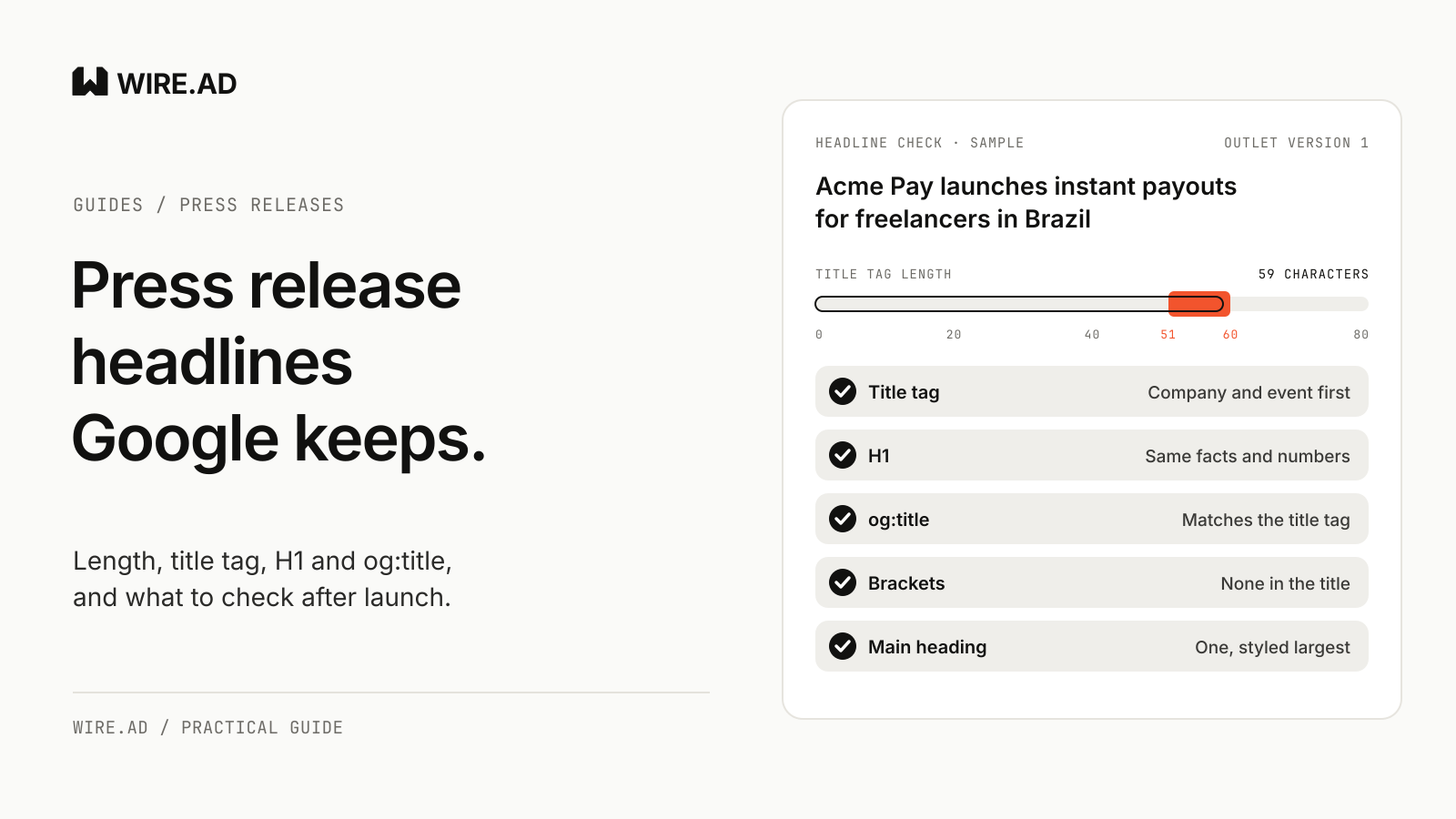
“Acme Pay launches instant payouts for freelancers in Brazil” is 59 characters. It names the company, the product and the market. “Acme Pay Unveils Revolutionary Next-Generation Payment Experience” says less and is longer.
How WIRE.AD does it. Every package includes an SEO title and description for each outlet version. The longer headline stays on the page, where readers have room for it.
Use one headline across title tag, H1 and og:title
The second cause is a mismatch between the parts of the page Google reads. If the title tag says one thing and the H1 says another, Google has a reason to choose, and it may use the visible heading instead.
Zyppy measured this with numbers in titles. When the title tag held a number and the H1 did not, Google showed a title without the number 25.8% of the time. When both held the number, Google kept a number in the title 97.3% of the time. For a funding round, a user count or a token supply, that gap is the difference between “Acme Chain raises $12M” and “Acme Chain raises seed round” in the result a buyer reads.
The og:title is the third piece. The Open Graph protocol defines it as “the title of your object as it should appear within the graph,” and Google now lists it among its title sources. Outlet templates set it in different ways, so ask your distributor which title tag and og:title each outlet will publish.
A clean release version has:
- A title tag of 51 to 60 characters with the company and the event.
- An H1 that matches it or extends it without changing the facts.
- An og:title with the same words as the title tag.
- One heading styled as the main title, with category labels and outlet slogans in smaller type.
How WIRE.AD does it. Every live page is audited for its label, links and risk wording, and the report lists each placement with its label, level and role in the package.
Put the news first and keep the brand short
Google’s guidance on branding is direct: put the site name “at the beginning or end of each <title> element, separated from the rest of the text with a delimiter such as a hyphen, colon, or pipe.” Outlets add their own name this way, and that name comes out of your character budget.
The punctuation affects survival too. In the Zyppy sample, titles with square brackets were rewritten 77.6% of the time, and Google dropped the bracketed text entirely in 32.9% of cases. Parentheses fared better, with the text removed 19.7% of the time. Pipes were removed or replaced 41.0% of the time and dashes 19.7%. A headline like “[Press Release] Acme Chain lists ACME token on two exchanges” puts the least useful words where Google is most likely to cut them, and the label belongs on the page anyway, next to the headline.
Word order is the other half. When a title link is truncated to fit the screen, the end goes first. Put the company and the event at the start, and the qualifier after it: “Acme Chain opens staking for ACME holders in the EU” survives being cut at the word “holders.” A headline that opens with “In a major milestone for the industry” loses the news first.
How WIRE.AD does it. Every paid placement is labeled Sponsored or Press release on the page itself. Our guidance for SEO titles is to lead with the company and the event. Labels and risk wording sit in the body, never in the title.
Headlines for crypto, fintech and AI announcements
Regulated announcements add a second test. The headline is the line most often quoted alone, in a title link, a link preview or the source list under an AI answer, so it has to be accurate without the paragraph that qualifies it.
A few patterns cause problems in this niche:
- A headline that says “approved,” “licensed” or “registered” needs the exact status and the regulator, because a trimmed title can drop “applies for” and leave the company name next to the regulator’s. Write the status the filing supports, in the first half.
- Yield, return or price language in a token headline turns a news line into a promotion in several markets. Keep the event (a listing, a mainnet date, an audit) and leave performance out of the headline.
- “First,” “largest” and “leading” claims need a source in the body, and in a headline they rarely survive a rewrite with their qualifier attached.
- AI launch headlines often name a model or benchmark. Name the product and what it does first. The benchmark can sit in the subhead.
Our crypto guide on how to write a crypto press release covers the full release shape and the risk wording by market. The headline rule here is narrower. Read the first half of your headline alone; if it overstates the filing or the product, rewrite it before it goes out.
How WIRE.AD does it. Each version carries risk wording where needed, and the buyer’s claims are attributed to the buyer. Every paid placement is labeled. The same rules apply to crypto press release distribution orders.
Check what searchers and AI answers show after launch
Google has to recrawl a page to notice a changed title, which “may take a few days to a few weeks.” Checking on launch day tells you what the outlet published. Checking a week later tells you what Google chose to show.
Search each outlet URL and compare the title link with the headline you approved. When they differ, look for the cause in Google’s list: a mismatched H1, a missing title tag, a second large heading, a site name that took up the space. Send the mismatch to your distributor or the outlet; some can fix the title tag in their CMS, others cannot.
The same check applies to AI answers. Ask an assistant the question a buyer would ask about your launch and see which page it cites and how it names the event. If the cited page has a trimmed or wrong title, that is the outlet version to fix first. Our AI visibility service measures this before and after a campaign, and it promises no citations. The free AI Shortlist Check shows how an AI assistant answers five buyer questions in your category today.
How WIRE.AD does it. With the AI visibility service, AI answers are measured before placements go out and again four to eight weeks later, on the same questions. Every package includes 30 days of corrections: if your facts change after launch, the live pages are updated.
A press release headline checklist
- The company name and the event sit in the first 50 characters.
- The title tag runs 51 to 60 characters, including the outlet’s site name.
- The H1 and og:title carry the same facts and numbers as the title tag.
- No brackets around labels or dates; labels sit on the page next to the headline.
- Status words such as “approved” or “licensed” match the actual filing.
- No yield, return or price language in a token headline.
- One main heading per page, styled larger than any category label.
- Every outlet URL is searched a week after launch and compared with the approved headline.