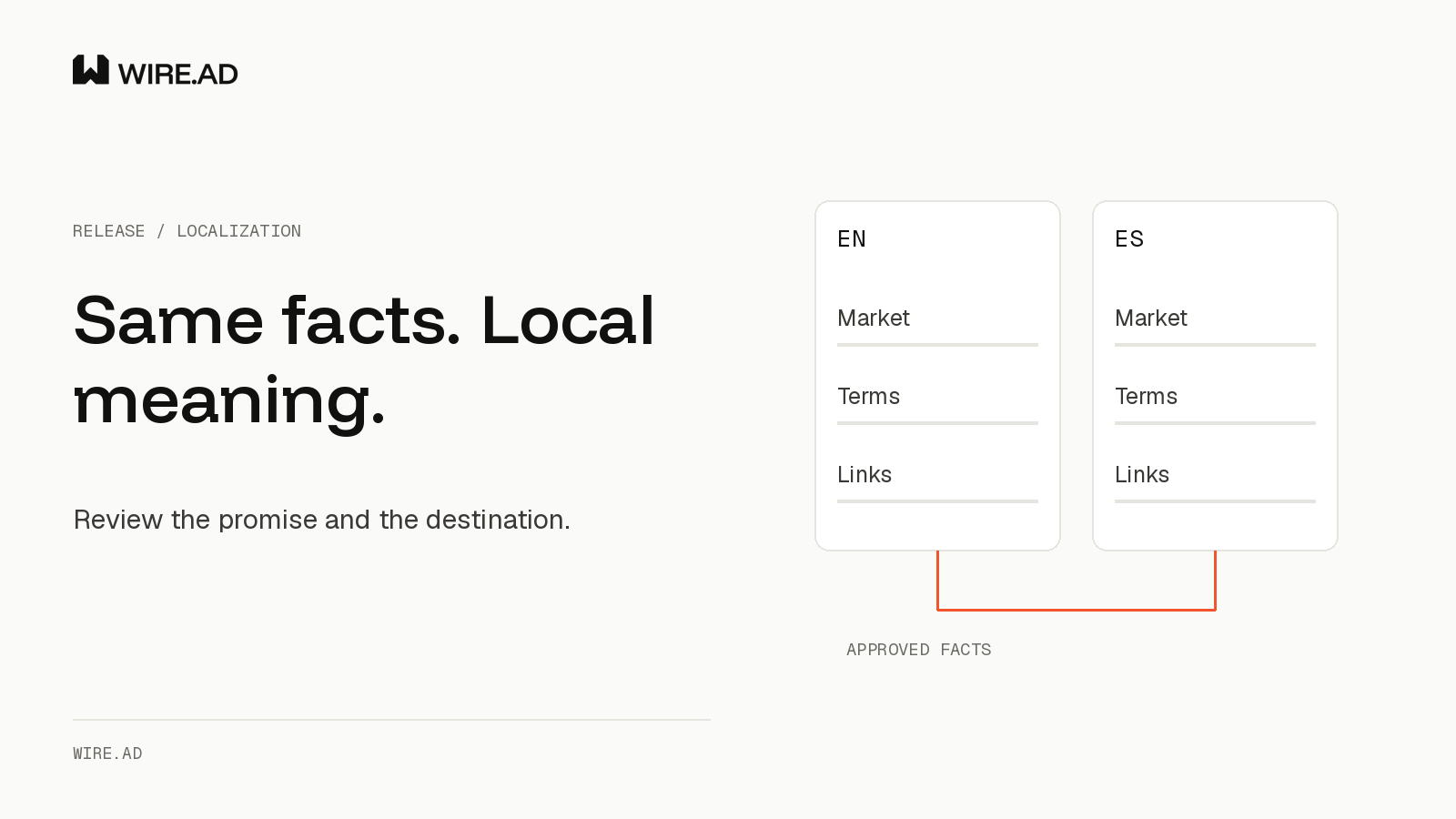
Press release localization starts with the market-specific facts: who can use the product, which terms apply and where the reader should go next. A fluent translation can still send someone to an unavailable signup page or turn a limited pilot into a general launch.
Treat each language version as a separately approved publication built from the same evidence. The workflow below is an editorial checklist for preparing those versions, with technical checks drawn from W3C and Google Search Central guidance.
Define the reader and market before translation
Write a short locale brief before assigning the text. Specify the target language, intended market, audience and purpose of the announcement. Spanish for a general international readership and Spanish for a product available only in Mexico require different availability wording.
Keep language and eligibility in separate fields. A reader choosing English does not become eligible for a US-only product. A company offering a Spanish page has not necessarily launched across every Spanish-speaking market.
Ask the product owner to approve the market statement and the destination page together. If the product is accepting applications, say that. If access requires an invitation, preserve that condition in the headline, opening and CTA wherever it matters.
The fintech announcement brief covers the underlying product and permission questions. Localization carries those approved answers into each version.
Freeze the facts that every version must preserve
Give the translator an approved source text and a compact fact sheet. Mark product names, legal entity names, quoted figures, units, eligibility restrictions and release stages as facts requiring confirmation before a change.
Include a terminology list with the preferred translation and a short explanation. A literal equivalent of “account,” “wallet” or “settlement” may describe a different product in the target market. When a term has a legal or regulated meaning, route it to the person responsible for that market.
Record ambiguous source language before translation begins. “Available next month” needs a confirmed month or release window. “Worldwide” needs an actual availability list. Resolving ambiguity in the source avoids asking each translator to invent an interpretation.
A useful handoff contains the approved copy version, fact sheet, glossary, destination links, image files and the names of the factual and language reviewers. Keep that packet alongside the press release source pack.
Review commercial details in their local context
Check each monetary amount with its currency and billing basis. A dollar symbol on its own can be unclear. Changing the display format should preserve the actual amount and currency; a localized price requires commercial approval.
Write dates so the intended day is clear to the reader. Where timing is material, include an agreed time zone. Check that the translated release, landing page and signup flow describe the same availability window.
W3C’s internationalization quick tips recommend supporting local formats and reviewing images and examples for cultural suitability. They also advise supplying graphics with editable text and allowing for text expansion.
Apply those principles to the release package: keep the source graphic, translated text layer and final export together. Ask the local reviewer to check the actual crop, including small captions and any qualification attached to a number.
Approve meaning after the first translation
Separate the language review from factual approval. A language reviewer checks whether the copy sounds natural and says what the source intended. A product or market owner confirms that the published promise matches the service readers can access.
Review high-risk passages together: the headline, opening, quoted statements, availability paragraph, pricing, eligibility and CTA. Then inspect the remaining body for consistency. A qualification preserved in one paragraph can still disappear from a headline or image.
Use back-translation as a diagnostic when a passage is difficult to assess. Ask a second reviewer to explain the translated meaning in the source language, then compare it with the approved claim. A matching back-translation is useful evidence for review, not automatic approval.
Keep a short record of substantive changes. If the local reviewer replaces “launch” with “invitation-only pilot,” confirm whether the source version also needs correction before either version goes live.
Give each version a usable destination
Open every product, signup, terms and contact link from the translated release. The destination should let the intended reader complete the action described. Record language limitations when an important destination exists only in another language.
For a company-owned multilingual announcement, Google recommends separate URLs for language versions. It also advises giving users links to choose another version and avoiding automatic language redirects.
That is a publishing choice for the company and its web team. A distribution buyer should ask each outlet how it handles language versions and which public URL will appear in the delivery record. Agreement to publish a translation does not establish the outlet’s search configuration.
For downloadable files, verify that the link opens the intended language and approved version. The HTML and PDF checklist explains how to keep the public page and download consistent.
Check language markup and search annotations separately
W3C’s HTML language guidance recommends declaring the default text language on the html element and marking passages in another language where appropriate. Text direction is a separate setting; language markup alone does not establish a right-to-left layout.
Google’s localized-version documentation describes hreflang annotations for related language or regional URLs. Each version should reference itself and its alternatives, with reciprocal links. Google supports HTML, HTTP-header and sitemap implementations.
Ask the responsible web team to validate the chosen implementation on the rendered public pages. Language declarations, alternate-version annotations and canonical URLs serve different purposes. A translated headline alone does not prove that those settings are correct, and correct annotations do not guarantee search visibility.
Use a locale handoff sheet
For each version, keep one record with these fields:
- Target language and market, plus the intended audience.
- Approved source-copy version and the matching translated version.
- Availability, eligibility, currency and date wording.
- Local reviewer and factual approver, with approval tied to that version.
- Final image, caption, alt text and destination links.
- Public release URL, related language URLs and any unresolved limitation.
For example, a hypothetical payments company may announce a merchant pilot in Mexico in English and Spanish. Both versions should retain the pilot stage and merchant eligibility. The Spanish headline can read naturally without implying a consumer launch or availability elsewhere.
If the Spanish signup page is unfinished, the approval decision must address the actual reader journey. The team can finish that destination, change the CTA to an accurate contact route or hold the version. Translating the button while retaining an unusable destination leaves the launch incomplete.
Verify each public version after release
Read the published headline and opening, follow the CTA, inspect the image and switch between languages using the public navigation. Check the text shown in link previews as well as the article body.
Save the actual URLs and identify any version needing a correction. If a fact changes later, locate every affected language version and send a precise correction request for each one.
Before buying multilingual distribution, ask who approves local meaning, who verifies the destination pages and how corrections reach every language version. Put those responsibilities in the campaign brief.