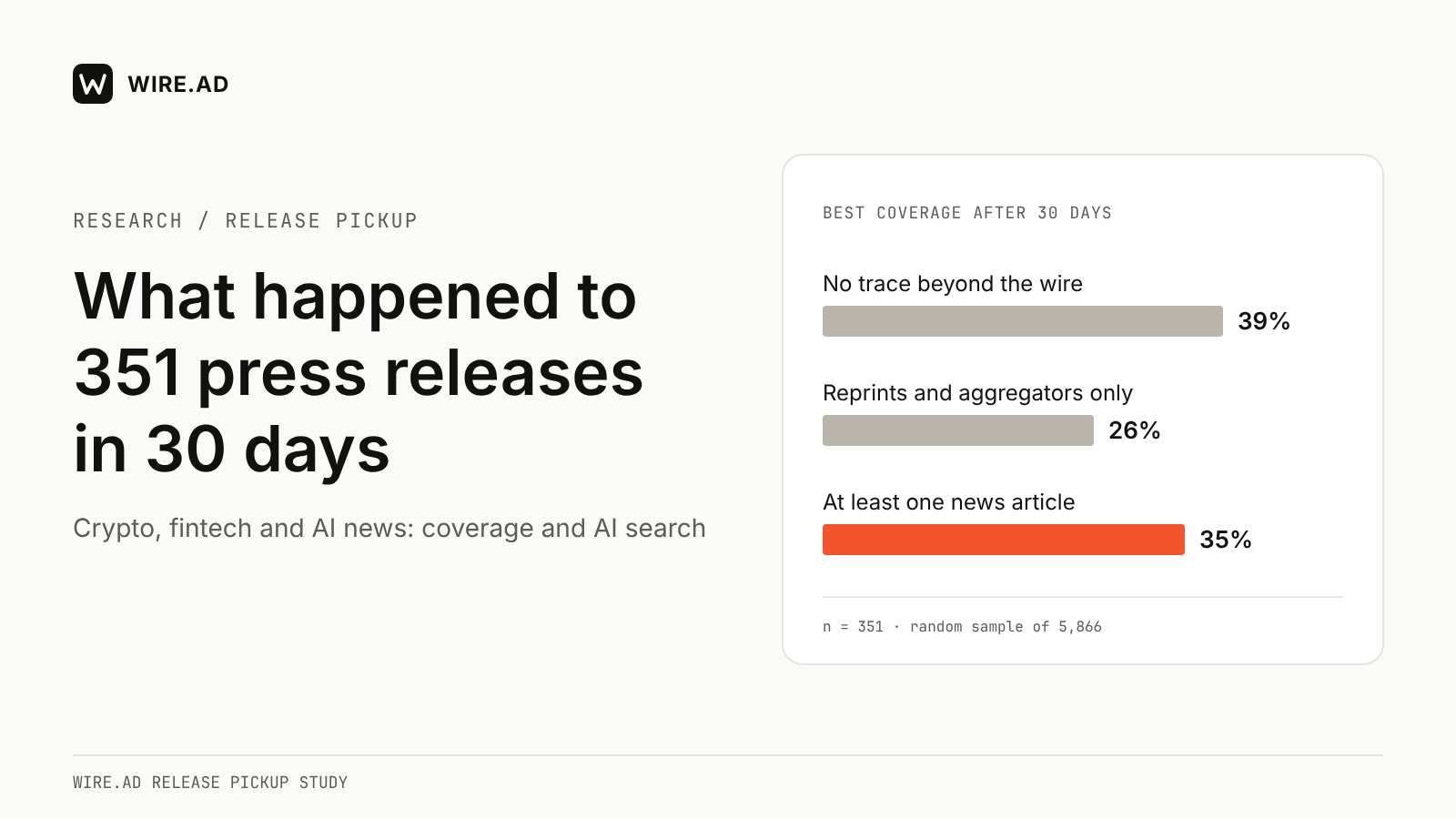
Press release pickup is far thinner than most launch plans assume. WIRE.AD drew a random sample of 351 press releases that crypto, fintech and AI companies sent through major newswires in August and September 2026, then followed each one for 30 days. 65% got no news article written about them. 39% left no trace in news search beyond the newswire page itself.
The second half of the study looks at AI search, the other place a buyer may go to check a company. We asked an OpenAI model with web search about every one of those announcements, twice: once by company name, once by describing the news without the name. The results say a lot about which pages AI answers actually read.
The release pickup study in numbers
| Finding | Result |
|---|---|
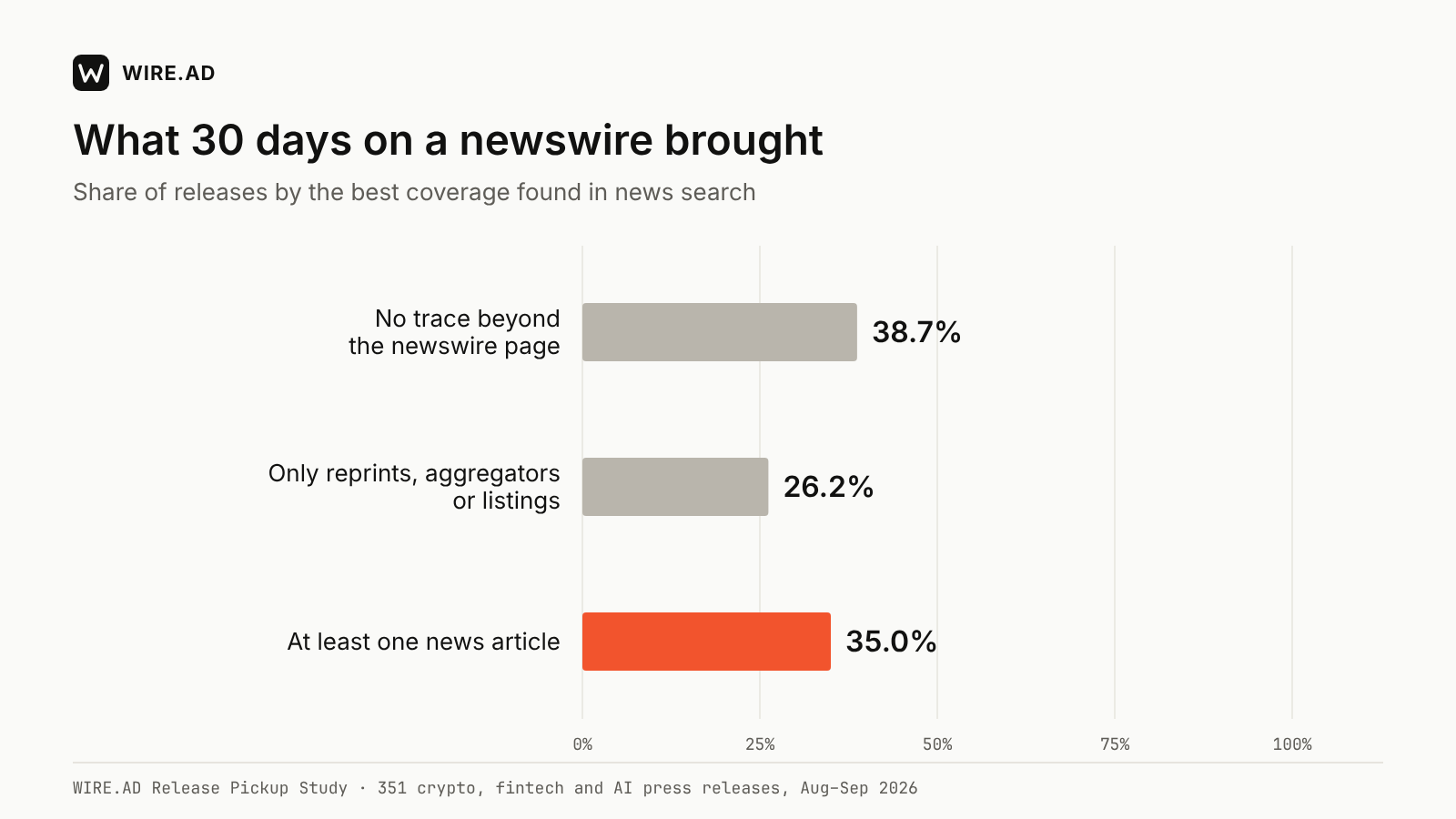
| Releases with no news article in 30 days | 65.0% (228 of 351) |
| Releases with no trace beyond the newswire page | 38.7% (136 of 351) |
| Releases with only reprints, aggregator copies or listings | 26.2% (92 of 351) |
| Releases with at least one news article | 35.0% (123 of 351) |
| Releases with three or more news articles | 11.1% (39 of 351) |
| Share of all news articles taken by the top 10% of releases | 65% |
| AI search described the news when asked by company name | 68.9% |
| AI search named the company when asked about the news without the name | 59.3% |
A news article here means a story on a news publication under its own headline. A reprint is the release text republished under the original headline. Aggregators are finance and crypto portals that repost wire feeds automatically.
Most releases stop at the wire
The typical release in the sample earned zero articles, and the median was zero in every vertical. Crypto releases got at least one article 34.5% of the time, fintech 33.1%, AI 37.7%. The 95% confidence range for the headline figure is 60% to 70%, so the gap is not a quirk of the sample.
Reprints made the picture look busier than it was. A quarter of releases (26.2%) did show up on other sites, but only as copies on finance portals, market-data pages and exchange news feeds. Those pages repeat the headline word for word. They prove the release was distributed.
They rarely put it in front of a reader who was not already looking for the company, which is the job most launch budgets are paying for.
Coverage was also heavily concentrated. The top 10% of releases collected 65% of all the news articles in the sample. A handful of announcements, mostly from large companies or with a well-known partner attached, picked up between five and twenty stories each.
Most of the rest got none.
How WIRE.AD does it. Every package pairs the wire with placements on outlets chosen for the client’s vertical, and each one gets a version of the release written for that outlet. The report lists every placement with its URL and its label, so the client sees articles and reprints separately, never as a single count.
Funding news and original data earn articles
The kind of news mattered more than the vertical. Half of all funding announcements (50%) got at least one article, and releases built on original research or survey data did best at 55%. Executive hires, event and award news, and financial results sat at 25% to 28%.
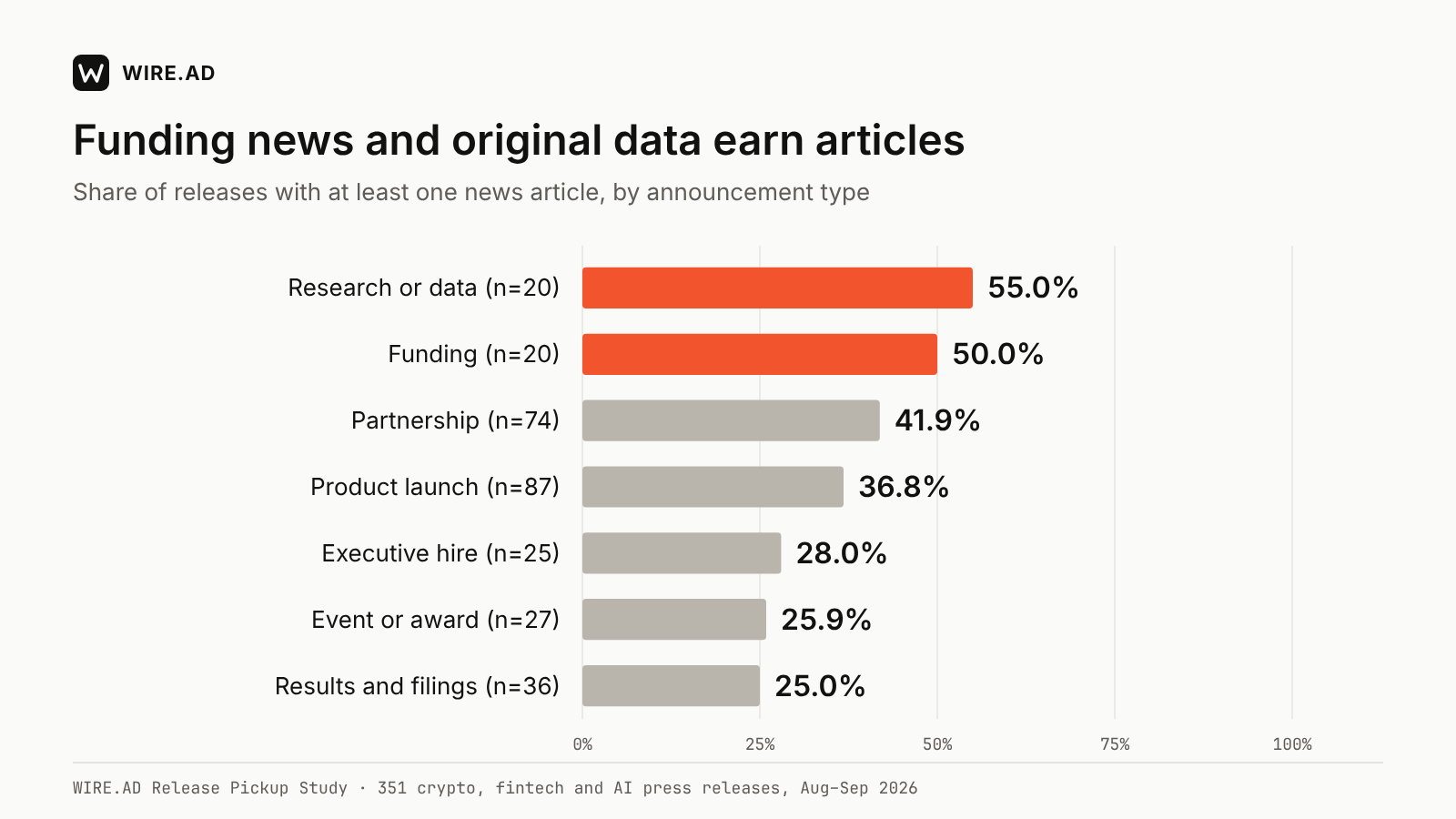
Partnerships landed in the middle at 41.9%, and product launches just below at 36.8%. The ones that drew several stories tended to come from companies reporters already follow, or named a large partner such as a stock exchange or a global bank. Two practical points follow. A release about a sponsorship, a conference booth or an award is distribution, and should be priced and planned as distribution. A release with a number journalists can quote, a funding amount or a dataset, has a real chance of earned coverage and deserves outlet outreach on top of the wire.
How WIRE.AD does it. The brief asks what the news is before it asks where it should run, and the proposal matches outlets to the story: funding and data news to outlets that cover deals and numbers, event and award news to labeled placements built for reach.
AI search reads the company’s own newsroom
When we asked “What did [company] announce in [month]?”, the answer described the right news 68.9% of the time. The links behind those answers were the surprise. 59.3% of all citations pointed to the company’s own website: its newsroom, blog or investor page. Newswire pages made up 18.3%. News outlets made up 6.9%.
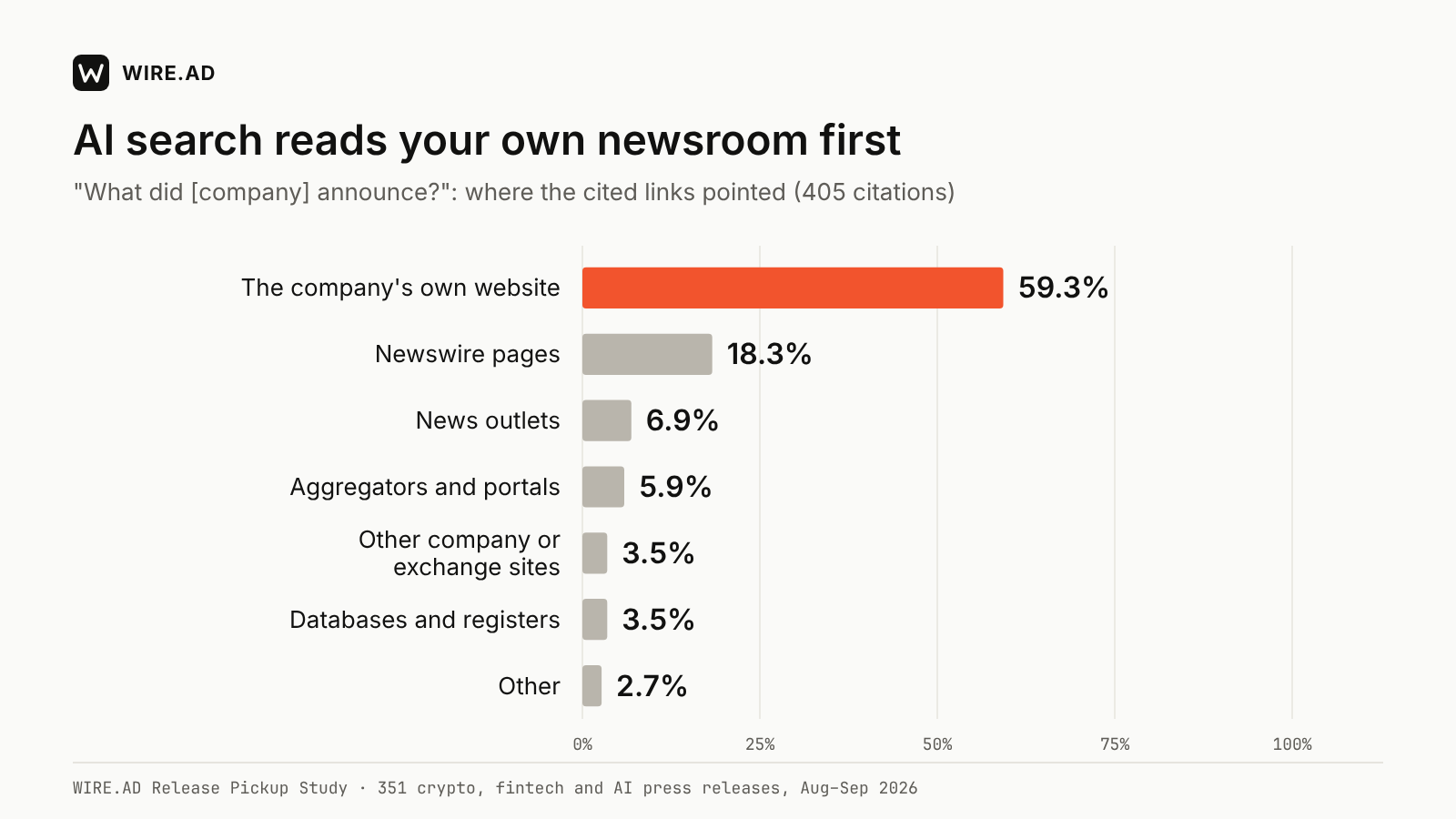
For a branded question, then, the most important page is one the company controls. A release that lives only on the wire and never on the company’s own site gives AI search less to work with. We covered the wire side of this in our look at newswire citations in ChatGPT.
Questions without the company name behaved differently, and this is where earned coverage starts to count. When the question described the news instead (for example, “Which crypto infrastructure firm launched an institutional OTC desk in September?”), news outlets rose to 14% of citations, almost level with newswires at 14.9%.
Companies with articles were named more often
This is the finding that matters most for launches. On the question that described the news without naming the company, AI search named the company 70.7% of the time when the news had at least one article. When it had none, the figure was 53.1%.
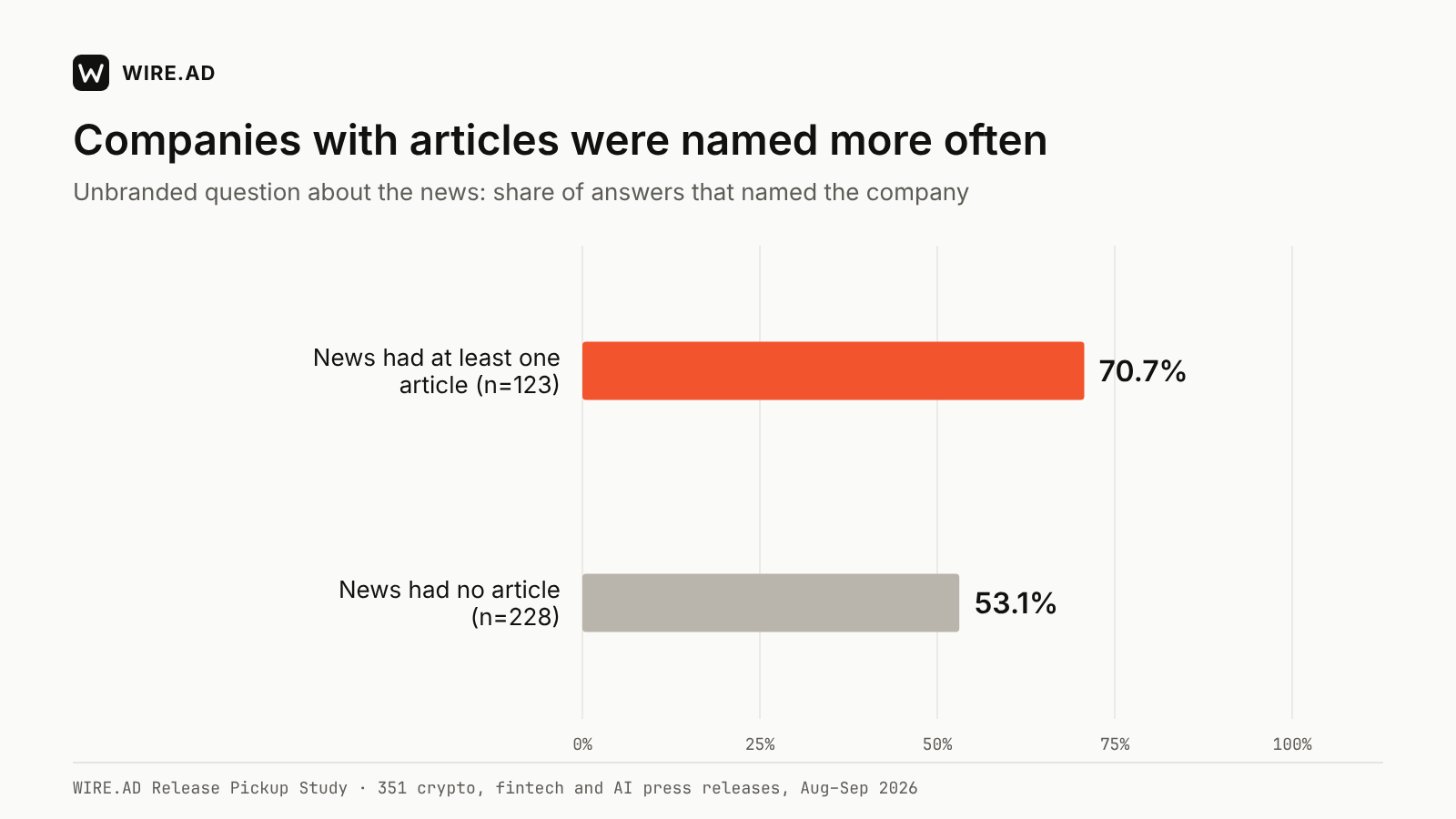
The difference is statistically clear (p ≈ 0.001), and it held whether the news had one article or several. It is still a correlation. Companies that earn articles may also be better known, and AI answers vary from one run to the next. What the data does show is the direction: an independent article gives AI search a second source that tells the same story in different words, and answers that do not start from your name find you more often.
How WIRE.AD does it. Any campaign can add an AI visibility reading before and after, built on the questions your buyers ask, both branded and unbranded. The AI visibility page explains the reading, and the free AI Shortlist Check shows where your company stands today.
What to do with this before your next launch
- Publish the full release on your own newsroom the same day it goes out on the wire. It is the page AI search cites most.
- Treat the wire as distribution, then budget separately for coverage on outlets your buyers read.
- Lead with news that has a number in it: a funding amount, a usage figure, a dataset.
- Ask for a report that separates articles, reprints and aggregator copies. One total hides the difference.
- Check AI answers before and after, with questions that do not include your company name.
To plan coverage around your next announcement, send a brief and WIRE.AD replies with a fixed-price package. The crypto press release distribution page explains what a package includes.
How we ran the study
We took every release listed from 1 August to 30 September 2026 in the cryptocurrency, financial technology and artificial intelligence feeds of a large business newswire, plus the full feed of a crypto-focused newswire: 5,866 releases. From these we drew a stratified random sample of 360 (120 per vertical). Each draw had to be in English, come from a company working in that vertical and be a real company announcement. Correction notices, duplicates and two non-English items found on review were removed, leaving 351.
For each release we searched Google News for the company name from the day before publication to 31 days after, and checked each result against the release. We then asked an OpenAI model with web search two questions about each announcement on 4 November 2026 and recorded every cited link. Finally, we reviewed a random set of 79 of those judgments by hand, and 76 of them held up.
Three limits apply. Google News misses many small crypto sites, paywalled trade titles and non-English press, so true coverage is somewhat higher than measured. Some articles under their own headline may be paid placements, which search results do not reveal. And one newswire supplied most of the fintech and AI sample, so its industry categories (which include banks and asset managers) shape those groups.