Google now tells publishers in writing to fact-check anything a model wrote, metadata included. The UK opened its crypto licensing window, the EU’s markets regulator wants rules for crypto influencers, the FTC is asking whether ad platforms should answer for impersonation scams, and a university study counted how often AI Overviews cite sources that don’t back them up.
This week in 30 seconds
- Google now asks for a human fact-check of everything a model writes before it goes live, titles, meta descriptions, structured data and alt text included.
- The FCA’s crypto authorization window is open until February 28, 2027, and s.21 approvers now notify the regulator in fewer cases.
- ESMA wants MiCA’s marketing rules to reach influencers and paid promoters. It is advice to lawmakers, with no dates.
- The FTC asks whether ad platforms should answer for impersonation ads their AI tools help make. Comments close November 30.
- About 11% of the AI Overviews claims one university could check weren’t backed by the cited source, and a vendor study finds cited pages lose half their AI citations within 11 days.
Google guidance on fact-checking AI-generated content
On October 1 Google added three sentences to its guidance on using generative AI content. Models predict a likely sequence of words, their output can contain hallucinations, and so it is “critical to manually factcheck and review all AI-generated content” before it goes live. The review covers title elements, meta descriptions, structured data and image alt text as well as the body. Google’s changelog says the edit brings the page in line with what it already tells developers at its events. The same day, with no changelog entry, it revised its page on helpful, reliable, people-first content, which now calls the quality of the main content one of the most critical factors in judging a page.
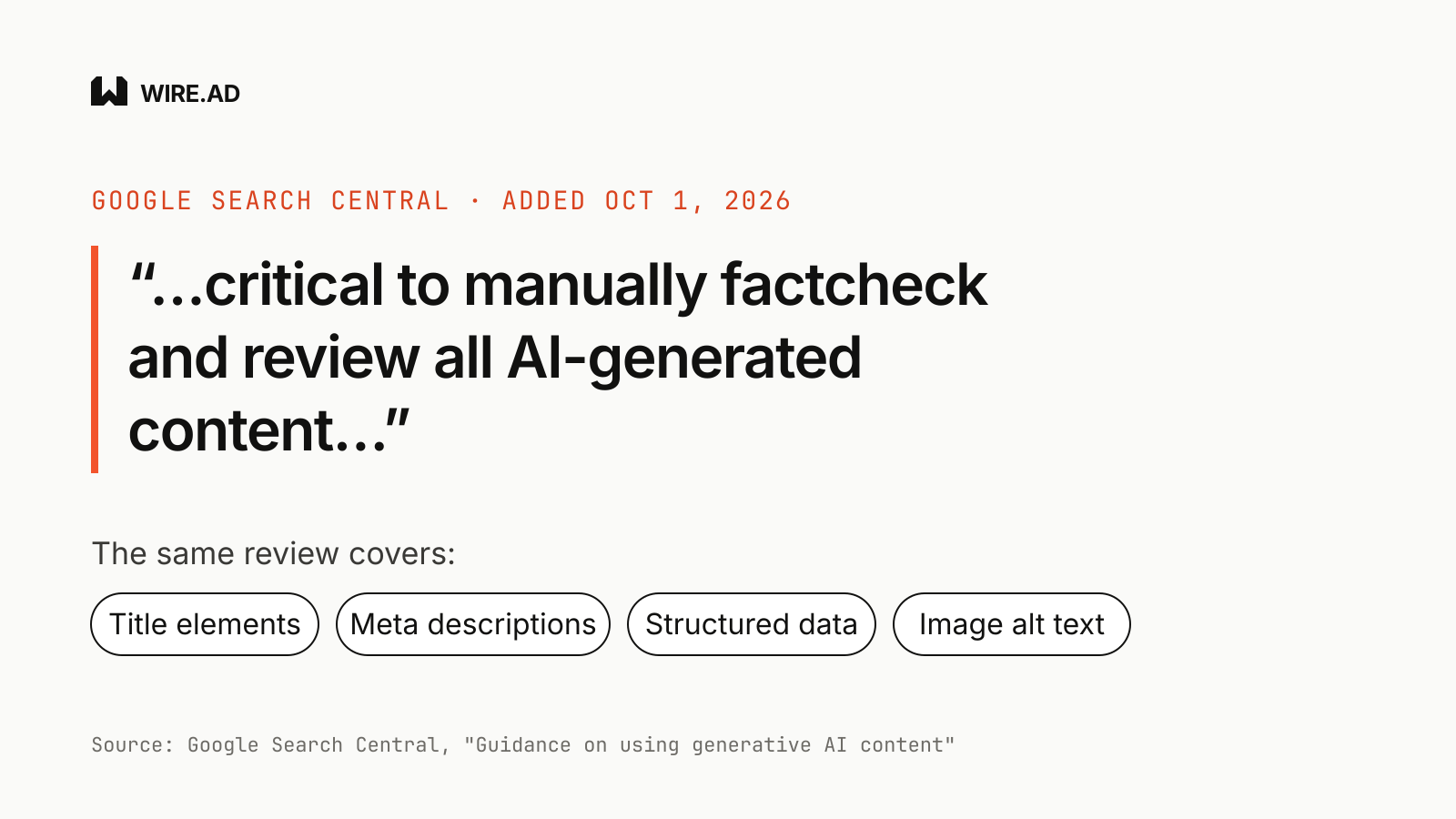
Chart: WIRE.AD. Quote: Google Search Central, updated October 1, 2026.
If your team drafts releases, newsroom pages or listing announcements with a model, put a named person’s sign-off on the text and on everything generated around it: the title tag, the meta description, the JSON-LD and the alt text. Google doesn’t tie the change to rankings, so there’s no penalty to fear yet, only a clearer standard.
FCA crypto authorization window and promotion approvals
The FCA opened its gateway on September 30 for crypto firms applying under the new UK regime. Applications close February 28, 2027, the regime starts October 25, 2027, and the regulator stresses that authorisation “is not automatic”. A separate change, instrument FCA 2026/60, took effect October 1 and amends SUP 16.31. A section 21 approver now has to notify the FCA within 7 days of approving a crypto promotion in two cases only: during its first three months of approving crypto promotions, and for direct-offer promotions. The six-monthly approver report stays.
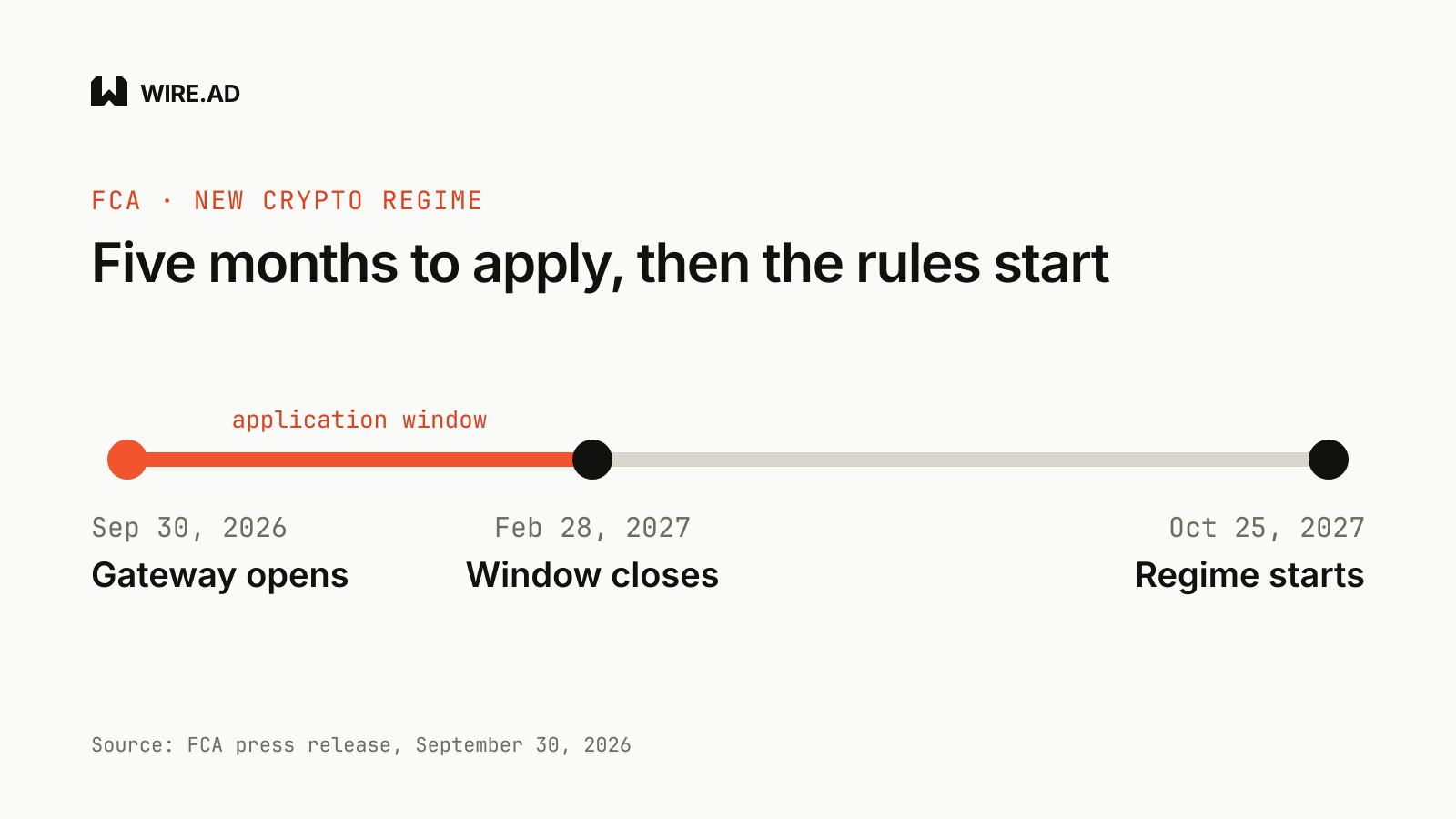
Chart: WIRE.AD. Dates: FCA, September 30, 2026.
This matters most to exchanges, token issuers and fintechs marketing to UK consumers whose launch and listing announcements go through an s.21 approver. Decide early whether you apply in the window. Under the FCA’s guidance for s.21 approvers, a firm that applies can keep using its approver until the FCA decides, while a firm that doesn’t moves to transitional or run-off rules once the regime starts. Fewer notifications leave the standard where it was: an approved promotion still has to be fair, clear and not misleading. Which route your entity takes is a question for your lawyers.
ESMA proposal for MiCA rules on crypto influencers
ESMA’s response to the Commission’s MiCA review, published September 30, asks for “stricter rules for the marketing of crypto-assets” and names influencers and third-party promoters. The paper calls MiCA’s marketing provisions “very high level”, notes that they don’t reach influencers, and invites the Commission to ban or limit some marketing techniques the way MiFID II does. Its other asks include cost transparency, disclosure duties for staking, lending and borrowing, powers to block fraudulent websites and freeze assets, more reach over non-EU firms soliciting EU investors, and a ban on CASP services tied to stablecoins outside MiCA. All of it is advice to lawmakers, with no binding text and no dates.
Projects and CASPs that pay KOLs, creators or sponsored posts around EU listings and token launches should get ahead of it, and so should the agencies that buy that inventory. Keep a list of every paid promoter, put disclosure and conflict clauses into KOL contracts, and keep EU-facing claims inside what the white paper supports. One pass over current contracts with counsel is worth the time.
Announcing in the UK or the EU? Every WIRE.AD version carries the risk wording of the market where it runs, and every paid placement is labeled.
FTC comment period on platform AI ad tools
The FTC’s advance notice of proposed rulemaking under the Impersonation Rule, 16 CFR Part 461, appeared in the Federal Register on October 1 at 91 FR 62347. It asks whether search engines, social networks and marketplaces should carry duties or liability when their AI ad tools, from copy and image generation to targeting and delivery, help impersonation scams. There is no rule text yet. The options on the table include ad pre-screening, advertiser verification, reporting tools, takedowns and a possible safe harbor. The Commission voted to publish on September 24, and comments close November 30, 2026.
Fintech and crypto brands that get impersonated in search and social ads have a reason to file a comment. In the meantime, keep dated screenshots of lookalike ads that run during launch weeks, and expect stricter advertiser verification on the platforms you buy from.
WashU audit of AI Overviews citations
Researchers at Washington University published an audit on September 29 of 55,393 searches run between March 13 and April 21, 2026. AI Overviews showed up on 13.7% of all queries and on nearly 65% of queries phrased as questions, and 29.8% of the domains they cited weren’t on the first page of results. Of 98,020 claims the team could check, about 89% were supported by the cited source, 7% weren’t in the cited text and 4% contradicted it. The authors treat that combined 11% as an upper bound. The paper goes to ACM IMC this month.
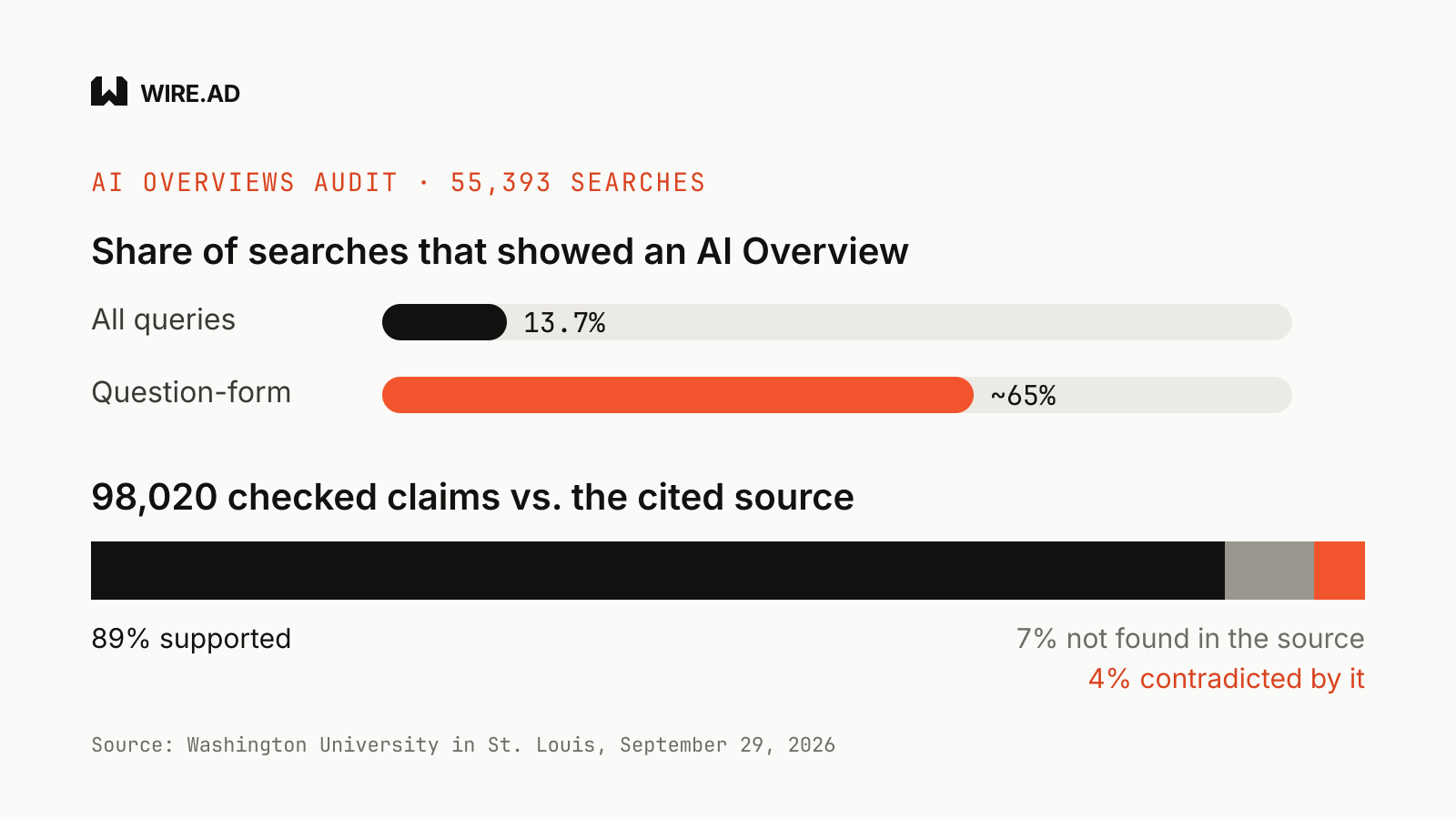
Chart: WIRE.AD. Data: Washington University in St. Louis, September 29, 2026.
If your round, investors or licenses appear in AI answers, those answers may lean on pages well outside the top results. After each announcement, search the questions a buyer or journalist would ask, such as “who invested in X” or “is X licensed”, and fix the pages the answers cite.
Number of the week: 11 days
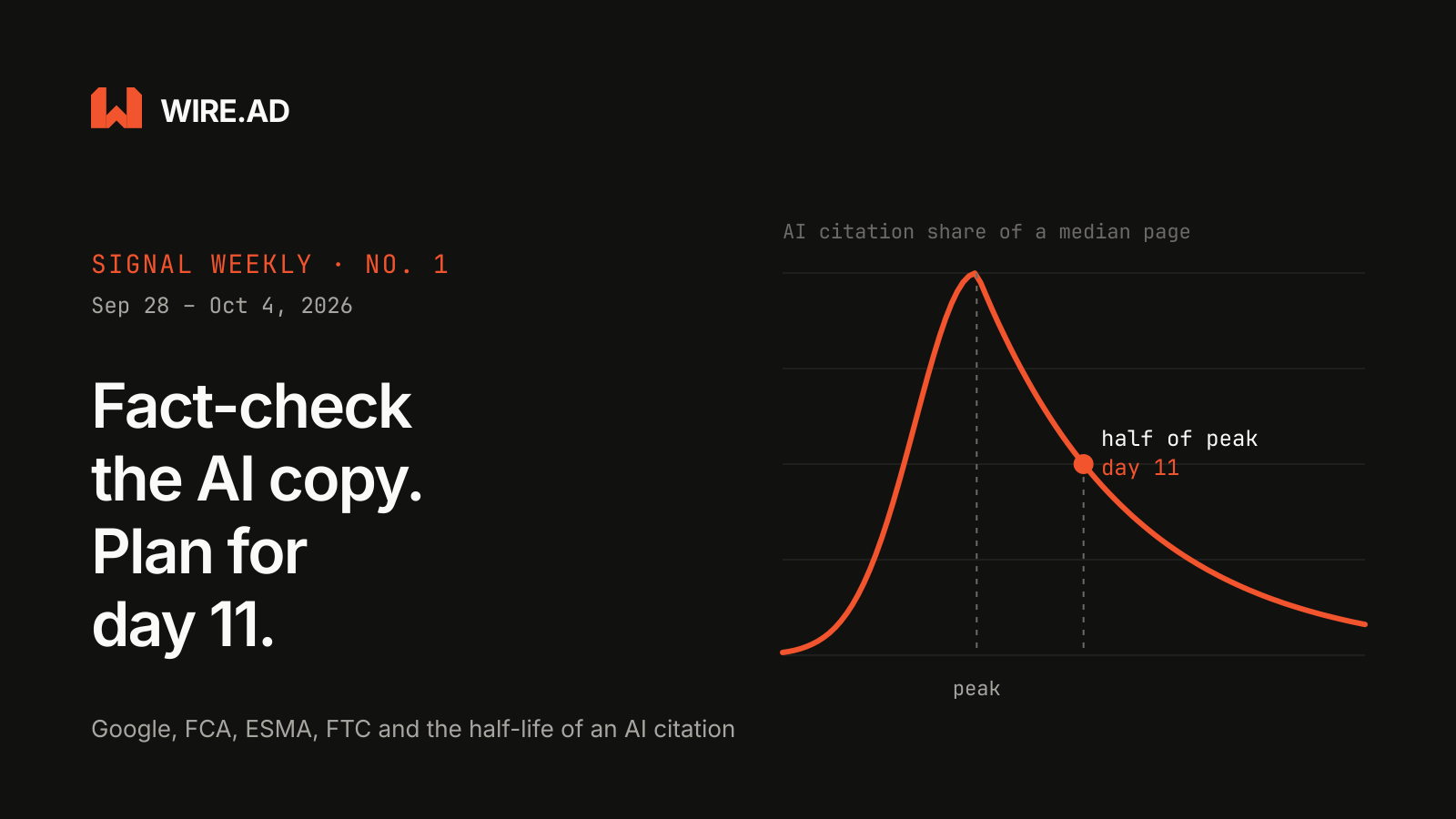
Profound published a study on September 30 that tracked citation share for 883,000 pages across ChatGPT, Perplexity, Claude, Google AI Overviews, AI Mode, Gemini and Copilot for 12 months. The median page lost half its citation share within 11 days of its peak, and 78% of cited pages halved within two weeks. Pages pinned to a date or an event faded fastest, and a funding or listing release is exactly that kind of page. Pages cited by five or more engines were 5.5 times as likely to hold above half their peak after eight weeks.
It’s one vendor’s study of its own metric, with the method on the page. Read that way, it still makes a practical case for treating a launch as two pieces: the dated release, and a lasting page that says what the product does, who funded it and the key numbers, updated once the news cycle passes. Our crypto press release pricing guide works the same way: one page, reviewed every quarter. WIRE.AD measures what AI answers say about a company before a campaign and again after it (AI visibility).
Want to see how your last launch held up? Run a free AI Shortlist Check and add your last PR report: we check whether AI names you when buyers ask and review each placement, whether it is live, labeled, indexed and how it links to you.
Dates to put in your calendar
| Date | What happens |
|---|---|
| October 12 to 16, 2026 | The WashU audit of AI Overviews citations is presented at ACM IMC in Karlsruhe |
| November 30, 2026 | Comments close on the FTC’s notice on platform AI ad tools |
| February 28, 2027 | The FCA’s crypto authorization window closes |
| October 25, 2027 | The UK crypto regime starts |
What we’re watching next week
The WashU team presents its AI Overviews audit at ACM IMC, October 12 to 16, and we’ll read the full paper for which kinds of pages AI Overviews cite out of context. We’ll also follow the FTC docket as the first comments come in, to see how ad platforms answer the liability question.