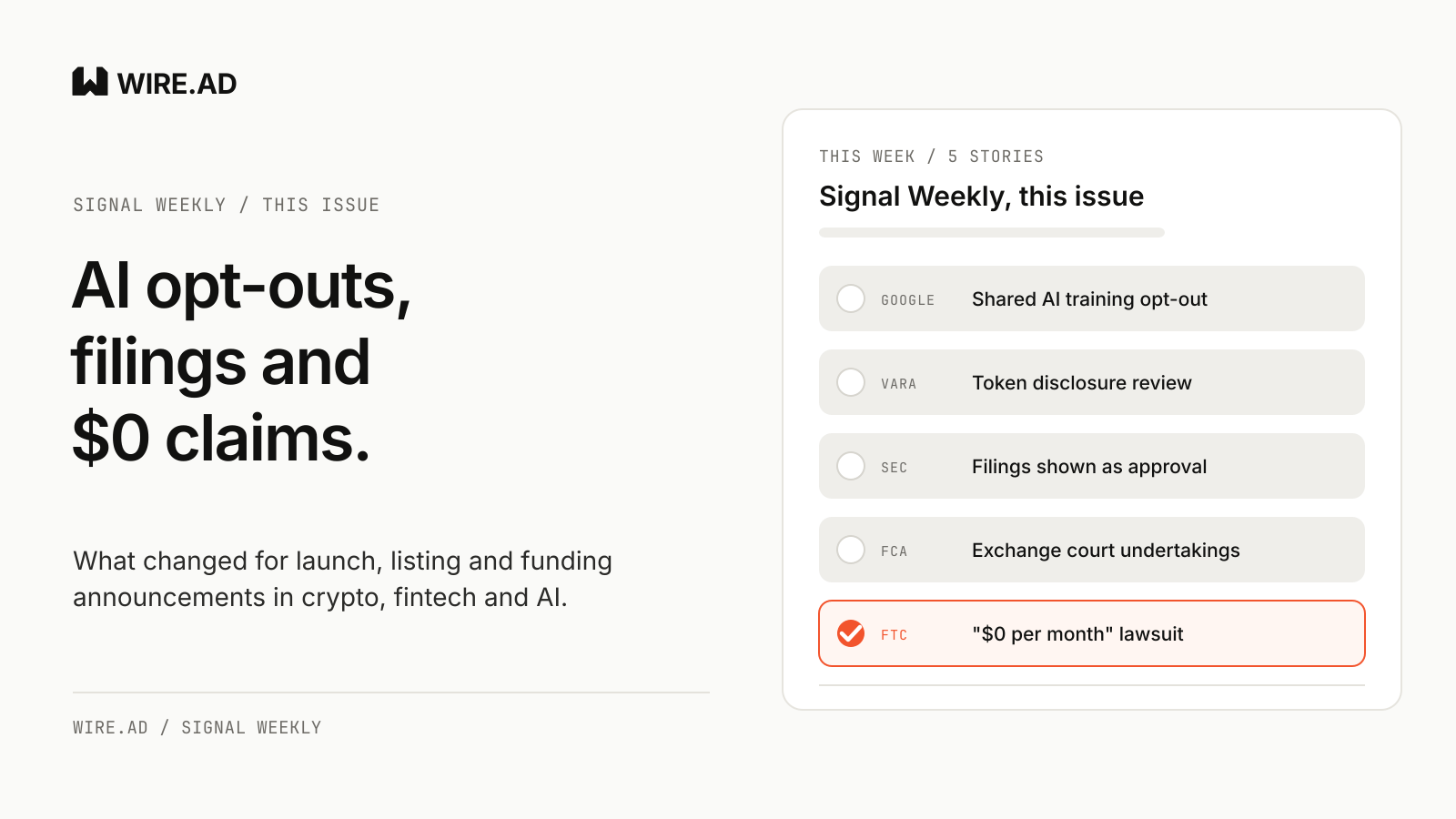
If your newsroom adds an AI training opt-out to robots.txt next year, the same line can take your launch out of Gemini’s cited answers. That is the change to settle first this week. Also: what VARA expects Dubai exchanges to publish per token, why “filed with the SEC” must never become “approved”, which channels the FCA counts in a promotion, and the “$0” claim the FTC took to court.
This week in 30 seconds
- Google plans to treat a shared AIPREF opt-out in robots.txt as a Google-Extended block, which also covers grounding in Gemini Apps. Google aims to support it in 2027.
- VARA’s circular of October 28 restates what Dubai broker-dealers and exchanges must already publish for every token under its rulebooks, and shows where its review found gaps.
- The SEC charged two entities it says showed investors false SEC filings as proof of approval.
- The FCA settled its court case over HTX with High Court undertakings that cover the website, apps and social media.
- The FTC and state partners sued Toast over a “$0 per month” plan and a “24/7/365 support” promise.
Google plans for a shared AI training control
On October 30 Google announced plans to support a shared AI training control in robots.txt, built on the AIPREF working group at the IETF. A site will set one “policy token” for all participating AI providers instead of writing a rule for each one. When a site opts out of training with that token and says nothing about Google-Extended, Google “plans to interpret that as if the publisher had disallowed Google-Extended.” Company-specific controls keep working alongside it. Google’s crawler documentation gives the token as user-agent: __usage_ai-training and the start as early 2027.
The detail that matters for announcements is what Google-Extended covers. Per the same documentation, it controls Gemini training and also grounding in Gemini Apps, and the blog post says sites that “specifically allow Google-Extended are eligible to appear in responses and receive clicks via grounding in Gemini Apps.” Google-Extended has no effect on inclusion in Google Search or on ranking.
Our reading: a company that adds the shared opt-out to its newsroom without a Google-Extended line may drop out of Gemini’s grounded answers about its own launch. Google-Extended is one switch for both Gemini training and Gemini grounding, so decide before 2027 which matters more for your newsroom. An explicit Google-Extended allow next to the shared token keeps you eligible for grounding in Gemini Apps, but it also lets Google use the pages for Gemini training. The shared token would then opt you out of the other participating providers only. Ask whoever runs your CMS or CDN before they ship a blanket AI block.
Our AI visibility service records what AI assistants say about a company before a campaign and asks the same questions again afterwards. It measures; it does not guarantee citations.
VARA circular on public disclosures
VARA published a circular on October 28 with the results of a thematic review, begun in June 2026, of the public disclosures of Dubai-licensed crypto firms. The review covered a representative population of licensed firms, and token data is one part of it. The circular creates no new obligation: it restates duties already in VARA’s rulebooks and describes good practice. It found disclosures that were incomplete, vague, hard to find or out of date, and says some licensed firms treated disclosure “primarily as a licensing deliverable, rather than as a continuing regulatory obligation.” For every token offered, broker-dealers and exchanges must publish, among other things, the name and symbol, issuance date, market capitalization and fully diluted value, circulating supply, smart-contract audit information and specified price history. VARA found cases where that data was missing or covered only some tokens, and cases where firms linked out to third-party data sites instead of disclosing the data themselves. Its good-practice example is a dedicated asset-information page for each token. It also flags statements that client assets are “protected”, “secure” or “segregated” with no explanation behind them.
For a token team listing on a Dubai-licensed exchange, our reading: the exchange already has to publish this data, and the circular shows supervisors are checking it, so expect the exchange to ask you for it in a fixed format. Send a token fact sheet with the listing request that follows VARA’s fields: name and symbol, issuance date, circulating supply, market capitalization and fully diluted value with an as-of date, price history, and the date and author of the last smart-contract audit. Use the same figures and the same as-of date in the listing announcement. The same caution applies to words like “secure” in the release itself. Our Dubai crypto PR guide covers VARA’s marketing rules.
SEC case over filings shown as proof of approval
On October 29 the SEC charged two Colorado-incorporated entities run from abroad, and its litigation release of October 30 sets out the allegations. From at least October 2025 through June 2026, the scheme promised risk-free returns from crypto trading “signals” and raised more than $130 million from tens of thousands of retail investors. The complaint says the defendants filed false Form ADV and Form D documents that were “shared with investors as supposed proof that the SEC had licensed or approved them.” Neither entity was registered with the SEC. The filings have been removed from the SEC website.
Legitimate funding announcements slip into the same vocabulary. A filing on EDGAR shows that a document was filed. Describe a filing exactly, by form name and date. Use “SEC-registered” only if the company is actually registered (a Form D is a notice of an exempt offering, not a registration), and never say “SEC-approved”: the SEC does not approve companies or offerings. Check the investor deck and the press kit for the same slip.
Announcing a round or a listing? Every WIRE.AD release goes out with the risk wording of each market it runs in, and every placement is labeled editorial or sponsored.
FCA settles its case over HTX
The FCA said on October 29 that it had settled its court case over HTX, formerly Huobi, and secured High Court undertakings from Huobi Global S.A., the first defendant, that it will not knowingly promote crypto services unlawfully to UK consumers. The undertakings cover “the HTX website, software applications and social media platforms.” HTX has left the UK: deposits are closed and new UK users cannot sign up. The settlement terms are confidential and carry no admission of liability. Proceedings began on October 21, 2025. “Being based overseas does not put them beyond the reach of UK law,” said Steve Smart, the FCA’s executive director of enforcement and market oversight.
For non-UK projects, the useful part is the list of channels. The undertakings name social media alongside the website and apps. Our reading: a launch plan that excludes the UK should cover social posts and paid targeting as well as the website, and the sign-up flow should block UK users too; check the details with UK counsel. Before launch, list every channel that will carry the promotion and confirm the UK exclusion on each one.
FTC lawsuit over a fintech’s “$0” and “24/7” claims
The FTC, joined by seven state attorneys general and two California local offices, sued Toast on October 29. The complaint says Toast advertised a “Pay-as-you-Go” plan with hardware and software for “$0 per month” while charging fees it did not clearly disclose, including $85 a month for payment processing during a temporary closure and an early termination fee of $150 for each remaining month. It also targets the “24/7/365 support” listed in every subscription package, and a $0.99 fee added to some online orders above $10 from September 2021 to late July 2023. The Commission voted 2-0. These are allegations, and the court will decide the case.
A fintech launch release repeats the same kind of claims: free tiers, zero fees, round-the-clock support. If support runs only on weekdays, the announcement should say so, and the landing page it links to should say the same thing.
Number of the week: $150
That is the early termination fee the FTC says Toast charged for each remaining month of a contract sold next to a “$0 per month” headline, according to the October 29 press release. The complaint says the fees were not clearly disclosed. It is an allegation, and the court will decide.
For a fintech launch, the lesson sits in the gap between the headline and the fee. A “$0” or “free” claim needs its conditions in the same paragraph, in the release and on the page it links to, because a regulator reads them together.
Want to see how your last announcement reads in AI answers? Run a free AI Shortlist Check and add your last PR report: we check whether AI names you when buyers ask and review each placement, whether it is live, labeled, indexed and how it links to you.
Dates to put in your calendar
| Date | What happens |
|---|---|
| November 18, 2026 | Comments close on the FCA’s CP26/36 crypto perimeter guidance, which includes changes to the financial promotion guidance in PERG 8 |
| November 30, 2026 | Comments close on the FTC’s advance notice on platforms’ role in impersonation scams, including their ad tools |
| February 28, 2027 | The FCA’s crypto application window closes |
| October 25, 2027 | The UK crypto regime starts |
What we’re watching next week
The FTC docket on platforms’ role in impersonation scams has four weeks left, and we’ll look at who files before November 30. We’ll also read the FCA’s CP26/36 for its PERG 8 changes on financial promotions, and track whether other AI providers commit to the shared training token.