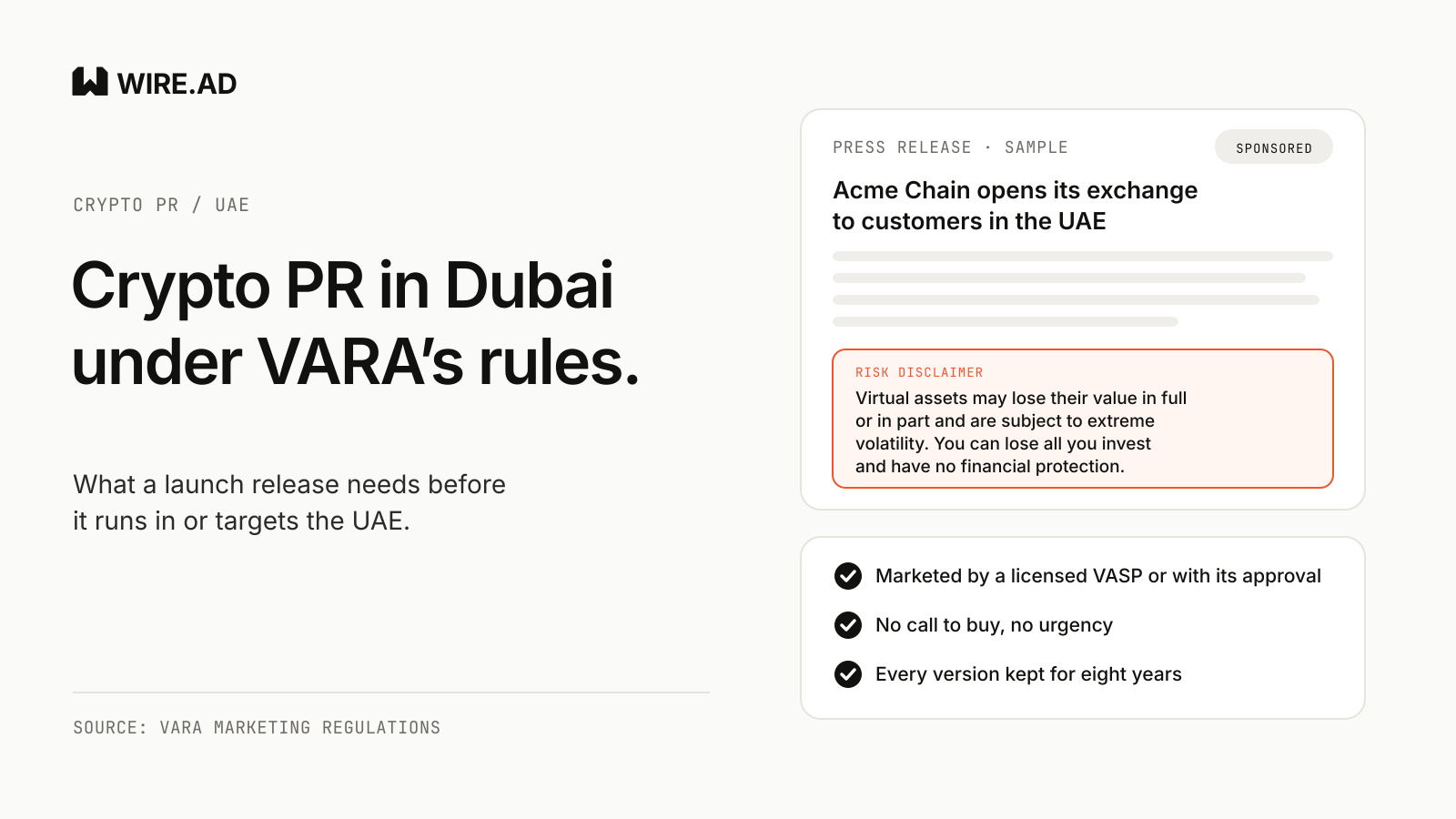
Crypto PR aimed at Dubai will, in most cases, count as marketing under VARA’s rules. The Regulations on the Marketing of Virtual Assets and Related Activities, in force since October 1, 2024, cover press releases, sponsored articles, paid or earned media, social posts and educational content about virtual assets whenever they run in or target the UAE. They apply to foreign companies as well as local ones, and to firms that hold no VARA license at all.
A token project registered in Singapore can be drawn into VARA’s rules by ordinary campaign details, such as a Dubai skyline in the launch visual, which VARA lists among the signals it weighs. This guide walks through what the rules ask of a launch announcement, using the regulation and VARA’s own guidance, which VARA describes as explanatory and non-binding. It is a practical summary for planning, so check the final campaign with your counsel.
When a press release counts as marketing
VARA defines marketing as “any advertisement, invitation, inducement, solicitation, offer or promotion”, and the list of examples is broad on purpose. It names “advertisements, sponsored editorials, paid or earned media”, along with blogs, comments, endorsements, podcasts, live streams, airdrops and educational articles.
So a paid release on a wire or a sponsored article on a crypto outlet will normally count as marketing. The regulation also lists earned media among the forms marketing can take, so coverage you did not pay for may still qualify, depending on its content and purpose. VARA’s guidance says it looks at the content, the audience, the channel, the commercial purpose and the intent behind it, and it judges a campaign as a whole rather than one post at a time.
Who may market crypto services in the UAE
Marketing of a virtual asset activity, such as exchange, brokerage or custody, may only be carried out by a VASP licensed by VARA for that activity, or on behalf of such a VASP and with its approval. That is rule I.B.3, and a breach can be fined up to AED 10 million per violation, the highest cap in the regulation.
The rules stop applying only when three conditions hold together. The company is outside the Emirate, it conducts no virtual asset activity in the Emirate, and it runs no marketing in or targeting the UAE.
The third condition is where PR choices matter. VARA’s guidance lists factors it may consider when deciding whether a campaign is “in or targeting the UAE”, and several of them are ordinary PR choices:
- the campaign targets the GCC, which VARA treats as including the UAE by default;
- the materials quote prices in AED;
- the visuals use the Dubai skyline or the UAE flag;
- the copy uses Emirati dialect or local slang;
- the plan includes UAE-specific press or a channel aimed at UAE residents;
- the campaign runs at a physical event in the Emirate.
VARA also says a campaign aimed at the UAE is, by default, aimed at Dubai. Carving Dubai out would have to be explicit in every communication.
How WIRE.AD does it. The brief asks which markets a campaign will run in, and registration and licenses are confirmed with the client before the first campaign. Promotion aimed at a market is accepted only from a company licensed for that market.
The risk wording each version has to carry
Rule I.C.2 sets the general standard for all crypto marketing. It must be fair, clear and not misleading. It must be identifiable as promotional. It must avoid implying that an investment is safe or that returns are guaranteed, and it must avoid suggesting that past performance predicts future results. It must also avoid urgency and any fear of missing out on future gains.
When the marketing is about a specific virtual asset, rule I.C.3 adds further duties. Three of them shape every launch text:
- no call to buy, and no message directing people to buy or sell the asset;
- a prominent disclaimer that virtual assets may lose their value in full or in part and are subject to extreme volatility;
- a clear statement that the holder can lose all the money they invest and has no financial protection.
VARA’s guidance tests these duties on examples. “Not financial advice. DYOR.” on its own fails. The guidance offers compliant wording instead: “Not financial advice. Crypto is highly volatile and may drop in value significantly. You may lose the amounts you invest and your investments do not benefit from any form of financial protection.”
Prominent means unmissable. The guidance asks for legible type, a color that stands apart from the background, and a position close to the main content. A footer link to a risk page is a weak fit for that test.
A listing post in VARA’s own case study shows how the overall message is judged. The fictional post announced an upcoming listing and a protocol update, both assumed to be true. It asked “Who’s getting ready to trade?” and added rocket emojis. VARA read the whole post as urgency to buy before a price rise, and it carried no risk disclaimer, so it failed. VARA adds that no single word or emoji is banned. The context decides.
How WIRE.AD does it. Each outlet version carries its own risk wording for the market it runs in. The client confirms the facts and approves every text before it goes live.
Labels for sponsored placements
Paid content needs a clear, prominent notice that it was published under a paid arrangement (rule I.C.2.k). The guidance gives the forms that work: “sponsored content”, “sponsored by ABC VASP” or “in paid partnership with ABC VASP”, placed in a prominent spot such as next to the headline. On social posts it expects “ad”, “advertisement”, “promoted” or “sponsored”, readable on desktop and mobile.
Two exemptions matter for PR, and both are narrow. The journalistic exemption covers media personnel licensed by the UAE Media Regulatory Office and foreign correspondents it accredits, writing content whose overall purpose is not marketing, with a disclosure of the author’s interests. The educational exemption covers purely educational content, and the guidance says content that is sponsored or paid for does not qualify as educational. Key opinion leaders and influencers fall outside both exemptions and must follow the rules in full.
For a launch team, this means a paid article dressed as a tutorial is still marketing. It needs the label, the disclaimers and, for a virtual asset activity, a licensed VASP behind it.
How WIRE.AD does it. Every paid placement is labeled, and outbound links carry rel="sponsored". The campaign report lists each placement with its URL, label and date, so your compliance team can see where every version ran.
Agencies, outlets and the eight-year record
The rules reach past the issuer. If an agency or any third party runs marketing for you, rule I.C.5 keeps you responsible for its compliance. The third party must also do reasonable diligence that you are allowed to market in the UAE, and it must get your approval before publishing anything on your behalf. A third party that skips those steps can be fined on its own.
Publishers and platforms that carry crypto marketing in or targeting the UAE have a duty too. Rule I.E.1 asks them to take commercially reasonable steps to make sure the marketing complies, and rule I.E.2 asks them to keep records of that diligence for eight years.
The issuer and anyone else doing the marketing carry the broadest record duty. Rule I.C.4 requires every company marketing a virtual asset or virtual asset activity in or targeting the UAE to keep a record of all marketing, and of how it was distributed, for at least eight years from the last time it ran. That covers the release text, each outlet version, the publication dates and the channels.
What the fines look like
Schedule 1 of the Marketing Regulations sets maximum fines per violation:
| Violation | Maximum fine per violation |
|---|---|
| Marketing a virtual asset activity without a license or a licensed VASP’s approval (I.B.3) | AED 10,000,000 |
| Breaking the general requirements or the virtual asset requirements (I.C.2, I.C.3) | AED 10,000,000 |
| Third-party marketing duties, such as an agency’s (I.C.5) | AED 2,000,000 |
| Breaching the journalistic or educational exemption conditions (I.D.1, I.D.2) | AED 2,000,000 |
| Platforms and channels failing to take reasonable steps (I.E.1) | AED 10,000,000 |
| Platform and channel record keeping (I.E.2) | AED 500,000 |
A repeat violation within one year doubles the applicable fine. Unpaid fines accrue a further 1% per month, compounding.
The fines VARA has published amounts for have been far below those caps, and VARA keeps issuing them. In October 2024 it fined 7 entities between AED 50,000 and AED 100,000 each, for operating without licenses and breaching the marketing rules. In October 2025 it fined 19 firms between AED 100,000 and AED 600,000 for unlicensed activity and marketing breaches. Notices published in June and July 2026 added fines on exchanges that served Dubai customers without a license, one of them also for marketing its services in Dubai without authorization.
A checklist before a launch that reaches the UAE
- List every market in the campaign plan and mark the ones that put it “in or targeting the UAE”: GCC targeting, AED prices, Dubai imagery, local press, events in the Emirate.
- Confirm who markets the activity: a VARA-licensed VASP, or a company acting with that VASP’s approval.
- Remove any call to buy, any urgency and any hint of guaranteed or past returns from the release and from each outlet version.
- Put the full volatility and loss disclaimer in each version, close to the main text, legible, easy to spot and proportionate.
- Label every paid placement “Sponsored” or “Sponsored by” your company, next to the headline, and label paid social posts as ads.
- Approve each third-party version in writing before it runs.
- Save every version, link and publication date in a place you can still open eight years from now.
The crypto press release guide covers length limits, risk wording by market and what each announcement has to contain, and the native advertising disclosure checklist covers labels across outlets and social previews. For a campaign placed on crypto media outlets with risk wording in every version and every placement labeled, send a brief.