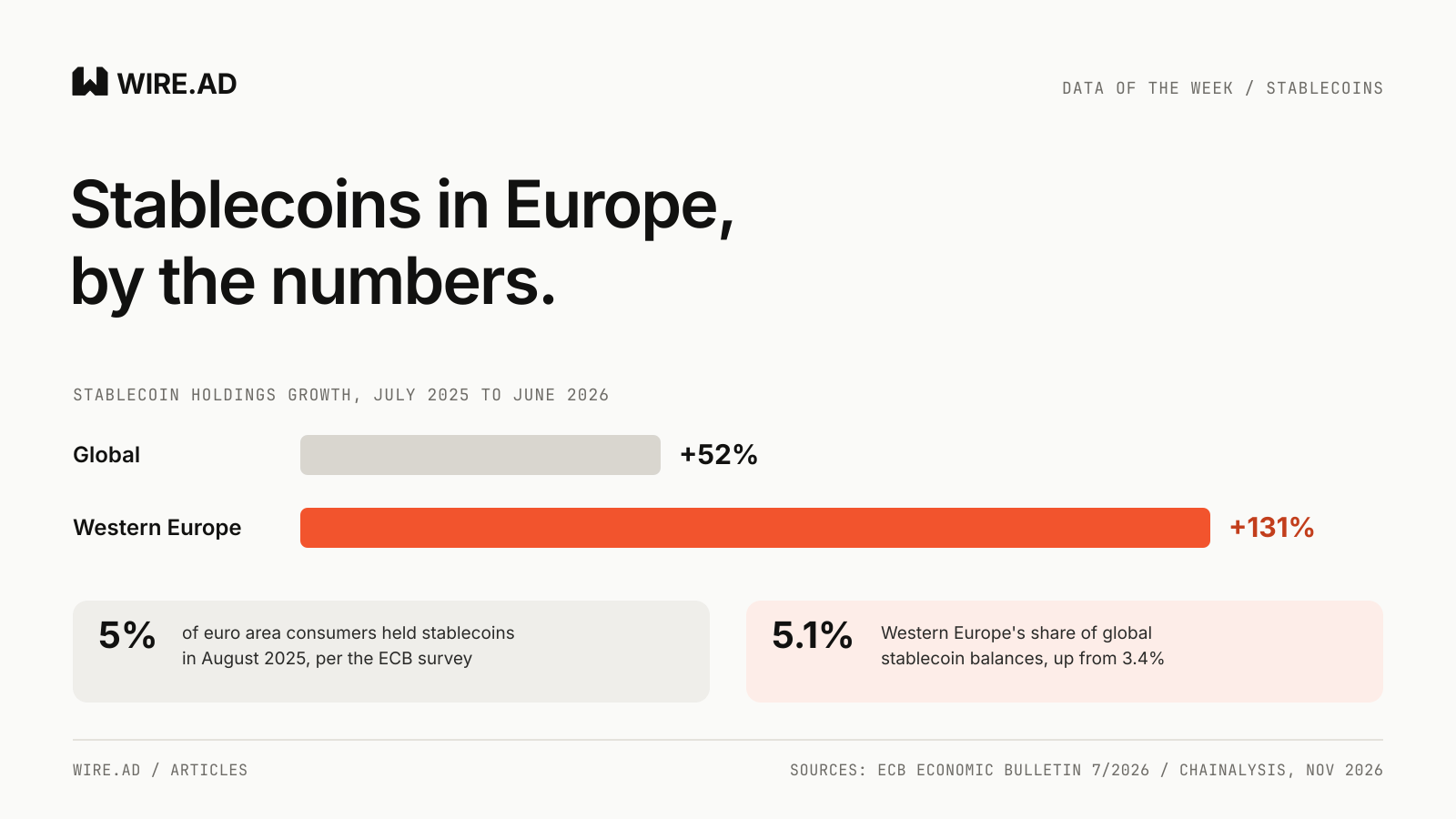
Stablecoin adoption in Europe is still small as a share of consumers and growing fast in wallet balances. The ECB reported on November 11 that 5% of euro area consumers reported holding stablecoins in August 2025, over a third of everyone who held crypto. Two days earlier, Chainalysis reported that stablecoin holdings across Western Europe rose 131% from July 2025 to June 2026, against 52% globally. Both numbers are useful in a launch release, as long as each one is quoted for what it measures.
How many people in the euro area hold stablecoins
The ECB figures come from a box in its Economic Bulletin, Issue 7/2026, built on two waves of its Consumer Expectations Survey. The share of consumers who own crypto-assets rose from 9.8% in November 2024 to 13% in August 2025. In that August wave, 5% said they held stablecoins.
Most holdings are small. The ECB says the distribution of amounts “is skewed towards smaller amounts,” though close to 10% of stablecoin owners are estimated to have held €10,000 or more in November 2025.
Read the fine print before quoting it. The survey covers the 11 largest euro area countries, and the ECB calls the data experimental, subject to measurement uncertainty and small samples, since few respondents own crypto at all. The breakdown by token rests on 1,286 respondents.
Which stablecoins euro area consumers hold
Among consumers with crypto, around 63% hold bitcoin, 36% ether and 22% XRP. Dollar tokens lead the stablecoins. The two most widely held are owned by 17% and 12% of crypto holders, ahead of the largest euro token at 10%. All other stablecoins, in euro or not, account for less than 9% of reported holdings.
One finding matters for payments and remittance products. Respondents born in another EU country or outside the EU were 2.1 percentage points more likely to hold stablecoins than domestic consumers, after other characteristics were taken into account. The ECB says this is consistent with stablecoins being used for cross-border payments or remittances, while noting that the survey does not report how assets are used.
The central bank also says why it is watching. If stablecoins become significantly more widely used, it points to three vulnerabilities: runs and de-pegging, spillovers from a liquidation of dollar stablecoin reserves, and currency substitution. It adds that MiCA is “a robust regulatory framework” that reduces many of these risks.
Write the release with that list in mind. A release that states the issuer’s MiCA status, its reserve assets and its redemption terms in the first paragraphs gives editors the facts they ask about first.
How WIRE.AD does it. We confirm every fact in the release with the client before it goes live, from the authorization status to the reserve and redemption wording. The risk wording is then written for each market the release runs in.
Where stablecoin holdings grew fastest in Western Europe
The Chainalysis report of November 9 measures on-chain value held and moved in wallets. For July 2025 to June 2026 it puts Western Europe’s crypto economy at $2.08 trillion, the second largest of any region, up 1.2%. The EU grew 2.2%. The UK shrank 8% and stayed the largest market in the region at $424.5 billion.
Stablecoins moved much faster. Holdings rose 131% against 52% globally, personal wallet holdings grew in every country measured, and the region’s share of global stablecoin balances went from 3.4% to 5.1%, with Austria and France recording the strongest gains.
The country detail gives a launch team its local angle:
- France: personal wallets holding stablecoins rose from 3,577 in June 2025 to 12,255 in June 2026, and self-custody stablecoin balances grew 192%.
- UK: domestic wallet-to-wallet stablecoin transfers reached $2.09 billion, up from $109 million a year earlier, and 1.03% of eligible retail wallets moved at least 80% of their crypto into stablecoins.
- Euro: euro pairs reached 11.8% of crypto trading volume across the 33 leading government-issued currencies by the end of the period, still below the 14.5% share Chainalysis uses as the euro’s benchmark from FX markets.
Chainalysis is careful about cause. On the euro’s rise and on the UK slowdown, it says its data “cannot establish a direct link” to MiCA. A release that quotes these numbers should keep that caution.
How to cite stablecoin statistics in a press release
The ECB and Chainalysis figures can look contradictory because they measure different things. One is a share of people in 11 euro area countries in 2025; the other is the value held in wallets across a region that includes the UK and Switzerland, over a different 12 months.
So every number in a release needs four labels: who published it, what it counts, where, and when. “5% of euro area consumers held stablecoins in August 2025, according to the ECB” is a citable line. “Stablecoin use in Europe is 5%” is a line an editor will cut or query.
The measure can change a figure by orders of magnitude. Allium’s Q3 report counted $97.9 trillion in raw stablecoin transfers worldwide in the first nine months of 2026. After screening out exchange, DeFi, infrastructure, automated and mint and burn flows, 2.5% remained as end-user transfers, and payments were about a fifth of that, at $482 billion.
Policy lines need their own check, because figures in market coverage can lag the regulator’s final text. The Bank of England’s November 2025 consultation proposed per-coin holding limits of £20,000 for individuals and £10 million for businesses. Its policy statement of June 22, 2026 says it “will not implement per-coin holding limits for individuals and businesses” and will instead introduce a temporary guardrail on issuance, initially £40 billion per systemic stablecoin, set out in a draft Code of Practice the Bank intends to finalize by the end of 2026. A release takes the rule from the regulator’s own text and the market figures from the analyst who measured them, and linking both in the source pack saves the editor the check.
How WIRE.AD does it. Each statistic sits in the fact sheet with its publisher, measure, region and date, and the client confirms it before any version goes live. Every version per outlet uses the confirmed figures.
What the data means for a UK or EU stablecoin launch
Each market gets its own version. For an issuer authorized under MiCA, the EU numbers and the euro angle make the lead. For a UK firm, the domestic transfer figure is the stronger hook. For French outlets, the self-custody data gives the local angle for a product offered in France.
The market rules decide which version runs where, and our guide to crypto marketing rules by country covers how regulators judge targeting.
How WIRE.AD does it. The risk wording is written for each market a version runs in. Every placement is labeled Sponsored or Press release with rel=“sponsored” links, 30 days of corrections are included, and the report lists every placement.
Announcing a stablecoin, a wallet or a payments product in Europe? Send the launch plan and the sources you want to quote. You get a fixed-price proposal for crypto press release distribution: facts confirmed with you, a version per outlet and every placement labeled.