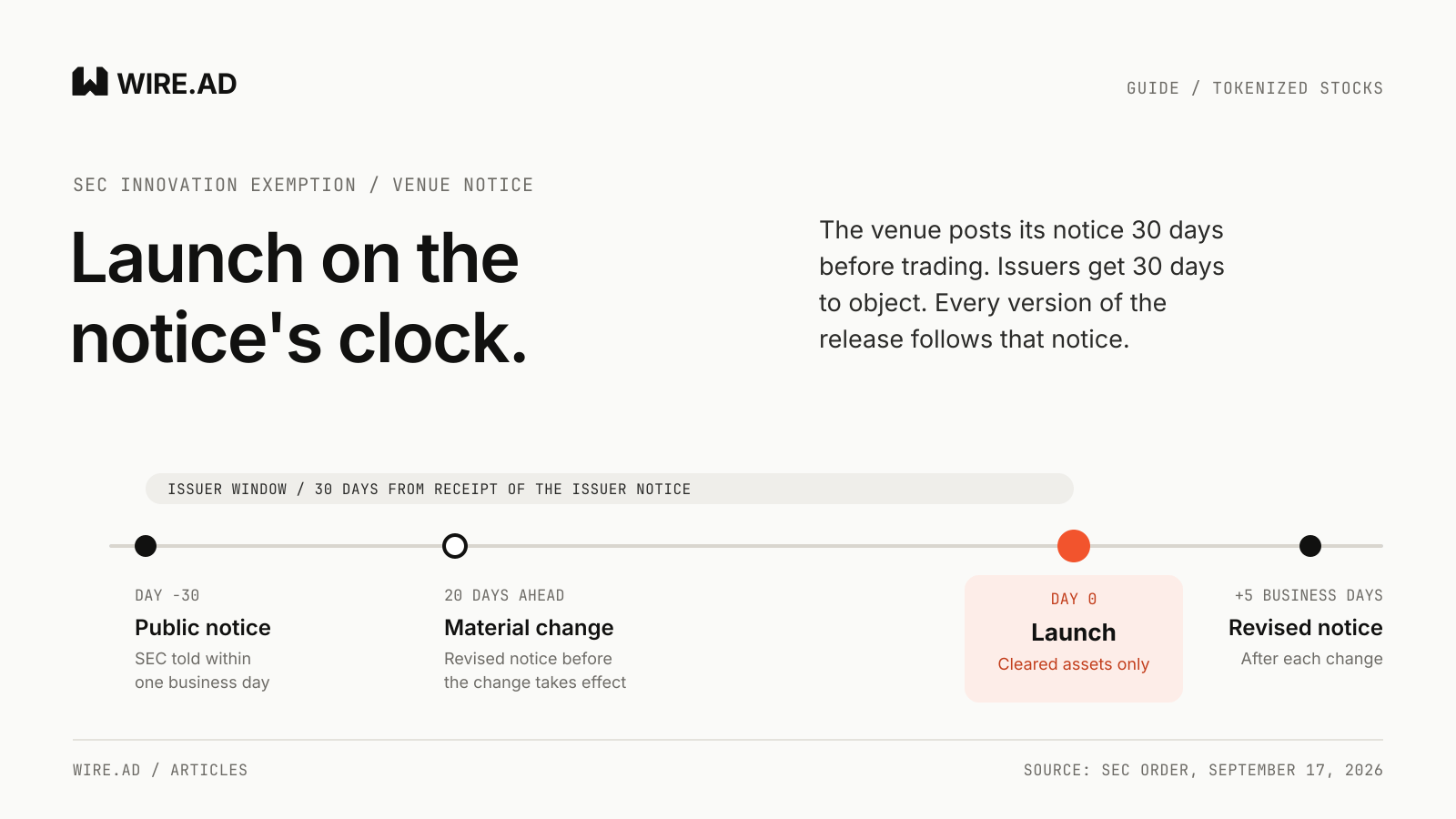
A tokenized stock launch announcement under the SEC’s innovation exemption should match the public notice that the venue must post at least 30 days before it trades. List as live only stocks the issuer tokenized itself or whose 30-day objection window closed without an objection, mark the rest as expected with a date, and carry the venue’s not-registered disclaimer in every version. OKXICE, the joint venture of OKX and ICE, has set its start for November 23, and its public notices show how each step reads in public.
What the innovation exemption asks a venue to publish
The SEC order of September 17 lets a Tokenized Securities Venue (TSV) trade tokenized U.S. stocks through permissioned automated market maker pools without counting as an “exchange”, as long as it meets the conditions. The relief runs until September 17, 2031.
The first condition is a document. At least 30 calendar days before it operates, a TSV must publish a notice “prominently on its publicly available website,” written “in plain English.” Within one business day it must tell the SEC where the notice lives. The notice must also say that the venue is not registered with the Commission. And the venue may not say, in public or in private, that it is registered with the SEC or that its trading has been approved or endorsed by it.
The SEC keeps a public list of firms that have told it they intend to operate as a TSV. Inclusion, the staff says, does not mean a firm “has established that it meets the conditions of the TSV Exemption.” As of November 12 it holds four names, the newest being Formation Securities LLC, which filed on November 9. The staff adds that it “does not pass upon the merits or accuracy of any TSV Notice.”
Two things follow for the launch team. The notice is the text that issuers, journalists and regulators will hold the release against. And the order states that it gives no exemption from the anti-fraud rules, naming section 10(b) and Rule 10b-5 among those that still apply. Treat every claim in the campaign as if those rules cover it.
How WIRE.AD does it. The fact sheet for a venue launch is built from the published notice, and the client confirms each line before any version goes live. Asset names, eligibility and the disclaimer come from that one sheet, so the release and the outlet versions say the same thing.
Which stocks a launch announcement can name
For a stock tokenized by a third party, the venue must first send the issuer a written notice. Trading “may not commence until at least 30 calendar days from the date when the issuer receives the Issuer Notice.” An issuer that objects in writing on or before the 30th day blocks the listing on that venue, and the venue must update its public notice within five business days.
Many issuers have objected. OKXICE’s public notice of November 5 lists 67 issuers that had sent an objection, Apple, Microsoft, NVIDIA, Tesla and Meta among them.
The launch post on November 11 said “more than 70 assets are expected to be listed” and named several of the issuers taking part. Expected is the safe word while any name on a list can still change before trading starts.
So the asset list in a release should mirror the notice on the day the release goes out. Names still inside their 30-day window go in as expected, with the date. Names that objected stay out of the copy, the creative and the ticker graphics.
The disclaimer every version needs
The OKX announcement ends with two lines a crypto or fintech team can treat as a model: OKXICE TSV “is not a registered exchange or broker-dealer and is not approved by the SEC,” and “No information provided by OKXICE TSV is a recommendation to buy or sell any Tokenized NMS Stock.” It also states who can use the venue: eligible U.S.-based customers who pass identity verification.
Those lines are the easiest to lose when a release is cut down for a partner outlet, a newsletter slot or a social post. Keep them, and the eligibility line, in the body of every version, close to the first mention of trading.
How WIRE.AD does it. Versions run in the markets the venue serves, with the venue’s disclaimer and eligibility line in the body of each one. Every placement is labeled Sponsored or Press release, its links carry rel=“sponsored”, and your counsel signs off on the final file.
Volume caps, pauses and halts to plan for
The order limits scale. A venue can trade up to 75 Tier 1 symbols (stocks in the S&P 500 and Russell 1000, plus certain exchange-traded products), each capped at 0.25% of the prior month’s average daily share volume, and up to 250 Tier 2 symbols at 2.5%. Copy that promises “every U.S. stock” overstates what the exemption allows.
Pauses are built in. After the first breach of a volume threshold in a stock, each further breach means a three-month pause in that stock. The venue must tell participants immediately through its regular channels, such as its website or app, and amend the notice within five business days. Trading also stops whenever trading in the underlying stock stops on its primary listing exchange, including a halt or a suspension.
And the exemption covers secondary trading only. “No primary issuance or initial offerings of securities are permitted on a TSV,” the order says. A release that frames a listing as a raise or an on-chain IPO describes something the venue cannot do.
When the notice changes after launch
A venue publishes a revised notice within five business days when it starts or stops trading a stock, pauses or resumes over volume limits, or receives an objection. It must announce a material change 20 calendar days ahead, report non-material changes within 30 days after each quarter, and correct inaccurate information within five business days of finding it. Every version stays online.
As of November 12, the OKXICE page lists 13 dated versions, from October 4 to November 5.
Each revision can make a line in last week’s coverage out of date. Plan the newsroom update and any correction requests on the same clock as the notice.
How WIRE.AD does it. Corrections are part of every package for 30 days. When the notice changes, the updated line goes to each outlet that carried the old one, and the report lists every placement with the version it now shows.
What issuers and liquidity providers disclose
A public company that receives an issuer notice has 30 days to decide. If it objects, its name can appear in the venue’s public notice, as the OKXICE list shows. The notice goes to the principal executive office address on the cover of the company’s Exchange Act reports, so Nasdaq’s issuer FAQ advises confirming that address is current and that the mailboxes are “actively monitored.” A fintech or AI issuer that opts in and wants to announce it is still a public company making an announcement, so it runs through the same public company announcement process as any other news.
Liquidity providers have required disclosures too. A firm relying on the order’s dealer exemption (the order calls it a “Covered Firm”) must, where applicable, “prominently disclose on any public-facing website” that it is not registered as a broker-dealer, that it may have liquidity agreements with a TSV, and that it may receive “fees, tokens, or other incentives” for providing liquidity. A release about that role reads best when it repeats those three points.
Tokenized stock launch timeline
The steps below run on the notice’s clock. The rest of the campaign, from outlet choice to community feeds, follows the usual crypto press release distribution plan.
- 30 or more days before trading: publish the notice and email the SEC within one business day. Draft the newsroom page from the notice.
- For each stock tokenized by a third party, send the issuer notice at least 30 days before that stock should trade, counted from the day the issuer receives it. Keep a dated status for each asset: issuer-tokenized, window open, cleared or objected.
- Pre-launch release: list cleared assets, mark the rest as expected, add the disclaimer and eligibility line.
- Launch day: confirm the asset list against the notice that morning.
- When the venue starts or stops a stock, pauses or resumes one, receives an objection or finds an error, the revised notice is due within five business days. Update the newsroom and send correction requests on the same clock.
- Any material change after launch: the revised notice goes up 20 calendar days ahead, and campaign copy about the change waits for it.
- Keep a pause and halt line approved with the launch release.
Announcing a tokenized stock venue, a tokenization product or a liquidity role? Send the link to your notice and the launch plan. You get a fixed-price proposal: facts confirmed with you, a version per outlet and every placement labeled.