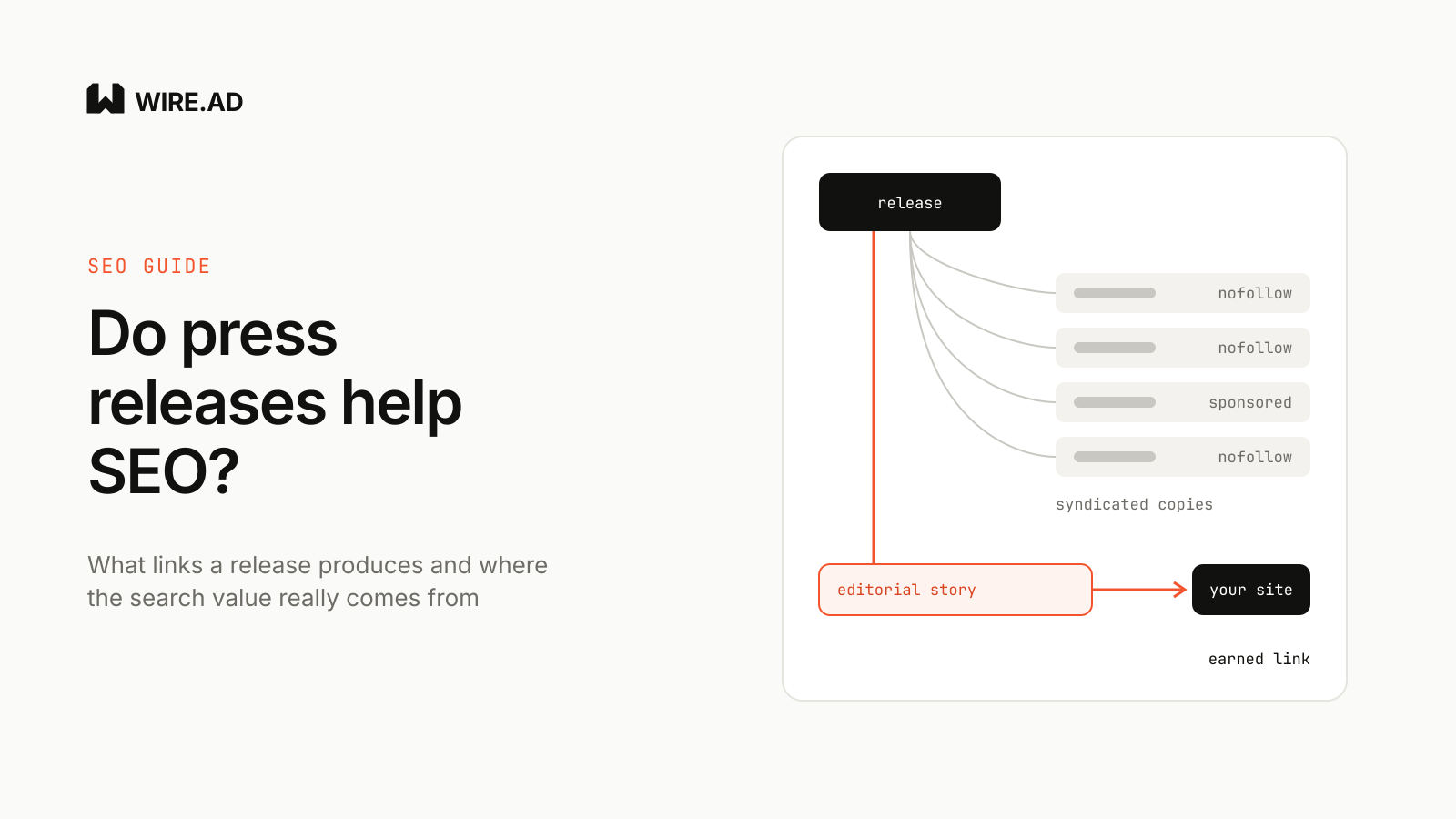
Mostly no, not in the way distribution is sold. The links inside a distributed release carry nofollow or sponsored attributes, and Google has said it ignores most press release links. What a release can do for search is get your own page crawled, put your brand into news surfaces, and reach reporters whose own stories carry the links Google counts. The payoff sits in coverage, brand searches and the page you point at.
What Google says about press release links
Google’s spam policies name the practice directly. Among the examples of buying or selling links for ranking purposes sits “links with optimized anchor text in … press releases distributed on other sites” (Google Search Central, spam policies). The same page keeps paid distribution legitimate, since buying and selling links is “a normal part of the economy of the web” for advertising and sponsorship, and such links are allowed “as long as they are qualified with a rel="nofollow" or rel="sponsored" attribute value”.
The attribute documentation says what those labels do. Google asks publishers to mark “advertisements or paid placements” with sponsored, and says links carrying these attributes “will generally not be followed”, while the pages behind them may still be crawled through sitemaps or links elsewhere (Google Search Central, qualify outbound links).
Since September 2019, Google has treated nofollow, sponsored and ugc as hints rather than directives, and nofollow became a crawling hint from March 1, 2020. Sales pages read the word “hint” as permission to pass ranking value again. The announcement itself says Google will “not consider them for ranking purposes” (Google Search Central blog, September 10, 2019).
Links that do pass credit are fragile as well as against policy. Google’s December 2022 link spam update describes using SpamBrain “to neutralize the impact of unnatural links”, and states that “any credit passed by these unnatural links are lost” (Google Search Central blog, December 14, 2022). Bing says the same in fewer words: “Links should be earned organically through high-quality, useful content”, and link buying violates its guidelines (Bing Webmaster Guidelines).
On releases specifically, Google’s John Mueller said in 2018, as reported by Search Engine Roundtable, that the company tries to ignore links from press releases because companies issue the releases themselves, and that “we do ignore most of those” (Search Engine Roundtable, June 29, 2018).
Hosting the release is a separate question, and there the distributors are in the clear. Google’s site reputation policy lists “Wire service or press release service sites” among the examples it does not treat as site reputation abuse (Google Search Central, spam policies). The release page is allowed. Paying for the ranking credit inside it is the part Google acts on. That is why WIRE.AD labels every placement in a report as editorial or sponsored and does not sell dofollow links.
What links a press release actually produces
| What the release produces | Usual link status | Ranking value | What it is good for |
|---|---|---|---|
| The page on the distributor’s own site | nofollow, sponsored or a reference tag | Close to none | Fast crawling, news surfaces, a citable URL |
| Copies on partner and aggregator sites | Usually nofollow, many never indexed | Close to none, and duplicated | Occasional visibility on brand queries |
| A story a journalist writes after reading it | Editorial, usually followed | The links Google counts | Coverage, referral traffic, AI citations |
| Your own newsroom page | Your own page | Can rank for brand and news queries | The source of record others link to |
The distributors document this themselves. EIN Presswire’s FAQ says it “only allows for no-follow links in press releases” because it is a Google News provider and follows Google’s guidelines (EIN Presswire). Business Wire says links in distributed releases are “automatically marked with a special tag” that tells search engines the link is for reference, and that it embeds a citation pointing back to the customer’s own URL (Business Wire, last updated May 28, 2025). PR Newswire added nofollow coding to links in releases back in 2013, as reported at the time by PR News (PR News, October 1, 2013), and its own resource page states that linking out from a release “won’t influence its search engine rankings directly” while it can “boost awareness” and produce organic third-party links. The same page adds: “You shouldn’t create a press release for the sole purpose of ranking in search engines” (PR Newswire).
The copies are the second half of the problem. Each one is a near-identical page on a different domain, and Google’s own News documentation tells publishers that syndication partners “should use meta tags to block the indexing” of the content rather than rely on a canonical tag (Google News Publisher Help). Its news policies go further and require publishers to block links in content syndicated at scale where the primary goal is building links (Google News content policies). An analysis of 5,272 digital PR placements, published by a PR software vendor, found clear syndication patterns in roughly 30 to 35 percent of them and judged the copies worth less than the same number of independently earned links (analysis of syndicated links, March 17, 2026). That is one vendor’s dataset, so read it as directional. The practical consequence holds either way: a report listing a long column of URLs is a list of copies of one text, not a link profile.
How WIRE.AD does it. The report lists each placement with its label and its role in the package and groups reposted copies separately, so the coverage you see is coverage you can count.
Where the SEO value actually comes from
Crawling and discovery. Google uses links “to find new pages to crawl” (Google Search Central, crawlable links), and pages behind blocked links can still be reached by other routes. A release can get a new launch page found quickly. It does not make that page rank.
Coverage written by journalists. Mueller said in 2013, as reported by Search Engine Roundtable, that links in stories journalists write on their own after reading a release do not have to be nofollowed (Search Engine Roundtable, July 30, 2013). Earning those links is a relevance problem. In Muck Rack’s 2025 survey of 1,515 journalists, 84% said at least some of their stories originate from PR pitches, 86% disregard pitches outside their beat, 41% want new or exclusive information and 62% say interview access should be offered (Muck Rack, June 2025). Cision’s 2025 media survey of 3,126 respondents reports that “data is consistently the number one request” to include with a pitch, and that relevance is the first reason pitches get rejected (Cision, 2025 State of the Media).
Brand search. A mention without a link is not a link. Mueller said in 2022, as reported by Search Engine Journal, that readers may pick up a mention and search for the site anyway (Search Engine Journal, April 5, 2022). Those searches are now reportable: Search Console’s Performance report separates branded from non-branded queries (Google Search Central blog, November 2025), with Google noting that the classifications “are for information only and don’t affect your site’s ranking in Search”. Data runs from March 2025, and the filter is limited to top-level properties with enough volume (Search Console Help).
The page you point at. One canonical page on your own domain is the asset the release creates value for. Keep the full data, assets and FAQ there and a summary in the release. Mueller warned in 2021, in a reported office-hours answer, that if a full report goes into a release, “it’s possible that these press releases will rank instead of your content” (office-hours recap, July 23, 2021).
Press releases and AI answers
A May 2026 study of more than 25 million AI citations by a media database company found that about 99% of links cited by AI come from non-paid sources, that journalism accounts for about 27% of all citations, that paid and advertorial content accounts for 0.3% and that press releases represent 1.1%, appearing “almost exclusively in industry trend responses” (Muck Rack, May 2026).
A separate analysis of 4 million citations by a digital PR tool vendor puts news publications at 14.09% of citations, press releases on syndicated news channels at 0.32% of news citations and 0.04% of the whole dataset, and newswire domains at 0.21%. Company-owned press releases and newsroom content reach 2.98% overall and 18.15% of ChatGPT citations (BuzzStream, last updated April 8, 2026). The vendor sells digital PR software, so treat the split as directional rather than settled.
Google asks for nothing special here. To be eligible as a supporting link in AI Overviews or AI Mode a page must be indexed and eligible to show with a snippet, and “There are no additional technical requirements” (Google Search Central, AI features). The syndicated copy of a release is rarely what gets cited. Earned journalism and your own newsroom page are.
How WIRE.AD does it. Every version points to one canonical page on your own site, where the full facts live, and an AI visibility reading before and after the campaign shows how the answers about you changed.
What to avoid
- Keyword anchor text in the release. This is the exact wording in Google’s policy. Use the brand name or the plain URL, and write links “as naturally as possible” (Google Search Central).
- Buying dofollow placements. Any paid article whose links pass ranking credit is link spam under the policy, Bing prohibits it, and SpamBrain can zero the credit out. You pay for something designed to be worth nothing.
- Mass distribution aimed at links. Google’s warning signs for large-scale article campaigns include “Having the articles published across many different sites” and using the same or similar content across them (Google Search Central blog, May 25, 2017).
- Pages bolted onto a strong third-party domain to rank on its signals. Wire pages and native advertising written for readers are explicitly outside the site reputation policy. A category page planted on an unrelated news site is not.
- Unlabeled sponsored content. The FTC’s native advertising guide says “it’s deceptive to mislead consumers about the commercial nature of content”, and that a necessary disclosure must be clear and prominent (FTC).
- Counting syndication copies as backlinks. Most are nofollow, duplicated, or never indexed.
- Near-identical releases at high frequency. Repeated text gives Google nothing new to index and gives reporters nothing to write about.
How to write a release that earns links
- Publish the canonical page on your own domain first, indexed and linked from your newsroom, with the full data, the assets and the methodology on it.
- Keep the headline, dateline and first paragraph aligned between that page and the distributed release, and include a clean link to the canonical URL where the distributor’s policy allows it (Business Wire, January 8, 2026).
- Bring a number. Data is the first thing journalists ask to be included, and PR Newswire says statistics, quotes and data make releases better at attracting links.
- Name a spokesperson who is available for interviews, since interview access is what a large share of journalists want offered.
- Write facts rather than promotion, and answer who, what, when, where, why and how.
- Use one to three links with branded or URL anchors (PR Newswire beginner’s guide). EIN Presswire’s editorial guidelines cap link density at one per 100 words and ask for 300 to 800 words (EIN Presswire).
- Pitch the release to reporters on the beat instead of relying on distribution alone. The format rules that get a file accepted are set out in our guide to writing a crypto press release.
How to measure the SEO effect
Measure at two, four and twelve weeks against the previous period.
- Editorial referring domains. Count only stories written by journalists. Exclude the distributor’s own page and every syndication copy. The Search Console Links report plus a backlink tool is enough.
- Branded queries. Use the branded filter in the Performance report for impressions and clicks, keeping Google’s note that the classification is informational.
- The canonical page. Check indexing in URL Inspection, then the page’s clicks, impressions and queries.
- Referral traffic. Tag the links you own with UTM parameters, and expect some republishers to strip them (Business Wire, July 30, 2025).
- Coverage log. One row per story: URL, type of outlet, whether it links, and the link attribute.
- AI visibility. Ask the main assistants a few category-level questions and record whether your brand or your coverage is cited. Releases themselves show up mainly on trend questions.
What not to report as a result: the number of syndication URLs, or the domain authority of the partner sites those URLs sit on.
Pre-send checklist
- Canonical page live, indexed, in the sitemap and linked from the newsroom.
- Headline and lede match the canonical page, with the full data kept on your own site.
- One to three links, branded or URL anchors only, UTM tags on owned links.
- A real news hook, one data point, a named spokesperson available for interviews.
- Every paid placement labeled, and no request for dofollow links anywhere in the order.
- A target list of reporters who cover this beat.
Questions to ask before you pay for distribution
- Which placements are guaranteed by name, and which part of the count is automatic reposting?
- What label will readers see on the page, and what
relattribute will the links to us carry? - Will each named placement be indexed, and how long does the page stay live?
- Does the report separate placements from copies, so our referring-domain count stays honest?
- Who pitches the release to reporters after it goes out, and with what target list?
- What happens to the fee if a desk rejects the release?
Buying distribution and need the reporting to hold up? Send the announcement and the markets it has to reach, and WIRE.AD comes back with a fixed-price package, the label on each placement and a report that keeps copies separate.