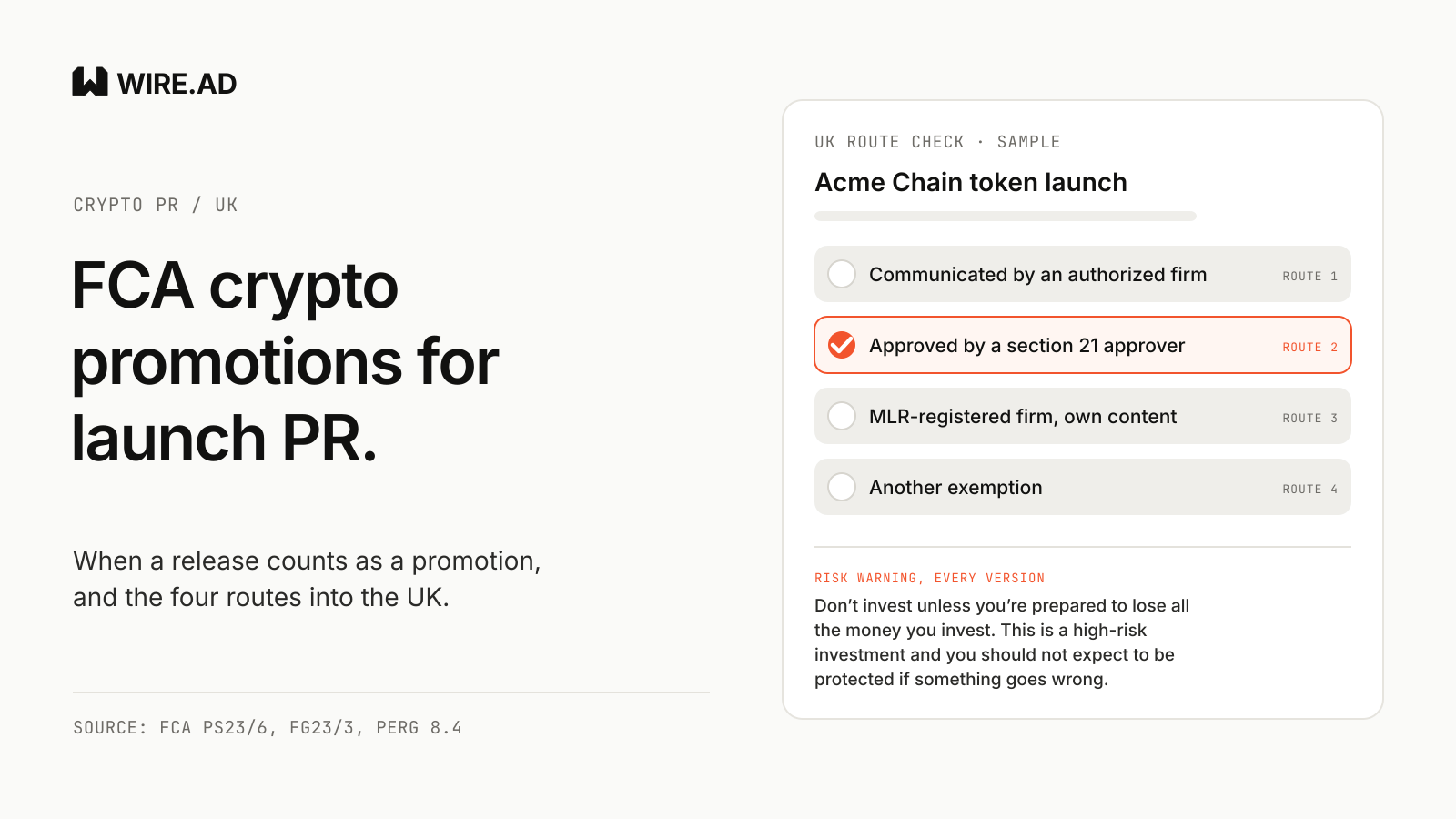
FCA crypto financial promotions rules apply to any crypto marketing that UK consumers can see and act on, wherever the company is based. A launch release, a sponsored article or a post on X that invites people to buy, sell or exchange crypto is a financial promotion under section 21 of the Financial Services and Markets Act 2000, and since October 8, 2023 it has had to reach the UK through one of four lawful routes. The first three routes also bring the FCA’s rules, including a prescribed risk warning.
Promoting crypto in breach of section 21 is a criminal offense, punishable by up to two years in prison, an unlimited fine, or both. This guide covers when a press release becomes a promotion, how an overseas launch can stay outside the UK, what each version has to say, and how the FCA has enforced the rules so far. It is a planning summary built from the FCA’s rules and guidance, so check the final campaign with your counsel.
When a press release becomes a financial promotion
The FCA’s perimeter guidance (PERG 8.4) applies an objective test. A communication is an invitation or inducement when a reasonable observer would see it as meant to persuade the reader to engage in investment activity, and would read it as doing so. Purely factual information falls outside, provided the facts are not presented in a way that makes them an inducement.
So the wording carries the weight. A release that reports a listing date, the trading pairs and the networks supported reads as news. The same release with “Get in early before the price moves” and a sign-up link reads as an inducement.
PERG 8.4 also addresses journalism. Editorial that recommends buying is likely to be an inducement, while an objective account is not. A company does not cause the communication of an article merely by giving a journalist a press release or a quote, provided it has no control over how the article is prepared and published.
A sponsored article sits on the other side of that line. The company pays for it and usually approves the copy. The FCA has not written a rule for sponsored articles as such, but on the logic of PERG 8.4 a paid placement whose text the company controls is best treated as the company’s own communication. That is our reading, and it is a good reason to send every paid version through the same review as an ad.
When an overseas launch reaches the UK
The restriction covers communications that originate outside the UK but are capable of having an effect there. The FCA’s guidance is plain on this point: a promotion does not need to target UK consumers. If people in the UK can view it and act on it, it is likely to be in scope.
Article 12 of the Financial Promotion Order sets out how a communication sent from abroad counts as directed only at people outside the UK. Two conditions do the work:
- the communication is not referred to in, or directly accessible from, any other communication aimed at people in the UK;
- proper systems and procedures stop UK recipients from engaging in the investment activity it promotes.
Two further signals count in a company’s favor: a statement that the communication is directed only at persons outside the UK, and a statement that it must not be acted on by persons in the UK. A “not for UK residents” footer on its own does little if UK visitors can still sign up and buy.
The FCA’s case against the HTX exchange shows the factors it looks at. Its particulars of claim point to a website in English, GBP as an available currency, UK photo ID accepted at sign-up, visits from the UK and an FCA employee who completed a test purchase from a UK IP address.
How WIRE.AD does it. The brief asks which markets a campaign will run in, and registration and licenses are confirmed with the client before the first campaign. Promotion aimed at a market is accepted only from a company licensed or registered there for what it promotes.
The four lawful routes into the UK
A crypto promotion that reaches the UK has to use one of these routes:
- It is communicated by a firm authorized under FSMA.
- It is made by an unauthorized company and approved by an authorized firm with permission to approve promotions, often called a section 21 approver. Since February 7, 2024, an authorized firm has needed that specific FCA permission, or a relevant exemption, to approve promotions for unauthorized companies.
- It is communicated by, or on behalf of, a cryptoasset business registered with the FCA under the Money Laundering Regulations, relying on the Article 73ZA exemption. A promotion made on the business’s behalf qualifies only when it is non-real time and the registered business prepared its content.
- It falls within another exemption in the Financial Promotion Order.
A firm authorized only as an e-money or payment institution is not an authorized person for this purpose, so it can neither communicate nor approve crypto promotions on that basis.
The third route has an end date. The Cryptoassets Regulations 2026 omit Article 73ZA when the UK’s full crypto regime starts on October 25, 2027, and registration under the Money Laundering Regulations will not convert into authorization. The FCA opened its application window on September 30, 2026, and firms that want the transitional arrangements must apply by February 28, 2027. Launch teams planning campaigns after October 2027 should check which route their release will rely on by then.
What each version has to say
Every crypto promotion must be fair, clear and not misleading. The FCA’s guidance (FG23/3) turns that into practical tests: benefits should not appear more prominently than risks, claims about returns should reflect what a consumer can reasonably expect, any “commission free” line needs an equally prominent mention of other costs, and figures and images must be accurate and current. A reference to past performance needs a warning that it is not a reliable indicator of future results. Words such as “guaranteed”, “protected” or “secure” need full and prominent context to be used at all.
The rules then add requirements specific to crypto:
- The prescribed risk warning. “Don’t invest unless you’re prepared to lose all the money you invest. This is a high-risk investment and you should not expect to be protected if something goes wrong.” It links to a risk summary written to be read in about two minutes, and a shorter prescribed version exists for channels with character limits set by a third-party platform.
- No incentives to invest. Refer-a-friend bonuses and similar rewards for investing are banned.
- A 24-hour cooling-off period for first-time investors with a firm, before they see a direct offer.
The cooling-off rule matters for release copy. A direct offer financial promotion is one that specifies how to respond or includes a form to do so, such as a “buy now” button. PS23/6 says information about an investment, without that manner of response, does not trigger these extra steps. A release that describes the product and points readers to the company’s site sits in a different place from one that includes a link straight into a purchase flow.
How WIRE.AD does it. Each outlet version carries its own risk wording for the market it runs in. The client confirms the facts and approves every version before it goes live.
Social posts, influencers and paid placements
The regime is technology neutral. FG23/3 names YouTube, Reddit, X, Discord and Telegram, and the FCA’s social media guidance (FG24/1) adds that private or invitation-only channels can carry financial promotions too. The FCA has said that anyone making crypto promotions on social media without one of the four routes commits a criminal offense, and that includes influencers who promote crypto. FG23/3 also expects promotions on social media to disclose any commercial relationship, such as being paid to promote a token.
For a launch team, this means the risk warning and the route apply to the thread on X and the Telegram post as much as to the release on a wire.
How WIRE.AD does it. Every paid placement is labeled, and outbound links carry rel="sponsored". The campaign report lists each placement with its URL, label and date, so a compliance team can see where every version ran.
How the FCA enforces the rules
The FCA’s own figures show the scale:
- in the regime’s first year, the FCA issued 1,702 consumer alerts about illegal crypto promotions, and its actions led to the takedown of more than 900 scam crypto websites and the removal of 56 apps from UK app stores;
- in 2024, 1,098 of the 19,766 promotions that authorized firms amended or withdrew after FCA intervention were in the FCA’s digital assets portfolio;
- in 2025, 1,528 of the FCA’s 2,329 alerts concerned unauthorized crypto entities and promotions.
In October 2025 the FCA began its first enforcement action under the regime, a High Court claim against HTX, formerly Huobi, over promotions on its website and on social platforms. The FCA asked social media companies to block HTX’s accounts for UK users and asked app stores to remove its apps. On October 27, 2026 the court stayed the claim on the terms of a confidential settlement. Huobi Global S.A., which the FCA’s claim names as the exchange’s operator, gave undertakings to the court, running until October 21, 2031, not to knowingly communicate financial promotions in breach of section 21 on its website, its apps or social platforms. The list names X, Facebook, Instagram, Telegram, TikTok, YouTube, Discord, Medium and LinkedIn.
Two of those, Medium and LinkedIn, are also where companies post their own announcements, and section 21 covers them in the same way.
A checklist before a crypto launch reaches the UK
- Decide whether the UK is in the campaign. If it is out, put systems in place that stop UK users from signing up, and keep UK-facing pages and posts from linking to the promotion.
- If the UK is in, name the route: an authorized firm, a section 21 approver, an MLR-registered business preparing its own content, or another exemption. Note what changes on October 25, 2027.
- Read each version against PERG 8.4: report facts, and remove lines that push readers to buy.
- Put the prescribed risk warning and the link to the risk summary in every version that is a promotion, legible and close to the main claims.
- Remove refer-a-friend offers, bonuses for investing and any “buy now” link from release copy.
- Give risks the same prominence as benefits, and add the past performance warning wherever returns appear.
- Label every paid placement and disclose paid relationships on social posts.
- Keep each approved version with its URL and publication date.
The crypto press release guide covers headlines, structure and risk wording by event, and the guide to crypto PR in Dubai covers VARA’s rules for campaigns that also reach the UAE. For a campaign placed on crypto media outlets with risk wording in every version and every placement labeled, send a brief.