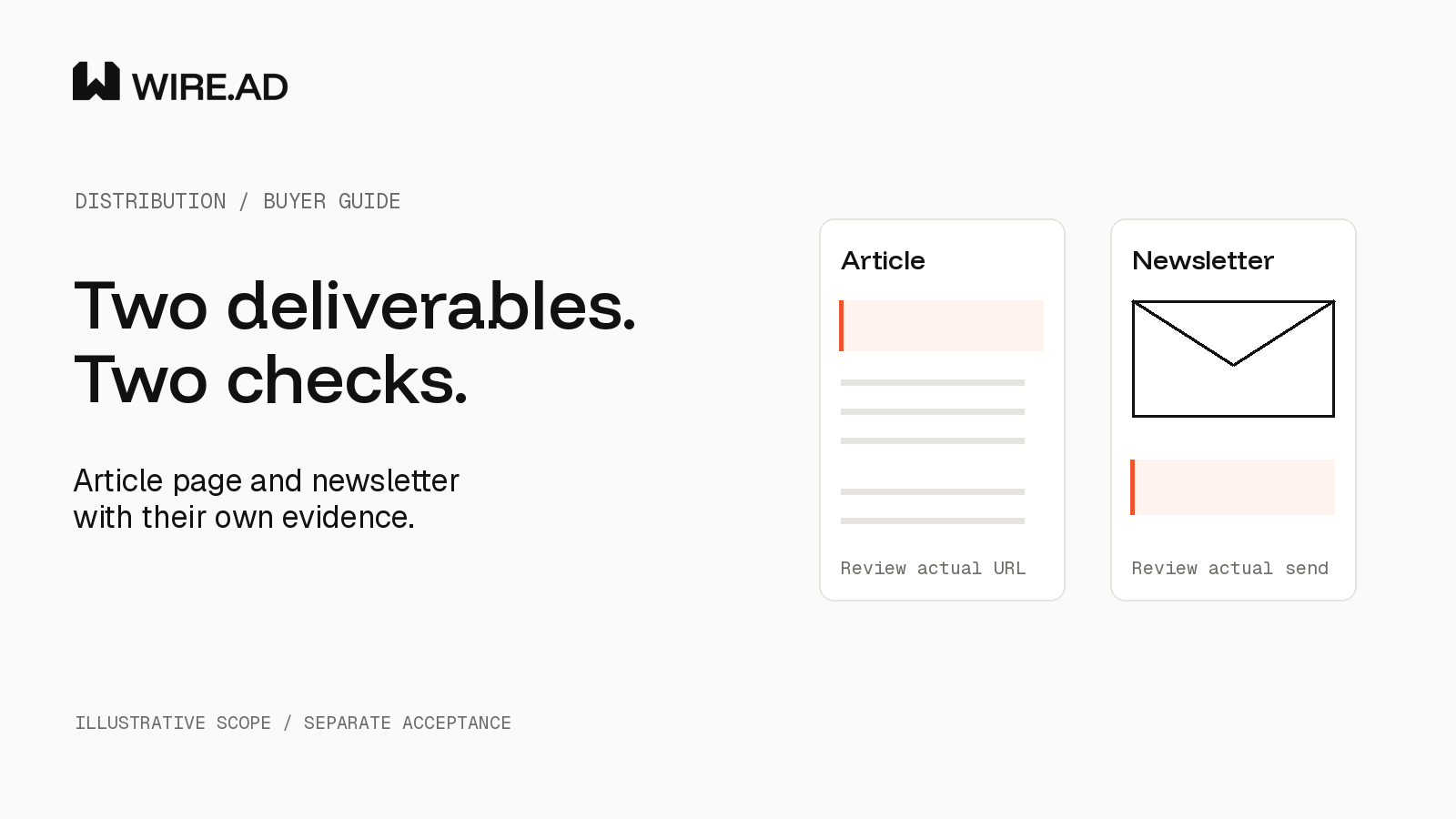
A sponsored article newsletter package should specify the article and email placement as separate deliverables, with their formats, timing, labels, links and acceptance evidence. Agree the scope in writing before comparing prices, so each proposal describes the same work.
“Article plus newsletter” leaves several practical questions open. The article might be a permanent reading page or a time-limited placement. The email might contain the full message, a short teaser or a link among other items. Those choices affect production, review and what the buyer can verify afterward.
Describe the article placement
Ask which outlet and section will carry the article, what format is offered and who produces the text. Record the expected length, supplied assets, revision process, publication window and how long the page is intended to remain available.
Confirm how the commercial relationship will appear on the reading page and on cards or teasers that lead to it. The FTC’s native advertising guidance evaluates the overall impression and explains the importance of clear, prominent disclosure where readers encounter paid content.
Agree the allowed destination links and how corrections will be requested. A commercial article can be fact-checked without being represented as independent editorial coverage. Keep the placement’s status clear in the order and in the report.
Identify the newsletter product
Name the newsletter, intended edition or send window, language and audience description. Ask what the purchased position actually contains: a dedicated message, a sponsored block, an article teaser or another defined format.
The following is a proposed scope sheet, not an offer of particular inventory:
| Deliverable | Scope to agree | Acceptance evidence |
|---|---|---|
| Sponsored article | Outlet, section, approved text, labels and links | Actual public URL and reviewed page |
| Newsletter placement | Edition, position, approved subject or teaser and destination | Final sent creative and send record |
| Supporting assets | Image size, copy limits, alt text and required credits | Approved files used in each format |
| Follow-up | Correction route, reporting window and availability terms | Dated response or updated evidence |
If a proposal includes homepage promotion or additional posts, list those separately. An incidental social share should not silently replace a contracted email placement.
Keep the approval boundaries visible
The buyer should know which text can be approved and which decisions remain with the publisher. Agree who checks product facts, quotations, availability and market restrictions. Identify the final approver for each supplied asset.
Use a hypothetical fintech pilot as a check. If the article describes invitation-only merchant access, the newsletter teaser should preserve that condition. An email headline that suggests open signup changes the promise even if it links to a careful article.
The fintech announcement brief covers those source facts. For different language versions, the localization checklist helps keep the market and availability review attached to each version.
Review the reader’s next click
Agree whether the email links to the sponsored article or directly to the company. Then review that destination as the intended reader. Check its current offer, eligible users, terms and working signup or documentation path.
If campaign parameters are used, define them before the links are handed over. Google’s campaign URL guidance explains how UTM parameters identify referring campaigns in Analytics. Values are case-sensitive, so keep naming consistent.
Give the article and newsletter distinct identifiers when you need to compare their referred visits. Open the final published or sent link to check that the agreed parameters survive. The UTM tracking guide covers the naming and verification steps.
Agree what the report will mean
Request a definition for every metric the seller proposes to report. Ask which product, edition, time window and data source it describes. If unique and total counts are offered, ask how each is calculated and whether automated activity is filtered.
Record unavailable metrics as unavailable. A placement can be delivered even when some performance data cannot be supplied, provided the contract clearly states what evidence will be delivered. Decide whether that evidence is sufficient before accepting the offer.
Keep publication, referred visits and business actions in separate fields. A live article proves that a page can be opened. A recorded visit concerns an interaction with the destination. A lead needs an agreed event and measurement method. Do not add them together into one unexplained “reach” total.
Compare equivalent proposals
Build a comparison from the agreed fields: article format, newsletter product, production work, rights, publication window, retention, revisions and verification. Show any exclusion beside the price rather than burying it in a footnote.
Before paying, ask what happens if an edition moves, a page is removed or the approved link is altered. Get the applicable correction, replacement or refund terms in writing. The distribution report guide explains how to retain actual URLs and follow-up actions.
The checklist describes questions for evaluating a package. It does not establish that a particular outlet, newsletter, supplier or performance guarantee is available.
Sources and review date
Sources checked October 22, 2026. This guide explains procurement and review steps; the examples are hypothetical.