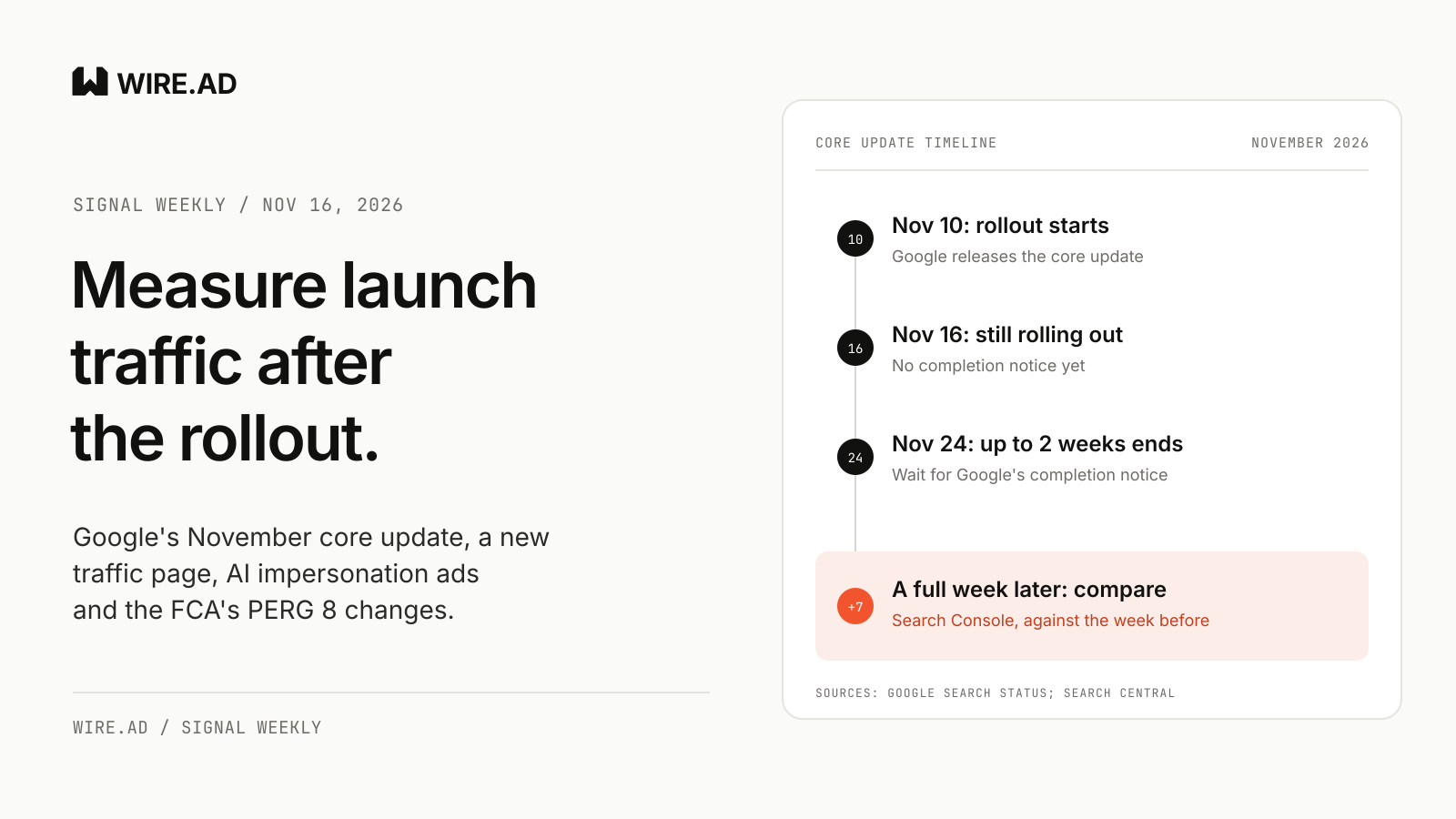
If your launch goes out before December, the November 2026 core update will still be moving your search numbers while you try to read them. Google released it on November 10 and says the rollout may take up to two weeks. Two days later it published a page on finding Google Search traffic in your own analytics. Also this week: a Google Ads rule on AI impersonation of public figures, the FCA consultation that closes Wednesday, and an off switch for AI answers in Bing.
This week in 30 seconds
- Google released the November 2026 core update on November 10. The rollout “may take up to 2 weeks to complete,” and Google advises waiting at least a full week after it ends before comparing data in Search Console.
- A new Google Search Central page, added November 12, says Google Search uses the origin referrer policy, so the Referer header contains only the scheme and host and doesn’t include the search query.
- Google warned on November 11 that CDN or firewall challenges make its crawlers back off, and pages “will begin to drop out of Search” if the block stays.
- Google Ads clarified on November 11 that ads impersonating public figures using AI are not allowed “even if they disclose that they were generated or edited using AI.” The FTC’s docket on platform impersonation ads showed 156 posted comments on November 16.
- The FCA’s CP26/36 closes on November 18. Its draft guidance says the new technical services exclusion “has not been replicated in the financial promotions regime.”
- Microsoft described two ways to search Bing without AI answers: a browser extension, in preview, and adding “-ai” to a search. New York’s crypto advertising guidance of November 12 has its own article, and so does Businesses in ChatGPT.
Google’s November 2026 core update and your launch numbers
The Google Search Status Dashboard logged the update at 10:07 Pacific time on November 10: “Released the November 2026 core update, which applies globally and to all languages. The rollout may take up to 2 weeks to complete.” On the morning of November 16 the incident still carried that single entry, with no completion notice.
Google’s core updates page sets out how to read the data afterwards. Confirm the rollout has finished. Wait “at least a full week after a core update completes before analyzing your site in Search Console,” then compare that week with a week before the rollout started. For a small drop in position, Google says there is “no need to take drastic action,” and it calls deleting content “a last resort.”
On November 12 Google added a page on how to identify Google Search traffic in web analytics or server logs. Google Search uses the origin referrer policy, so the Referer header “contains only the scheme and host of the referring page, without the URL path or query parameters.” It “doesn’t include the search query.” Browsers can still drop the header, for example in private browsing. Among the reasons totals differ from Search Console: client-side redirects may replace the Referer with your own URL, redirects that drop the query string lose parameters, and Search Console counts only organic clicks.
Our reading: if your launch falls inside the rollout window, launch-week organic numbers tell you little. Add a custom annotation in Search Console on the launch date (up to 120 characters; everyone with access to the property sees it). Hold the search comparison until a week after Google marks the rollout complete, and compare against a week before November 10. Before the release goes out, check that your analytics counts referrals from google.com, local Google domains such as google.co.uk, and the Google app on Android as organic, that no custom channel rule or referral exclusion reclassifies them, and that the short links and tracking redirects in the release keep the query string. Our UTM tracking guide covers the link side. Report Google Ads clicks separately.
Exempt verified crawlers before launch day
A Search Central post on November 11 described what happens when a site moves behind a content delivery network. Faster responses lead Google’s crawlers to raise their crawl rate, while a cold cache sends every first request back to the origin server. When a CDN or web application firewall meets crawlers with a CAPTCHA, “Google’s crawlers fail the test,” and if that stays in place, “our crawlers will back off,” and pages “will begin to drop out of Search.”
Google’s advice is to allow verified bots in CDN and firewall settings, and to “programmatically fetch your highest-traffic, upcoming peak-traffic pages (such as promotional or seasonal launches)” so edge caches are ready. If the origin needs a break, return 429 or 503 “for a short window (a few hours, or 1-2 days at most).”
Our reading: launch week is a common time to tighten bot rules or move a newsroom to a new host. Ask for the verified-bot exemption in writing before launch day, then warm the cache for the release page, the newsroom post and the product page. AI crawlers need the same check. OpenAI’s crawler documentation says “Sites that are opted out of OAI-SearchBot will not be shown in ChatGPT search answers, though can still appear as navigational links,” and recommends allowing OAI-SearchBot in robots.txt and allowing requests from OpenAI’s published IP ranges. Add those ranges to the same firewall exemption.
Does AI name you when buyers ask? Run a free AI Shortlist Check to see whether AI answers name you.
Google Ads rules on AI impersonation of public figures
On November 11 Google updated its Unacceptable Business Practices policy “to clarify that ads that impersonate public figures using AI are not allowed, even if they disclose that they were generated or edited using AI.” Google says the clarification “does not change the enforcement of the policy.”
The FTC question is the platform side of the same problem. Its request for comment, published October 1, asks whether search engine, social media and digital marketplace platforms should face rules to prevent impersonation scams, and comments close November 30. On November 16 the docket showed 156 posted comments, most from individuals. None of the posted titles names a search engine or social media company. A company whose brand or founder has been impersonated in ads can file one until November 30.
Our reading: launches attract fake ads, and if a scam ad uses AI to impersonate your founder or another public figure, an AI disclosure line does not make it acceptable under Google’s policy. Before launch day, publish one page that lists your official channels, ad accounts and spokespeople, and link it from the release. When a fake ad appears, report it to Google under this policy. The release and that page give you something concrete to point to.
The FCA’s CP26/36 closes Wednesday
Last week we said we would read the PERG 8 financial promotion changes in the FCA’s CP26/36 before it closes on November 18. The consultation paper explains that the Cryptoassets Amendment Regulations make issuing qualifying stablecoins a controlled activity and qualifying stablecoins “a controlled investment in their own right.” A new article 73ZAA exemption covers communications about the transfer or exchange of a UK qualifying stablecoin, but that limb does not apply to “other cryptoassets, including other qualifying stablecoins.” The FCA says the effect is that the exemption “applies to many payment-related activities involving UK qualifying stablecoins.”
A second point sits in the draft PERG 18 guidance on the technical services exclusion (Question 18.8.34). The exclusion applies to arranging activities, and the draft guidance says it “does not determine whether communications made through or in connection with the technical service are subject to the financial promotion restriction.” It adds that the exclusion “has not been replicated in the financial promotions regime,” so providers “should therefore consider separately whether they communicate invitations or inducements to engage in investment activity.”
The FCA aims to publish final guidance in January 2027. The regime starts on October 25, 2027.
Our reading: a wallet, interface or DeFi front end that expects to rely on the technical services exclusion should still consider separately whether its UK launch copy is a financial promotion. Before the announcement is written, ask counsel which exemption applies or which authorized firm approves the copy. For a stablecoin payment feature, name the coin and its issuer exactly, because the exemption turns on whether it is a UK qualifying stablecoin.
Announcing to UK readers next quarter? Get the copy approved first, then send us the brief. Every WIRE.AD release carries the risk wording of each market it runs in, and the facts are confirmed with you before anything goes live.
Bing offers an off switch for AI answers
On November 11 Microsoft described two ways to search Bing without AI answers. The Microsoft Bing AI Search Choice extension, in preview for Chrome and Edge, adds a toggle that applies across all Bing searches and also sets Bing as the default search engine. The other way: add “-ai” to any query.
Our reading: “-ai” gives you a quick side-by-side check. On launch day, search your company and product name in Bing twice, once as usual and once with “-ai”, and save both pages. If the AI answer describes the company from an old page and leaves the launch out, fix that page before the campaign spends. Our AI visibility add-on records what AI assistants say about a company before and after a campaign.
Number of the week: 156
That is how many posted comments the regulations.gov docket for the FTC’s impersonation rule (FTC-2026-1552) showed on November 16, two weeks before comments close. The organizations among them include scam victims’ groups and a security company.
The platforms the possible rule would cover have yet to appear in the list.
Dates to put in your calendar
| Date | What happens |
|---|---|
| November 18, 2026 | Comments close on the FCA’s CP26/36 crypto perimeter guidance and GC26/7 DeFi guidance |
| November 24, 2026 | End of the up-to-two-week window Google gave for the November 2026 core update rollout |
| November 30, 2026 | Comments close on the FTC’s request for comment on platforms and impersonation scams |
| December 15, 2026 | Temporary grounding preferences open in Bing Webmaster Tools for sites still using NoArchive or NoCache |
| January 2027 | The FCA aims to publish final CP26/36 perimeter guidance |
| February 1, 2027 | Microsoft starts honoring the new AI Training and AI Grounding preferences as it crawls |
| February 28, 2027 | The FCA’s application window closes for firms with existing UK cryptoasset business that want to rely on the savings provision |
| March 1, 2027 | Deadline to publish Microsoft AI Training and AI Grounding preferences; after it, NoArchive and NoCache no longer count as training or grounding preferences |
| October 25, 2027 | The UK cryptoasset regime comes into force |
What we’re watching next week
We’ll check the Search Status Dashboard for the end of the core update rollout, and the FTC docket for filings from the platforms themselves. After CP26/36 closes, the FCA aims to publish final guidance in January 2027. OpenAI has yet to give a date for the shared training signal. Its crawler documentation, checked November 16, still names GPTBot as the training control. The SFC’s news releases through November 16 show no misleading-names bill yet.